
In a triangle, values of all the angles are integers (in degree measure). Which one of the following cannot be the proportion of their measures?
6 ∶ 7 ∶ 8
Analyzing Triangle Angle Proportions with Integer Angles
The question asks us to identify which given ratio cannot represent the proportions of the angles in a triangle, given that all angle measures are integers (in degrees).
Understanding the Sum of Angles in a Triangle
A fundamental property in geometry states that the sum of the interior angles of any triangle is always 180 degrees. If the angles of a triangle are \(A\), \(B\), and \(C\), then:
\[ A + B + C = 180^\circ \]
We are also told that \(A\), \(B\), and \(C\) are all integers.
Relating Proportion to Angle Measures
If the angles of a triangle are in the proportion \(a : b : c\), it means the angles can be written as \(ka\), \(kb\), and \(kc\) for some constant scaling factor \(k\). Using the sum of angles property:
\[ ka + kb + kc = 180 \]\[ k(a + b + c) = 180 \]\[ k = \frac{180}{a + b + c} \]
For the angles (\(ka\), \(kb\), \(kc\)) to be integers, the value of \(k\) multiplied by each part of the proportion (\(a\), \(b\), \(c\)) must result in a whole number. This means that \(k \times a\), \(k \times b\), and \(k \times c\) must all be integers.
Evaluating Each Given Proportion
Let's test each option by finding the scaling factor \(k\) and the resulting angles. We need to see if all three angles are integers for each proportion.
Analyzing Proportion 1: 1 ∶ 2 ∶ 3
- The sum of the proportional parts is \(1 + 2 + 3 = 6\).
- The scaling factor is \(k = \frac{180}{6} = 30\).
- The angles are:
- \(30 \times 1 = 30^\circ\)
- \(30 \times 2 = 60^\circ\)
- \(30 \times 3 = 90^\circ\)
- All angles (30, 60, 90) are integers. This proportion is possible for integer angles.
Analyzing Proportion 2: 3 ∶ 4 ∶ 5
- The sum of the proportional parts is \(3 + 4 + 5 = 12\).
- The scaling factor is \(k = \frac{180}{12} = 15\).
- The angles are:
- \(15 \times 3 = 45^\circ\)
- \(15 \times 4 = 60^\circ\)
- \(15 \times 5 = 75^\circ\)
- All angles (45, 60, 75) are integers. This proportion is possible for integer angles.
Analyzing Proportion 3: 5 ∶ 6 ∶ 7
- The sum of the proportional parts is \(5 + 6 + 7 = 18\).
- The scaling factor is \(k = \frac{180}{18} = 10\).
- The angles are:
- \(10 \times 5 = 50^\circ\)
- \(10 \times 6 = 60^\circ\)
- \(10 \times 7 = 70^\circ\)
- All angles (50, 60, 70) are integers. This proportion is possible for integer angles.
Analyzing Proportion 4: 6 ∶ 7 ∶ 8
- The sum of the proportional parts is \(6 + 7 + 8 = 21\).
- The scaling factor is \(k = \frac{180}{21}\). Simplifying the fraction, we get \(k = \frac{60}{7}\).
- The angles are:
- \(k \times a = \frac{60}{7} \times 6 = \frac{360}{7}\)
- \(k \times b = \frac{60}{7} \times 7 = \frac{420}{7} = 60^\circ\)
- \(k \times c = \frac{60}{7} \times 8 = \frac{480}{7}\)
- Two of the angles, \(\frac{360}{7}\) and \(\frac{480}{7}\), are not integers. Since all angles must be integers, this proportion cannot be the proportion of the angles of a triangle with integer angle measures.
Summary Table of Proportions and Angles
Here is a summary of the calculations for each option:
| Proportion \(a:b:c\) | Sum \(a+b+c\) | Scaling Factor \(k = \frac{180}{a+b+c}\) | Calculated Angles (degrees) | Integer Angles? |
|---|---|---|---|---|
| 1 : 2 : 3 | 6 | \(\frac{180}{6} = 30\) | \(30, 60, 90\) | Yes |
| 3 : 4 : 5 | 12 | \(\frac{180}{12} = 15\) | \(45, 60, 75\) | Yes |
| 5 : 6 : 7 | 18 | \(\frac{180}{18} = 10\) | \(50, 60, 70\) | Yes |
| 6 : 7 : 8 | 21 | \(\frac{180}{21} = \frac{60}{7}\) | \(\frac{360}{7}, 60, \frac{480}{7}\) | No (Not all are integers) |
Conclusion on Impossible Proportion
The analysis shows that only the proportion 6 : 7 : 8 results in angle measures that are not all integers. Therefore, this proportion cannot be the proportion of the measures of the angles of a triangle where all angles are integers.
Revision Table: Key Triangle Angle Concepts
| Concept | Description | Relevance to Problem |
|---|---|---|
| Sum of Triangle Angles | The three interior angles sum up to 180 degrees. | Used to find the scaling factor \(k\). |
| Angle Proportion \(a:b:c\) | Angles are \(ka, kb, kc\) for some \(k\). | Defines the relationship between angles. |
| Integer Angles | Each angle measure is a whole number (e.g., \(30^\circ\), \(45^\circ\)). | The core condition to check for each proportion. |
Additional Information: Why Integer Angles Matter
The constraint that triangle angles must be integers in degrees is a specific condition that limits possible angle measures. While angles can theoretically have any real value (as long as they are positive and sum to 180), many geometry problems, especially in exams, specify integer angle measures. This simplifies calculations and relies on number properties, such as divisibility.
For a proportion \(a:b:c\), the angles are \(\frac{180a}{a+b+c}, \frac{180b}{a+b+c}, \frac{180c}{a+b+c}\). For these to be integers, the denominator \(a+b+c\) must 'divide' into the numerators appropriately. As shown in the solution, checking if \(\frac{180}{a+b+c}\) yields a scaling factor \(k\) such that \(ka, kb, kc\) are integers is the method to determine the possibility of integer angles for a given proportion.
Similar Questions
What is the area of quadrilateral ABCD?
AD is the median of the triangle ABC. If P is any point on AD, then which one of the following is correct?
In a triangle ABC, if 2 ∠A = 3 ∠B = 6 ∠C, then what is ∠A + ∠C equal to?
ABC is an equilateral triangle. The side BC is trisected at D such that BC = 3 BD. What is the ratio of AD 2to AB 2?
ABC is a triangle right angled at A and AD is perpendicular to BC, If BD = 8 cm and DC = 12.5 cm, then what is AD equal to?
If ABC is a right-angled triangle with AC as its hypotenuse, then which one of the following is correct?
In the figure given below, ABC is a triangle with AB perpendicular to BC. Further BD is perpendicular to AC. If AD = 9 cm and DC = 4 cm, then what is the length of BD?
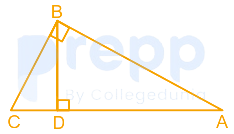
ABC is a triangle right angled at B. If AB = 5 cm and BC = 10 cm, then what is the length of the perpendicular drawn from the vertex B to the hypotenuse?
Which one of the following is correct in respect of a right-angled triangle?
Consider the following statements:
1. The perimeter of a triangle is greater than the sum of its three medians.
2. In any triangle ABC, if D is any point on BC, then AB + BC + CA > 2AD.
Which of the above statements is/are correct?
Important Questions from Triangles, Congruence and Similarity
G is the centroid of the equilateral triangle ABC. If AB = 8√ 3 cm, then the length of AG is equal to:
If sides of a triangle are 12 cm, 15 cm and 21 cm, then what is the inradius (in cm) of the triangle?
What is the area of quadrilateral ABCD?
It is given that ΔABC ~ ΔXYZ and Area ΔABC : Area ΔXYZ = 81 : 25. If AB = 18 cm, BC = 10 cm, CA = 15 cm, then what is the side XZ (in cm)?
Sides of two similar triangles are in the ratio 4 ∶ 9. Area of these triangles are in the ratio:



