
Consider the following statements: 1. The perimeter of a triangle is greater than the sum of its three medians. 2. In any triangle ABC, if D is any point on BC, then AB + BC + CA > 2AD.
Both 1 and 2
Analyzing Triangle Properties and Inequalities
This question asks us to evaluate two statements regarding the properties of triangles, specifically involving their perimeter, medians, and internal segments. We need to determine which of these statements is/are correct based on geometric principles and inequalities.
Analysing Statement 1: Perimeter vs. Medians
Statement 1 says: The perimeter of a triangle is greater than the sum of its three medians.
Let's consider a triangle ABC with sides of lengths a, b, and c. Let the lengths of the medians from vertices A, B, and C to the opposite sides be \(m_a\), \(m_b\), and \(m_c\) respectively.
The perimeter of the triangle is \(P = a + b + c\).
The sum of the medians is \(S_m = m_a + m_b + m_c\).
The statement claims that \(P > S_m\), or \(a + b + c > m_a + m_b + m_c\).
Let's examine a proof for this inequality. Consider the median \(m_a\) from vertex A to side BC. Let M be the midpoint of BC. Extend AM to a point D such that M is the midpoint of AD. Thus, \(AD = 2AM = 2m_a\).
Now, consider \(\triangle AMC\) and \(\triangle DMB\).
- AM = MD (by construction)
- BM = MC (since M is the midpoint of BC)
- \(\angle AMC = \angle DMB\) (vertically opposite angles)
By the Side-Angle-Side (SAS) congruence criterion, \(\triangle AMC \cong \triangle DMB\).
Therefore, the corresponding sides are equal: \(AC = BD\).
Now, consider \(\triangle ABD\). By the triangle inequality, the sum of the lengths of any two sides is greater than the length of the third side. So, in \(\triangle ABD\):
\begin{equation*} AB + BD > AD \end{equation*}
Substitute \(BD = AC\) and \(AD = 2AM = 2m_a\):
\begin{equation*} AB + AC > 2m_a \end{equation*}
In terms of side lengths b and c, this is:
\begin{equation*} c + b > 2m_a \end{equation*}
Similarly, by extending the median \(m_b\) from B to side AC, we can show:
\begin{equation*} a + c > 2m_b \end{equation*}
And by extending the median \(m_c\) from C to side AB, we can show:
\begin{equation*} a + b > 2m_c \end{equation*}
Now, let's add these three inequalities:
\begin{equation*} (c + b) + (a + c) + (a + b) > 2m_a + 2m_b + 2m_c \end{equation*}
\begin{equation*} 2a + 2b + 2c > 2(m_a + m_b + m_c) \end{equation*}
Dividing both sides by 2:
\begin{equation*} a + b + c > m_a + m_b + m_c \end{equation*}
This proves that the perimeter of the triangle is indeed greater than the sum of its medians.
Thus, Statement 1 is correct.
Evaluating Statement 2: Side Sum vs. Twice AD
Statement 2 says: In any triangle ABC, if D is any point on BC, then AB + BC + CA > 2AD.
Let's consider a triangle ABC and a point D that lies on the line segment BC. We can apply the triangle inequality to the two triangles formed by the segment AD: \(\triangle ABD\) and \(\triangle ACD\).
In \(\triangle ABD\), the sum of the lengths of sides AB and BD is greater than the length of the third side AD:
\begin{equation*} AB + BD > AD \end{equation*}
In \(\triangle ACD\), the sum of the lengths of sides AC and CD is greater than the length of the third side AD:
\begin{equation*} AC + CD > AD \end{equation*}
Now, let's add these two inequalities together:
\begin{equation*} (AB + BD) + (AC + CD) > AD + AD \end{equation*}
\begin{equation*} AB + AC + BD + CD > 2AD \end{equation*}
Since point D lies on the line segment BC, the lengths BD and CD add up to the length of BC:
\begin{equation*} BD + CD = BC \end{equation*}
Substitute \(BC\) for \(BD + CD\) in the inequality:
\begin{equation*} AB + AC + BC > 2AD \end{equation*}
Rearranging the terms on the left side to match the statement:
\begin{equation*} AB + BC + CA > 2AD \end{equation*}
This proves that for any triangle ABC, if D is any point on BC, the sum of the lengths of the three sides (perimeter) is greater than twice the length of the segment AD.
Thus, Statement 2 is correct.
Conclusion on Statement Correctness
Based on our analysis, both Statement 1 (The perimeter of a triangle is greater than the sum of its three medians) and Statement 2 (In any triangle ABC, if D is any point on BC, then AB + BC + CA > 2AD) are correct geometric properties.
Therefore, the correct option is the one that states both statements are correct.
Triangle Properties Revision Table
| Property | Description | Inequality/Relation |
|---|---|---|
| Triangle Inequality | The sum of the lengths of any two sides of a triangle is greater than the length of the third side. | \(a+b > c\), \(a+c > b\), \(b+c > a\) |
| Perimeter vs. Medians | The perimeter of a triangle is greater than the sum of the lengths of its medians. | \(a+b+c > m_a+m_b+m_c\) |
| Side Sum vs. Internal Segment | The sum of the three sides of a triangle is greater than twice the length of a segment from a vertex to any point on the opposite side. | \(AB+BC+CA > 2AD\) (for D on BC) |
Additional Information on Triangle Medians and Inequalities
A median of a triangle is a line segment joining a vertex to the midpoint of the opposite side. Every triangle has exactly three medians, one from each vertex.
- The three medians intersect at a single point called the centroid of the triangle.
- The centroid divides each median in a 2:1 ratio, with the longer segment being from the vertex. For example, if G is the centroid on median AM, then AG : GM = 2 : 1.
There are several other interesting inequalities related to triangle medians and sides, such as:
- The sum of the lengths of the medians is less than \(\frac{3}{2}\) times the sum of the lengths of the sides: \(m_a+m_b+m_c < \frac{3}{2}(a+b+c)\). (This is consistent with Statement 1, as \(a+b+c > m_a+m_b+m_c\) implies \(m_a+m_b+m_c\) is a smaller value).
- The sum of the squares of the medians is equal to \(\frac{3}{4}\) times the sum of the squares of the sides: \(m_a^2+m_b^2+m_c^2 = \frac{3}{4}(a^2+b^2+c^2)\).
These properties and inequalities are fundamental in understanding the geometric relationships within triangles.
Similar Questions
What is the area of quadrilateral ABCD?
ABC is a triangle right angled at A and AD is perpendicular to BC, If BD = 8 cm and DC = 12.5 cm, then what is AD equal to?
If ABC is a right-angled triangle with AC as its hypotenuse, then which one of the following is correct?
In the figure given below, ABC is a triangle with AB perpendicular to BC. Further BD is perpendicular to AC. If AD = 9 cm and DC = 4 cm, then what is the length of BD?
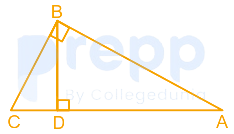
ABC is a triangle right angled at B. If AB = 5 cm and BC = 10 cm, then what is the length of the perpendicular drawn from the vertex B to the hypotenuse?
Which one of the following is correct in respect of a right-angled triangle?
Consider the following inequalities in respect of any triangle ABC:
1. AC - AB < BC
2. BC - AC < AB
3. AB - BC < AC
Which of the above are correct?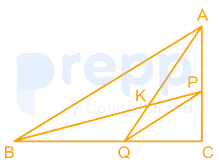
ABC is a triangle right angled at C as shown in the figure below. Which one of the following is correct?
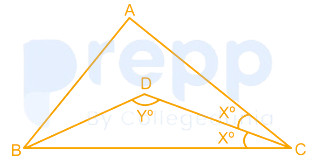
In the figure given below, ∠A = 80° and ∠ABC = 60°, BD and CD bisects angles B and C respectively. What are the values of x and y respectively?
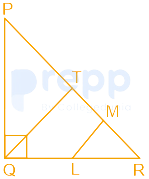
In the figure given below, PQR is a non-isosceles right-angles triangle, right angled at Q. If LM and QT are parallel and QT = PT, then what is ∠RLM equal to?
Important Questions from Triangles, Congruence and Similarity
G is the centroid of the equilateral triangle ABC. If AB = 8√ 3 cm, then the length of AG is equal to:
If sides of a triangle are 12 cm, 15 cm and 21 cm, then what is the inradius (in cm) of the triangle?
What is the area of quadrilateral ABCD?
It is given that ΔABC ~ ΔXYZ and Area ΔABC : Area ΔXYZ = 81 : 25. If AB = 18 cm, BC = 10 cm, CA = 15 cm, then what is the side XZ (in cm)?
Sides of two similar triangles are in the ratio 4 ∶ 9. Area of these triangles are in the ratio:



