
ABC is a triangle right angled at A and AD is perpendicular to BC, If BD = 8 cm and DC = 12.5 cm, then what is AD equal to?
10 cm
Solving for the Altitude in a Right-Angled Triangle
This question asks us to find the length of the altitude drawn to the hypotenuse in a right-angled triangle. We are given the lengths of the two segments that the altitude divides the hypotenuse into.
We have a triangle ABC, which is right-angled at vertex A. An altitude AD is drawn from A, perpendicular to the hypotenuse BC. The point D lies on BC. We are given the lengths of the segments BD and DC.
- BD = 8 cm
- DC = 12.5 cm
We need to find the length of AD.
Applying the Geometric Mean Theorem for Altitude
In a right-angled triangle, when an altitude is drawn from the right angle to the hypotenuse, a special relationship exists between the altitude and the segments of the hypotenuse. This relationship is described by the Geometric Mean Theorem (also known as the Altitude Theorem).
The theorem states that the square of the altitude drawn to the hypotenuse is equal to the product of the lengths of the two segments into which the hypotenuse is divided by the altitude.
Mathematically, for $\triangle ABC$ right-angled at A, with AD $\perp$ BC:
$\text{AD}^2 = \text{BD} \times \text{DC}$
Calculating the Length of AD
Now, we can substitute the given values of BD and DC into the formula:
$\text{AD}^2 = 8 \text{ cm} \times 12.5 \text{ cm}$
Let's perform the multiplication:
$8 \times 12.5 = 8 \times \frac{125}{10} = 8 \times \frac{25}{2} = 4 \times 25 = 100$
So, we have:
$\text{AD}^2 = 100 \text{ cm}^2$
To find AD, we need to take the square root of 100:
$\text{AD} = \sqrt{100 \text{ cm}^2}$
$\text{AD} = 10 \text{ cm}$
Thus, the length of AD is 10 cm.
Summary of Calculation
| Given | Value |
|---|---|
| BD | 8 cm |
| DC | 12.5 cm |
| Formula | Calculation | Result |
|---|---|---|
| $\text{AD}^2 = \text{BD} \times \text{DC}$ | $\text{AD}^2 = 8 \times 12.5$ | $\text{AD}^2 = 100$ |
| $\text{AD} = \sqrt{\text{AD}^2}$ | $\text{AD} = \sqrt{100}$ | $\text{AD} = 10$ cm |
The length of AD is 10 cm.
Revision Table: Key Concepts
| Concept | Description |
|---|---|
| Right-Angled Triangle | A triangle with one angle measuring 90 degrees. |
| Altitude | A line segment from a vertex of a triangle perpendicular to the opposite side (or extension of the side). |
| Hypotenuse | The side opposite the right angle in a right-angled triangle. |
| Geometric Mean Theorem (Altitude Theorem) | In a right triangle, the altitude to the hypotenuse is the geometric mean of the segments it divides the hypotenuse into ($\text{AD}^2 = \text{BD} \times \text{DC}$). |
Additional Information: Properties of Right Triangles with Altitude
Drawing an altitude to the hypotenuse of a right-angled triangle creates three similar triangles:
- The original triangle (ABC)
- The triangle formed by the altitude and one segment of the hypotenuse ($\triangle DBA$)
- The triangle formed by the altitude and the other segment of the hypotenuse ($\triangle DAC$)
These similarities lead to other useful relationships, such as:
- $\text{AB}^2 = \text{BD} \times \text{BC}$ (Leg Theorem)
- $\text{AC}^2 = \text{DC} \times \text{BC}$ (Leg Theorem)
- $\text{AB}^2 + \text{AC}^2 = \text{BC}^2$ (Pythagorean Theorem, since $\text{BC} = \text{BD} + \text{DC}$)
In our case, $\text{BC} = \text{BD} + \text{DC} = 8 + 12.5 = 20.5$ cm. We could also use the leg theorem to find AB or AC if needed, but the altitude theorem directly gives us AD.
Similar Questions
What is the area of quadrilateral ABCD?
If ABC is a right-angled triangle with AC as its hypotenuse, then which one of the following is correct?
In the figure given below, ABC is a triangle with AB perpendicular to BC. Further BD is perpendicular to AC. If AD = 9 cm and DC = 4 cm, then what is the length of BD?
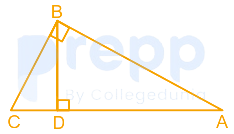
ABC is a triangle right angled at B. If AB = 5 cm and BC = 10 cm, then what is the length of the perpendicular drawn from the vertex B to the hypotenuse?
Which one of the following is correct in respect of a right-angled triangle?
Consider the following statements:
1. The perimeter of a triangle is greater than the sum of its three medians.
2. In any triangle ABC, if D is any point on BC, then AB + BC + CA > 2AD.
Which of the above statements is/are correct?Consider the following inequalities in respect of any triangle ABC:
1. AC - AB < BC
2. BC - AC < AB
3. AB - BC < AC
Which of the above are correct?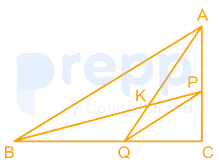
ABC is a triangle right angled at C as shown in the figure below. Which one of the following is correct?
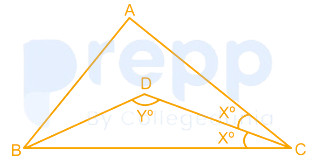
In the figure given below, ∠A = 80° and ∠ABC = 60°, BD and CD bisects angles B and C respectively. What are the values of x and y respectively?
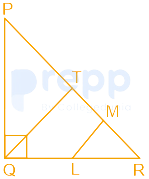
In the figure given below, PQR is a non-isosceles right-angles triangle, right angled at Q. If LM and QT are parallel and QT = PT, then what is ∠RLM equal to?
Important Questions from Triangles, Congruence and Similarity
G is the centroid of the equilateral triangle ABC. If AB = 8√ 3 cm, then the length of AG is equal to:
If sides of a triangle are 12 cm, 15 cm and 21 cm, then what is the inradius (in cm) of the triangle?
What is the area of quadrilateral ABCD?
It is given that ΔABC ~ ΔXYZ and Area ΔABC : Area ΔXYZ = 81 : 25. If AB = 18 cm, BC = 10 cm, CA = 15 cm, then what is the side XZ (in cm)?
Sides of two similar triangles are in the ratio 4 ∶ 9. Area of these triangles are in the ratio:



