
In the figure given below, ABC is a triangle with AB perpendicular to BC. Further BD is perpendicular to AC. If AD = 9 cm and DC = 4 cm, then what is the length of BD?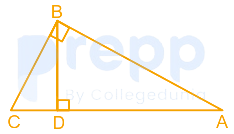
6 cm
Concept:
Pythagoras theorem:
It states that “In a right-angled triangle, the square of the hypotenuse side is equal to the sum of squares of the other two sides“.
Calculation:
Given, AD = 9 cm and DC = 4 cm
⇒ AC = AD + DC = 9 + 4 = 13 cm
In ∆ABC and ∆ADB, side AB is common, ∠ABC = ∠ADB = 90°
Also, ∠BAC = ∠BAD (common angle)
⇒ ∆ABC and ∆ADB are similar triangles, hence, the ratio of their corresponding sides is equal,
⇒ AB/AD = AC/AB
⇒ AB 2= AC × AD = 13 × 9 = 117
Now, in ∆ADB,
⇒ AB 2= AD 2+ BD 2
⇒ 117 = 81 + BD 2
∴ BD = √36 = 6 cmSimilar Questions
What is the area of quadrilateral ABCD?
ABC is a triangle right angled at A and AD is perpendicular to BC, If BD = 8 cm and DC = 12.5 cm, then what is AD equal to?
If ABC is a right-angled triangle with AC as its hypotenuse, then which one of the following is correct?
ABC is a triangle right angled at B. If AB = 5 cm and BC = 10 cm, then what is the length of the perpendicular drawn from the vertex B to the hypotenuse?
Which one of the following is correct in respect of a right-angled triangle?
Consider the following statements:
1. The perimeter of a triangle is greater than the sum of its three medians.
2. In any triangle ABC, if D is any point on BC, then AB + BC + CA > 2AD.
Which of the above statements is/are correct?Consider the following inequalities in respect of any triangle ABC:
1. AC - AB < BC
2. BC - AC < AB
3. AB - BC < AC
Which of the above are correct?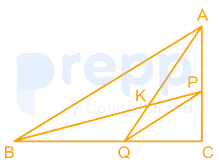
ABC is a triangle right angled at C as shown in the figure below. Which one of the following is correct?
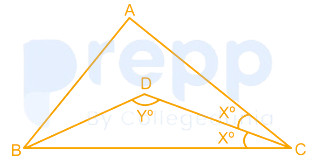
In the figure given below, ∠A = 80° and ∠ABC = 60°, BD and CD bisects angles B and C respectively. What are the values of x and y respectively?
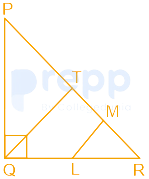
In the figure given below, PQR is a non-isosceles right-angles triangle, right angled at Q. If LM and QT are parallel and QT = PT, then what is ∠RLM equal to?
Important Questions from Triangles, Congruence and Similarity
G is the centroid of the equilateral triangle ABC. If AB = 8√ 3 cm, then the length of AG is equal to:
If sides of a triangle are 12 cm, 15 cm and 21 cm, then what is the inradius (in cm) of the triangle?
What is the area of quadrilateral ABCD?
It is given that ΔABC ~ ΔXYZ and Area ΔABC : Area ΔXYZ = 81 : 25. If AB = 18 cm, BC = 10 cm, CA = 15 cm, then what is the side XZ (in cm)?
Sides of two similar triangles are in the ratio 4 ∶ 9. Area of these triangles are in the ratio:



