
If ABC is a right-angled triangle with AC as its hypotenuse, then which one of the following is correct?
AC 3> AB 3+ BC 3
Understanding the Right-Angled Triangle Problem
The question presents a right-angled triangle labeled ABC. It specifies that AC is the hypotenuse. In a right-angled triangle, the hypotenuse is always the longest side and is the side opposite the 90-degree angle. The other two sides, AB and BC, are called the legs of the triangle.
We are asked to determine the correct mathematical relationship between the cubes of the lengths of these three sides: AB, BC, and AC.
Applying the Pythagorean Theorem
The fundamental theorem that describes the relationship between the sides of a right-angled triangle is the Pythagorean theorem. It states that the square of the length of the hypotenuse is equal to the sum of the squares of the lengths of the other two sides (the legs).
For our triangle ABC, with AC as the hypotenuse, the Pythagorean theorem is expressed as:
\(AC^2 = AB^2 + BC^2\)
Analyzing the Relationship Between the Cubes of the Sides
The question asks us to compare \(AC^3\) with \(AB^3 + BC^3\). We can use the relationship given by the Pythagorean theorem to find this connection.
Let's denote the side lengths as \(a = AB\), \(b = BC\), and \(c = AC\). From the Pythagorean theorem, we have:
\(c^2 = a^2 + b^2\)
Since \(a\) and \(b\) are lengths of sides of a triangle, they must be positive numbers (\(a > 0\), \(b > 0\)). Consequently, \(c^2 = a^2 + b^2 > a^2\) and \(c^2 > b^2\), which implies \(c > a\) and \(c > b\). The hypotenuse is indeed longer than either leg.
Deriving the Inequality for the Cubes
We want to compare \(c^3\) and \(a^3 + b^3\). Let's compare the squares of these quantities, as we know the relationship between \(c^2\) and \(a^2 + b^2\):
Consider \((c^3)^2 = (c^2)^3\). Since \(c^2 = a^2 + b^2\), we have \((c^2)^3 = (a^2 + b^2)^3\).
Now consider \((a^3 + b^3)^2\).
Let's expand both expressions:
- \((a^2 + b^2)^3 = (a^2)^3 + 3(a^2)^2(b^2) + 3(a^2)(b^2)^2 + (b^2)^3 = a^6 + 3a^4b^2 + 3a^2b^4 + b^6\)
- \((a^3 + b^3)^2 = (a^3)^2 + 2(a^3)(b^3) + (b^3)^2 = a^6 + 2a^3b^3 + b^6\)
We need to compare \(a^6 + 3a^4b^2 + 3a^2b^4 + b^6\) with \(a^6 + 2a^3b^3 + b^6\).
Subtracting \(a^6 + b^6\) from both sides of the comparison, we are left to compare \(3a^4b^2 + 3a^2b^4\) with \(2a^3b^3\).
Since \(a > 0\) and \(b > 0\), we know that \(a^2b^2 > 0\). We can divide both expressions by \(a^2b^2\) without affecting the direction of the inequality:
\(\frac{3a^4b^2 + 3a^2b^4}{a^2b^2}\) compared to \(\frac{2a^3b^3}{a^2b^2}\)
\(3a^2 + 3b^2\) compared to \(2ab\)
We know a fundamental inequality for positive numbers: \(a^2 + b^2 \ge 2ab\). This is true because \((a-b)^2 \ge 0\), which expands to \(a^2 - 2ab + b^2 \ge 0\), leading to \(a^2 + b^2 \ge 2ab\). Equality holds only when \(a = b\).
Multiplying the inequality \(a^2 + b^2 \ge 2ab\) by 3 (which is a positive number), we get:
\(3(a^2 + b^2) \ge 3(2ab)\)
\(3a^2 + 3b^2 \ge 6ab\)
Since \(a > 0\) and \(b > 0\), we know that \(6ab > 2ab\).
Combining these results, we have \(3a^2 + 3b^2 \ge 6ab > 2ab\). Therefore, the strict inequality \(3a^2 + 3b^2 > 2ab\) holds true for any positive values of \(a\) and \(b\).
This proves that \(a^6 + 3a^4b^2 + 3a^2b^4 + b^6 > a^6 + 2a^3b^3 + b^6\), which means \((a^2 + b^2)^3 > (a^3 + b^3)^2\).
Substituting \(a^2 + b^2 = c^2\), we have \(c^6 > (a^3 + b^3)^2\).
Since \(a > 0\) and \(b > 0\), \(a^3 > 0\) and \(b^3 > 0\), so \(a^3 + b^3 > 0\). Also, \(c^2 = a^2+b^2 > 0\), so \(c > 0\) and \(c^3 > 0\). We can take the positive square root of both sides of the inequality \(c^6 > (a^3 + b^3)^2\) while preserving the inequality direction:
\(\sqrt{c^6} > \sqrt{(a^3 + b^3)^2}\)
\(c^3 > a^3 + b^3\)
Substituting back the side lengths AC, AB, and BC:
\(AC^3 > AB^3 + BC^3\)
Evaluating the Given Options
Based on our derivation using the Pythagorean theorem for a right-angled triangle ABC with hypotenuse AC, we found that the relationship between the cubes of the sides is \(AC^3 > AB^3 + BC^3\).
Let's examine the provided options:
- Option 1: \(AC^3 < AB^3 + BC^3\). This states that the cube of the hypotenuse is less than the sum of the cubes of the legs, which contradicts our finding.
- Option 2: \(AC^3 > AB^3 + BC^3\). This statement matches the inequality we derived.
- Option 3: \(AC^3 \le AB^3 + BC^3\). This includes the possibility of \(AC^3 = AB^3 + BC^3\). Our derivation showed a strict inequality (\(AC^3 > AB^3 + BC^3\)), meaning equality is not possible for positive side lengths of a right triangle.
- Option 4: \(AC^3 \ge AB^3 + BC^3\). This also includes the possibility of equality, which is not correct as per our derivation showing a strict inequality.
Thus, only Option 2 accurately describes the relationship.
Conclusion on Right Triangle Side Cubes
For a right-angled triangle ABC where AC is the hypotenuse, the cube of the hypotenuse, \(AC^3\), is greater than the sum of the cubes of the other two sides, \(AB^3 + BC^3\).
Revision Table: Key Concepts for Right-Angled Triangles
| Concept | Description | Relationship/Formula |
|---|---|---|
| Right Angle | An angle measuring 90 degrees. | One angle in a right triangle is 90° |
| Hypotenuse (AC) | The side opposite the right angle; the longest side. | AC in \(\triangle\)ABC |
| Legs (AB, BC) | The two sides forming the right angle. | AB and BC in \(\triangle\)ABC |
| Pythagorean Theorem | Relationship between leg lengths and hypotenuse length. | \(AB^2 + BC^2 = AC^2\) |
| Cubes of Sides Relation | Inequality for the cubes of the side lengths. | \(AC^3 > AB^3 + BC^3\) |
Additional Information: Properties of Right Triangles
Understanding right-angled triangles is fundamental in geometry and trigonometry. Here are some additional points:
- Angle Properties: The sum of the two acute angles in a right triangle is always 90 degrees (they are complementary).
- Area Calculation: The area of a right triangle is easily calculated as half the product of its legs: Area = \(\frac{1}{2} \times \text{base} \times \text{height}\), where the legs can serve as the base and height. For triangle ABC, Area = \(\frac{1}{2} \times AB \times BC\).
- Special Right Triangles: Certain right triangles have side lengths in specific ratios, such as 45-45-90 triangles (sides in ratio \(1:1:\sqrt{2}\)) and 30-60-90 triangles (sides in ratio \(1:\sqrt{3}:2\)).
- Circumcenter: The circumcenter (center of the circumscribed circle) of a right triangle is always located at the midpoint of its hypotenuse.
Similar Questions
What is the area of quadrilateral ABCD?
ABC is a triangle right angled at A and AD is perpendicular to BC, If BD = 8 cm and DC = 12.5 cm, then what is AD equal to?
In the figure given below, ABC is a triangle with AB perpendicular to BC. Further BD is perpendicular to AC. If AD = 9 cm and DC = 4 cm, then what is the length of BD?
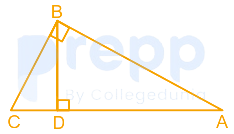
ABC is a triangle right angled at B. If AB = 5 cm and BC = 10 cm, then what is the length of the perpendicular drawn from the vertex B to the hypotenuse?
Which one of the following is correct in respect of a right-angled triangle?
Consider the following statements:
1. The perimeter of a triangle is greater than the sum of its three medians.
2. In any triangle ABC, if D is any point on BC, then AB + BC + CA > 2AD.
Which of the above statements is/are correct?Consider the following inequalities in respect of any triangle ABC:
1. AC - AB < BC
2. BC - AC < AB
3. AB - BC < AC
Which of the above are correct?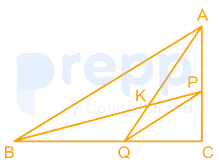
ABC is a triangle right angled at C as shown in the figure below. Which one of the following is correct?
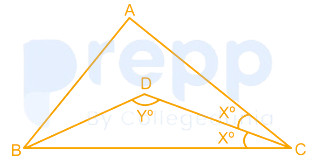
In the figure given below, ∠A = 80° and ∠ABC = 60°, BD and CD bisects angles B and C respectively. What are the values of x and y respectively?
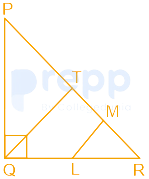
In the figure given below, PQR is a non-isosceles right-angles triangle, right angled at Q. If LM and QT are parallel and QT = PT, then what is ∠RLM equal to?
Important Questions from Triangles, Congruence and Similarity
G is the centroid of the equilateral triangle ABC. If AB = 8√ 3 cm, then the length of AG is equal to:
If sides of a triangle are 12 cm, 15 cm and 21 cm, then what is the inradius (in cm) of the triangle?
What is the area of quadrilateral ABCD?
It is given that ΔABC ~ ΔXYZ and Area ΔABC : Area ΔXYZ = 81 : 25. If AB = 18 cm, BC = 10 cm, CA = 15 cm, then what is the side XZ (in cm)?
Sides of two similar triangles are in the ratio 4 ∶ 9. Area of these triangles are in the ratio:



