
Let Δ ABC ∼ Δ RPQ and \(\frac{ar(\Delta ABC)}{ar(\Delta RPQ)}=\frac{16}{25}\) . If PQ = 4 cm, QR = 6 cm and PR = 7 cm, then AC (in cm) is equal to:
4.8
Understanding Similar Triangles and Area Ratios
The problem provides information about two similar triangles, Δ ABC and Δ RPQ. We are given that Δ ABC ∼ Δ RPQ. Similarity between triangles means that their corresponding angles are equal and the ratio of their corresponding sides is constant.
We are also given the ratio of the areas of these similar triangles: \[\frac{ar(\Delta ABC)}{ar(\Delta RPQ)} = \frac{16}{25}\] The side lengths of Δ RPQ are provided: PQ = 4 cm, QR = 6 cm, and PR = 7 cm. We need to find the length of side AC in Δ ABC.
Ratio of Areas and Corresponding Sides
A key property of similar triangles is that the ratio of their areas is equal to the square of the ratio of their corresponding sides. Since Δ ABC ∼ Δ RPQ, the corresponding sides are:
- AB corresponds to RP
- BC corresponds to PQ
- AC corresponds to RQ
Therefore, the ratio of the areas can be written in terms of the sides: \[\frac{ar(\Delta ABC)}{ar(\Delta RPQ)} = \left(\frac{AB}{RP}\right)^2 = \left(\frac{BC}{PQ}\right)^2 = \left(\frac{AC}{RQ}\right)^2\]
Calculating the Side Length AC
We are given the area ratio \(\frac{16}{25}\) and we want to find the length of side AC. From the similarity statement Δ ABC ∼ Δ RPQ, we know that AC corresponds to RQ. The length of RQ is given as 6 cm.
Using the property relating area ratios and side ratios, we have: \[\frac{ar(\Delta ABC)}{ar(\Delta RPQ)} = \left(\frac{AC}{RQ}\right)^2\]
Substitute the given values into the equation: \[\frac{16}{25} = \left(\frac{AC}{6}\right)^2\]
To find the ratio of the sides, take the square root of both sides of the equation: \[\sqrt{\frac{16}{25}} = \sqrt{\left(\frac{AC}{6}\right)^2}\] \[\frac{\sqrt{16}}{\sqrt{25}} = \frac{AC}{6}\] \[\frac{4}{5} = \frac{AC}{6}\]
Now, solve for AC by cross-multiplying: \[5 \times AC = 4 \times 6\] \[5 \times AC = 24\]
Divide by 5 to find AC: \[AC = \frac{24}{5}\] \[AC = 4.8 \text{ cm}\]
Thus, the length of side AC is 4.8 cm.
Summary of Calculation for AC
| Given Information | Relation for Similar Triangles | Calculation | Result |
|---|---|---|---|
| Δ ABC ∼ Δ RPQ | \(\frac{ar(\Delta ABC)}{ar(\Delta RPQ)} = \left(\frac{AC}{RQ}\right)^2\) | \(\frac{16}{25} = \left(\frac{AC}{6}\right)^2\) \(\sqrt{\frac{16}{25}} = \frac{AC}{6}\) \(\frac{4}{5} = \frac{AC}{6}\) \(AC = \frac{4}{5} \times 6\) \(AC = \frac{24}{5}\) |
AC = 4.8 cm |
| \(\frac{ar(\Delta ABC)}{ar(\Delta RPQ)}=\frac{16}{25}\) | |||
| RQ = 6 cm |
Revision Table: Similar Triangles Properties
| Property | Description | Relation for Δ ABC ∼ Δ RPQ |
|---|---|---|
| Corresponding Angles | Corresponding angles are equal. | \(\angle A = \angle R\), \(\angle B = \angle P\), \(\angle C = \angle Q\) |
| Corresponding Sides Ratio | The ratio of corresponding sides is constant (scale factor). | \(\frac{AB}{RP} = \frac{BC}{PQ} = \frac{AC}{RQ}\) |
| Area Ratio | The ratio of areas is the square of the ratio of corresponding sides. | \(\frac{ar(\Delta ABC)}{ar(\Delta RPQ)} = \left(\frac{AB}{RP}\right)^2 = \left(\frac{BC}{PQ}\right)^2 = \left(\frac{AC}{RQ}\right)^2\) |
| Perimeter Ratio | The ratio of perimeters is equal to the ratio of corresponding sides. | \(\frac{\text{Perimeter}(\Delta ABC)}{\text{Perimeter}(\Delta RPQ)} = \frac{AB}{RP} = \frac{BC}{PQ} = \frac{AC}{RQ}\) |
Additional Information: Applying Similar Triangle Concepts
Similar triangles are fundamental in geometry and are used in many practical applications, such as scaling maps, architectural designs, and solving problems involving distances that cannot be measured directly. The relationship between their areas and corresponding sides is a powerful tool for finding unknown lengths or areas when the scale factor or area ratio is known.
When working with similar triangles, it is crucial to correctly identify the corresponding sides. The similarity statement (Δ ABC ∼ Δ RPQ) indicates the correspondence: the vertices listed in the same order correspond to each other (A to R, B to P, C to Q). This correspondence defines which sides are proportional (AB/RP, BC/PQ, AC/RQ).
In this problem, understanding that AC corresponds to RQ based on the similarity statement Δ ABC ∼ Δ RPQ was essential to correctly apply the area ratio formula and solve for the unknown side length AC.
Similar Questions
If sides of a triangle are 12 cm, 15 cm and 21 cm, then what is the inradius (in cm) of the triangle?
In ΔPQR, PQ = PR and S is a point on QR such that ∠PSQ = 96° + ∠QPS and ∠QPR = 132°. What is the measure of ∠PSR?
If ∆ABC ~ ∆EDF such that AB = 6 cm, DF = 16 cm and DE = 8 cm, then the length of BC is:
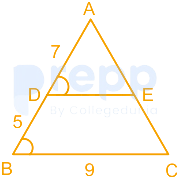
In ΔABC, D and E are the points on sides AB and AC, respectively such that ∠ADE = ∠B. If AD = 7 cm, BD = 5cm and BC = 9 cm, then DE (in cm) is equal to:
In triangle ABC, P and Q are the mid points of AB and AC, respectively. R is a point on PQ such that PR : RQ = 3 : 5 and QR = 20 cm, then what is the length (in cm) of BC?
ΔABC is similar to ΔPQR and AB : PQ = 2 : 3. AD is the median to the side BC in ΔABC and PS is the median to the side QR in ΔPQR. What is the value of (BD/QS) 2?
In a triangle ABC, AB = 12, BC = 18 and AC = 15. The medians AX and BY intersect sides BC and AC at X and Y respectively. If AX and BY intersect each other at O, then what is the value of OX?
In ΔABC, ∠C = 90°, Point P and Q are on the sides AC and BC, respectively, such that AP : PC = BQ : QC = 1 : 2 then, \(\frac{AQ^2+BP^2}{AB^2}\) is equal to:
The area of a ΔABC is one unit. DE is a straight line parallel to BC, joining the points D and E on AB and AC respectively such that AD : DB = 1 : 6. The ratio of the areas of ΔADE and ΔABC is:
The area of ΔABC is 44 cm 2. If D is the midpoint of BC and E is the midpoint of AB, then the area (in cm 2) of ΔBDE is:
Important Questions from Triangles, Congruence and Similarity
G is the centroid of the equilateral triangle ABC. If AB = 8√ 3 cm, then the length of AG is equal to:
If sides of a triangle are 12 cm, 15 cm and 21 cm, then what is the inradius (in cm) of the triangle?
What is the area of quadrilateral ABCD?
It is given that ΔABC ~ ΔXYZ and Area ΔABC : Area ΔXYZ = 81 : 25. If AB = 18 cm, BC = 10 cm, CA = 15 cm, then what is the side XZ (in cm)?
Sides of two similar triangles are in the ratio 4 ∶ 9. Area of these triangles are in the ratio:



