
Read the statements: A. The O/P frequency of a half wave rectifier is equal to the input frequency B. The O/P frequency of a full wave rectifier is double to the input frequency C. The regulation of an excellent rectifier should be zero. D. ripple factor in the full wave rectifier is 1.2. Choose the correct statements from the options given below:
A, C only
The question asks us to determine which statements about rectifiers are correct. Let's analyze each statement one by one:
- Statement A: The O/P frequency of a half wave rectifier is equal to the input frequency.
- Explanation: In a half wave rectifier, the rectification process allows only one half of the AC cycle (either positive or negative) to pass through, blocking the other half. Thus, each input cycle corresponds to one output cycle, meaning the output frequency is the same as the input frequency.
- Conclusion: This statement is correct.
- Statement B: The O/P frequency of a full wave rectifier is double to the input frequency.
- Explanation: In a full wave rectifier, both halves of the AC input are utilized to produce the output. Therefore, for every input cycle, there are two output cycles.
- Conclusion: This statement is correct.
- Statement C: The regulation of an excellent rectifier should be zero.
- Explanation: Voltage regulation refers to the change in output voltage from no load to full load. For an ideal rectifier, no change in output voltage is desired despite changes in load; hence, ideal regulation would be zero.
- Conclusion: This statement is correct.
- Statement D: Ripple factor in the full wave rectifier is 1.2.
- Explanation: The ripple factor is a measure of the AC ripple content in the output. The ripple factor for a full wave rectifier is actually around 0.482, not 1.2.
- Conclusion: This statement is incorrect.
Based on this analysis, the correct statements are A and C. Therefore, the correct option is:
- A, C only
Similar Questions
Consider the following rectifier circuits :
1. Half-wave rectifier without filter
2. Full-wave rectifier without filter
3. Full-wave rectifier with series inductance filter
4. Full-wave rectifier with capacitance filterThe sequence of these rectifier circuits in decreasing order of the ripple factor is
Assertion (A) : Capacitor input filter gives a high output voltage which drops as the load is increased.
Reason (R) : Capacitor input filters produce more heating in the rectifiers.
For the different values of 'L' while keeping 'RL' as constant, following graph is obtained from the given circuit.
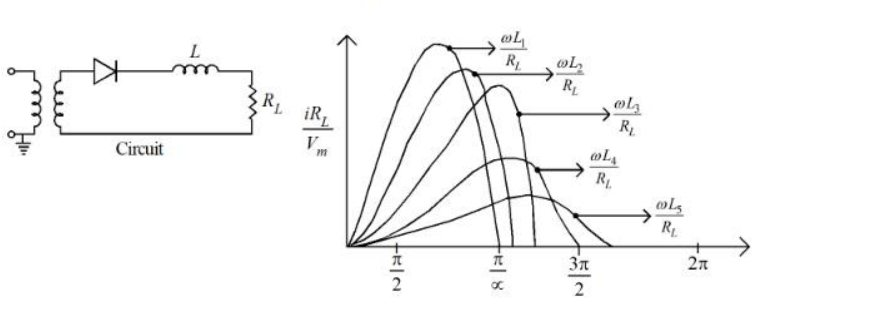
Choose the correct ascending order from the options given below for the different values of ' L ' :
The ratio of peak to peak input ripple voltage to peak to peak ripple output voltage is known as:
Statements regarding rectifier are :
A. RMS value of current in a half wave rectifier is \(\frac{I_m}{\sqrt{2}}\)
B. PIV of diode in a full wave bridge rectifier is Vm volts.
C. TUF and rectification efficiency for a rectifier are same parametrs.
D. Rectifier converts A.C. to rippled DC not pure D.C.
Choose the correct answer from the options given below:
In a rectifier the ripple factor can be expressed as
(a) \(\dfrac{I_{rms}}{I_{dc}}\) (b) \(\sqrt\dfrac{I_{dc}}{I_{rms}}\) (c) \(\sqrt{\left(\dfrac{I_{rms}}{I_{dc}}\right)^{2}-1}\) (d) \(\sqrt{1-\left(\dfrac{I_{rms}}{I_{dc}}\right)^{2}}\)
Which one of the above is correct ?
For a full-wave rectifier, which of the following statements are correct ?
(a) \(V_{dc}=\dfrac{2V_P}{\pi}\)
(b) \(f_{out}=2f_{in}\)
(c) \(V_{dc}=\dfrac{2\pi}{V_P}\)
(d) \(I_{dc}=\dfrac{I_m}{\sqrt{\pi}}\)
Options :
As compared to a full-wave rectifier using two diodes, the four diode bridge rectifier has the dominant advantage of :
In rectifiers :
(a) The efficiency of rectification is given by \(\eta=\dfrac{P_{ac}}{P_{dc}}\)
(b) The AC component on the output side : \(V_{ac}=\sqrt{V_{rms}^{2}-V_{dc}^{2}}\)
(c) Form factor is given by : \(FF=\dfrac{V_{dc}}{V_{rms}}\)
(d) Ripple factor is given by : \(RF=\sqrt{\left(\dfrac{V_{rms}}{V_{dc}}\right)^{2}-1}\)
Of these statements :
A half wave rectifier operates from 50 Hz supply and provides a peak output voltage of 60 V across the 600 Ω resistance. The value of capacitance for the capacitor filter would limit the peak to peak ripple voltage across load is 15 V :
Important Questions from Rectifier Circuits
PIV of a non conducting diode in a bridge rectifier is
The no-load output voltage of an ideal half wave rectifier is _______.
What is the minimum PIV required for a diode used in a full-wave rectifier circuit using a center-tapped transformer with a secondary voltage of 50V-0-50 V (rms)?
One of the following is a negative resistance device
Which of the following is NOT true for a rectifier?



