
A half wave rectifier operates from 50 Hz supply and provides a peak output voltage of 60 V across the 600 Ω resistance. The value of capacitance for the capacitor filter would limit the peak to peak ripple voltage across load is 15 V :
117 μF
A capacitor filter works by charging to the peak and then discharging into the load between peaks. If the discharge is small compared with the peak, the fall is nearly linear and the capacitor equation \(I=C\dfrac{dV}{dt}\) becomes
\(C=\dfrac{I_{dc}\,T}{V_{r(pp)}}=\dfrac{I_{dc}}{f\,V_{r(pp)}}\)
where T is the time between charging pulses. For a half-wave rectifier there is one pulse per cycle, so \(T=1/f=1/50=20\ \text{ms}\) — twice as long as a full-wave circuit would allow, which is why half-wave supplies need much larger capacitors.
Step 1 — find the DC load current. The output swings between 60 V and 45 V, so its average is
\(V_{dc}=V_{peak}-\dfrac{V_{r(pp)}}{2}=60-\dfrac{15}{2}=52.5\ \text{V}\)
\(I_{dc}=\dfrac{V_{dc}}{R_{L}}=\dfrac{52.5}{600}=87.5\ \text{mA}\)
Step 2 — substitute.
\(C=\dfrac{87.5\times10^{-3}}{50\times15}=\dfrac{0.0875}{750}=1.167\times10^{-4}\ \text{F}=117\ \mu\text{F}\)
which is option 2.
Two of the distractors are units traps. Option 3 gives the right number with the wrong prefix: 117 farads is a supercapacitor, physically absurd for a rectifier filter. Option 4, zero, would mean no filter at all and a ripple equal to the whole 60 V peak. Option 1, 100 μF, is what you get by carelessly using the peak voltage instead of the average for Idc: \(60/600=100\ \text{mA}\) gives 133 μF, and rounding 60 V against a 15 V ripple in other ways lands nearby — a reminder to use the mean output for the discharge current.
| Quantity | Value |
|---|---|
| Discharge time T | 20 ms (half-wave, 50 Hz) |
| Vdc | 52.5 V |
| Idc | 87.5 mA |
| C | 117 μF |
The design relationship worth remembering : ripple is inversely proportional to C, to f and to RL. Doubling the capacitance halves the ripple; a full-wave rectifier halves it again for free by doubling the pulse rate. The cost of a large C is a short, tall charging pulse — the diode conducts only near the crest, so its peak repetitive current is many times the DC load current and must be checked against the datasheet.
Hence, the required capacitance is 117 μF.
Similar Questions
Consider the following rectifier circuits :
1. Half-wave rectifier without filter
2. Full-wave rectifier without filter
3. Full-wave rectifier with series inductance filter
4. Full-wave rectifier with capacitance filterThe sequence of these rectifier circuits in decreasing order of the ripple factor is
Assertion (A) : Capacitor input filter gives a high output voltage which drops as the load is increased.
Reason (R) : Capacitor input filters produce more heating in the rectifiers.
For the different values of 'L' while keeping 'RL' as constant, following graph is obtained from the given circuit.
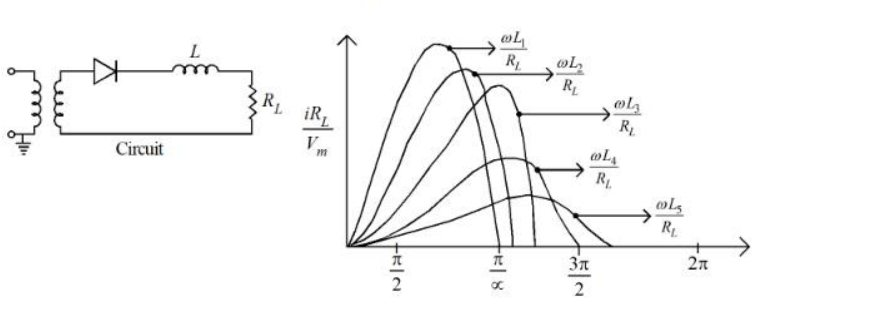
Choose the correct ascending order from the options given below for the different values of ' L ' :
The ratio of peak to peak input ripple voltage to peak to peak ripple output voltage is known as:
Read the statements:
A. The O/P frequency of a half wave rectifier is equal to the input frequency
B. The O/P frequency of a full wave rectifier is double to the input frequency
C. The regulation of an excellent rectifier should be zero.
D. ripple factor in the full wave rectifier is 1.2.
Choose the correct statements from the options given below:
Statements regarding rectifier are :
A. RMS value of current in a half wave rectifier is \(\frac{I_m}{\sqrt{2}}\)
B. PIV of diode in a full wave bridge rectifier is Vm volts.
C. TUF and rectification efficiency for a rectifier are same parametrs.
D. Rectifier converts A.C. to rippled DC not pure D.C.
Choose the correct answer from the options given below:
In a rectifier the ripple factor can be expressed as
(a) \(\dfrac{I_{rms}}{I_{dc}}\) (b) \(\sqrt\dfrac{I_{dc}}{I_{rms}}\) (c) \(\sqrt{\left(\dfrac{I_{rms}}{I_{dc}}\right)^{2}-1}\) (d) \(\sqrt{1-\left(\dfrac{I_{rms}}{I_{dc}}\right)^{2}}\)
Which one of the above is correct ?
For a full-wave rectifier, which of the following statements are correct ?
(a) \(V_{dc}=\dfrac{2V_P}{\pi}\)
(b) \(f_{out}=2f_{in}\)
(c) \(V_{dc}=\dfrac{2\pi}{V_P}\)
(d) \(I_{dc}=\dfrac{I_m}{\sqrt{\pi}}\)
Options :
As compared to a full-wave rectifier using two diodes, the four diode bridge rectifier has the dominant advantage of :
In rectifiers :
(a) The efficiency of rectification is given by \(\eta=\dfrac{P_{ac}}{P_{dc}}\)
(b) The AC component on the output side : \(V_{ac}=\sqrt{V_{rms}^{2}-V_{dc}^{2}}\)
(c) Form factor is given by : \(FF=\dfrac{V_{dc}}{V_{rms}}\)
(d) Ripple factor is given by : \(RF=\sqrt{\left(\dfrac{V_{rms}}{V_{dc}}\right)^{2}-1}\)
Of these statements :
Important Questions from Rectifier Circuits
PIV of a non conducting diode in a bridge rectifier is
The no-load output voltage of an ideal half wave rectifier is _______.
What is the minimum PIV required for a diode used in a full-wave rectifier circuit using a center-tapped transformer with a secondary voltage of 50V-0-50 V (rms)?
One of the following is a negative resistance device
Which of the following is NOT true for a rectifier?



