
In rectifiers : (a) The efficiency of rectification is given by \(\eta=\dfrac{P_{ac}}{P_{dc}}\) (b) The AC component on the output side : \(V_{ac}=\sqrt{V_{rms}^{2}-V_{dc}^{2}}\) (c) Form factor is given by : \(FF=\dfrac{V_{dc}}{V_{rms}}\) (d) Ripple factor is given by : \(RF=\sqrt{\left(\dfrac{V_{rms}}{V_{dc}}\right)^{2}-1}\) Of these statements :
(b) and (d) are correct
Two of the four definitions have been written upside down — check each against what it is meant to measure.
(a) is inverted. Rectification efficiency is the fraction of the input AC power that emerges as useful DC power, so the DC output belongs on top:
\(\eta=\dfrac{P_{dc}}{P_{ac}}\times100\%\)
Written as printed it would exceed 100 %, which is impossible for a passive circuit. The standard values are 40.6 % for a half-wave and 81.2 % for a full-wave rectifier.
(b) is correct. The output is a DC level with ripple riding on it, and the total RMS value combines the two in quadrature, exactly as with any signal split into its mean and its fluctuation:
\(V_{rms}^{2}=V_{dc}^{2}+V_{ac}^{2}\quad\Rightarrow\quad V_{ac}=\sqrt{V_{rms}^{2}-V_{dc}^{2}}\)
(c) is inverted too. Form factor is defined as
\(FF=\dfrac{V_{rms}}{V_{dc}}\)
and must always be \(\ge1\), since the RMS value of a varying waveform can never be less than its average. As printed it would be less than one. The standard values are 1.57 for half-wave and 1.11 for full-wave.
(d) is correct, and it follows directly from (b) and the true form factor:
\(RF=\dfrac{V_{ac}}{V_{dc}}=\dfrac{\sqrt{V_{rms}^{2}-V_{dc}^{2}}}{V_{dc}}=\sqrt{\left(\dfrac{V_{rms}}{V_{dc}}\right)^{2}-1}=\sqrt{FF^{2}-1}\)
So (b) and (d) — option 2.
| Quantity | Half-wave | Full-wave |
|---|---|---|
| Efficiency η | 40.6 % | 81.2 % |
| Form factor | 1.57 | 1.11 |
| Ripple factor | 1.21 | 0.482 |
| Ripple frequency | f | 2f |
Check the numbers against the formula : for a full-wave rectifier \(RF=\sqrt{1.11^{2}-1}=\sqrt{0.232}=0.482\) ✓, and for half-wave \(\sqrt{1.57^{2}-1}=1.21\) ✓. Two internally consistent results like this are the quickest way to confirm you have written the ratios the right way up.
What ripple factor means in practice. A half-wave output is 121 % ripple — more fluctuation than DC — which is why no supply is used without filtering. A capacitor filter reduces it to \(RF=\dfrac{1}{4\sqrt{3}fRC}\), and an active regulator brings it down further still.
Hence, the correct statements are (b) and (d).
Similar Questions
Consider the following rectifier circuits :
1. Half-wave rectifier without filter
2. Full-wave rectifier without filter
3. Full-wave rectifier with series inductance filter
4. Full-wave rectifier with capacitance filterThe sequence of these rectifier circuits in decreasing order of the ripple factor is
Assertion (A) : Capacitor input filter gives a high output voltage which drops as the load is increased.
Reason (R) : Capacitor input filters produce more heating in the rectifiers.
For the different values of 'L' while keeping 'RL' as constant, following graph is obtained from the given circuit.
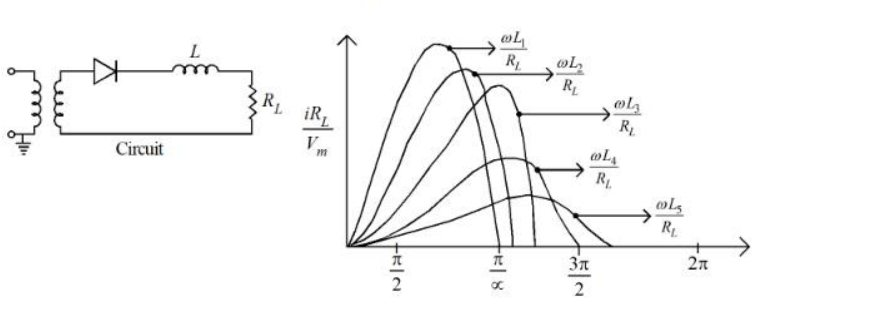
Choose the correct ascending order from the options given below for the different values of ' L ' :
The ratio of peak to peak input ripple voltage to peak to peak ripple output voltage is known as:
Read the statements:
A. The O/P frequency of a half wave rectifier is equal to the input frequency
B. The O/P frequency of a full wave rectifier is double to the input frequency
C. The regulation of an excellent rectifier should be zero.
D. ripple factor in the full wave rectifier is 1.2.
Choose the correct statements from the options given below:
Statements regarding rectifier are :
A. RMS value of current in a half wave rectifier is \(\frac{I_m}{\sqrt{2}}\)
B. PIV of diode in a full wave bridge rectifier is Vm volts.
C. TUF and rectification efficiency for a rectifier are same parametrs.
D. Rectifier converts A.C. to rippled DC not pure D.C.
Choose the correct answer from the options given below:
In a rectifier the ripple factor can be expressed as
(a) \(\dfrac{I_{rms}}{I_{dc}}\) (b) \(\sqrt\dfrac{I_{dc}}{I_{rms}}\) (c) \(\sqrt{\left(\dfrac{I_{rms}}{I_{dc}}\right)^{2}-1}\) (d) \(\sqrt{1-\left(\dfrac{I_{rms}}{I_{dc}}\right)^{2}}\)
Which one of the above is correct ?
For a full-wave rectifier, which of the following statements are correct ?
(a) \(V_{dc}=\dfrac{2V_P}{\pi}\)
(b) \(f_{out}=2f_{in}\)
(c) \(V_{dc}=\dfrac{2\pi}{V_P}\)
(d) \(I_{dc}=\dfrac{I_m}{\sqrt{\pi}}\)
Options :
As compared to a full-wave rectifier using two diodes, the four diode bridge rectifier has the dominant advantage of :
A half wave rectifier operates from 50 Hz supply and provides a peak output voltage of 60 V across the 600 Ω resistance. The value of capacitance for the capacitor filter would limit the peak to peak ripple voltage across load is 15 V :
Important Questions from Rectifier Circuits
PIV of a non conducting diode in a bridge rectifier is
The no-load output voltage of an ideal half wave rectifier is _______.
What is the minimum PIV required for a diode used in a full-wave rectifier circuit using a center-tapped transformer with a secondary voltage of 50V-0-50 V (rms)?
One of the following is a negative resistance device
Which of the following is NOT true for a rectifier?



