
In an equilateral triangle ABC, BD is drawn perpendicular to AC. What is BD 2equal to?
3AD 2
Equilateral Triangle Properties and Altitude BD Calculation
The question asks us to find the value of \(BD^2\) in relation to \(AD^2\), given that ABC is an equilateral triangle and BD is drawn perpendicular to AC.
Properties of Equilateral Triangle ABC
Let's recall the fundamental properties of an equilateral triangle:
- All sides are equal in length. Let's denote the side length as \(s\). So, \(AB = BC = AC = s\).
- All interior angles are equal to \(60^\circ\). Hence, \(\angle A = \angle B = \angle C = 60^\circ\).
Altitude BD Characteristics in Equilateral Triangle
When a line segment BD is drawn from vertex B perpendicular to the opposite side AC:
- BD is the altitude to side AC. This means \(\angle BDA = 90^\circ\).
- A key property of altitudes in equilateral triangles is that they also bisect the base. So, the point D is the midpoint of AC.
- This implies that the length of AD is exactly half the length of AC. Mathematically, \(AD = \frac{AC}{2}\).
- Since \(AC = s\), we have \(AD = \frac{s}{2}\).
- We can also relate the side length AB to AD. Since \(AB = s\) and \(AD = \frac{s}{2}\), it follows that \(AB = 2 \times AD\).
Pythagorean Theorem Application for \(BD^2\)
Now, let's focus on the right-angled triangle formed, \(\triangle ADB\). We know \(\angle ADB = 90^\circ\). We can apply the Pythagorean theorem, which states that in a right-angled triangle, the square of the hypotenuse (the side opposite the \(90^\circ\) angle) is equal to the sum of the squares of the other two sides.
In \(\triangle ADB\):
- Hypotenuse = \(AB\)
- Other two sides = \(AD\) and \(BD\)
Applying the theorem, we get:
\( AB^2 = AD^2 + BD^2 \)\(BD^2\) Derivation Using \(AD^2\)
We need to find what \(BD^2\) is equal to in terms of \(AD^2\). We established earlier that \(AB = 2 \times AD\) for our equilateral triangle scenario.
Let's substitute this relationship into the Pythagorean equation:
- Start with: \(AB^2 = AD^2 + BD^2\)
- Substitute \(AB = 2 \times AD\): \( (2 \times AD)^2 = AD^2 + BD^2 \)
- Simplify the left side: \( 4 \times AD^2 = AD^2 + BD^2 \)
- Now, rearrange the equation to solve for \(BD^2\). Subtract \(AD^2\) from both sides: \( BD^2 = 4 \times AD^2 - AD^2 \)
- Perform the subtraction: \( BD^2 = 3 \times AD^2 \)
Final Result for \(BD^2\)
Based on the derivation using the properties of an equilateral triangle and the Pythagorean theorem, we find that \(BD^2\) is equal to 3 times \(AD^2\).
Similar Questions
ABC is a triangle right angled at A and AD is perpendicular to BC, If BD = 8 cm and DC = 12.5 cm, then what is AD equal to?
If ABC is a right-angled triangle with AC as its hypotenuse, then which one of the following is correct?
In the figure given below, ABC is a triangle with AB perpendicular to BC. Further BD is perpendicular to AC. If AD = 9 cm and DC = 4 cm, then what is the length of BD?
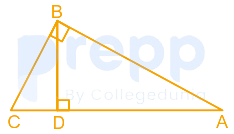
ABC is a triangle right angled at B. If AB = 5 cm and BC = 10 cm, then what is the length of the perpendicular drawn from the vertex B to the hypotenuse?
Which one of the following is correct in respect of a right-angled triangle?
Consider the following statements:
1. The perimeter of a triangle is greater than the sum of its three medians.
2. In any triangle ABC, if D is any point on BC, then AB + BC + CA > 2AD.
Which of the above statements is/are correct?Consider the following inequalities in respect of any triangle ABC:
1. AC - AB < BC
2. BC - AC < AB
3. AB - BC < AC
Which of the above are correct?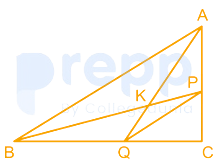
ABC is a triangle right angled at C as shown in the figure below. Which one of the following is correct?
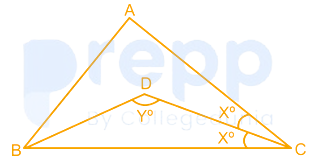
In the figure given below, ∠A = 80° and ∠ABC = 60°, BD and CD bisects angles B and C respectively. What are the values of x and y respectively?
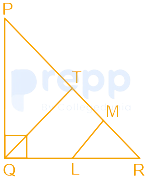
In the figure given below, PQR is a non-isosceles right-angles triangle, right angled at Q. If LM and QT are parallel and QT = PT, then what is ∠RLM equal to?
Important Questions from Triangles, Congruence and Similarity
In a $\Delta ABC$, $\angle C = (9/4) \angle B = (3/2) (\angle A+\angle B)$. Find the measure of the angles.
- The areas of two similar triangles $\Delta$XYZ and $\Delta$LMN are 49 cm$^2$ and 9 cm$^2$, respectively. If LM = 9 cm, then the length of XY is:
Triangles \(PQR\) and \(ABC\) are similar triangles. Triangle \(ABC\) have the following sides
\(AB = 12 \text{ cm}\),
\(AC = 15 \text{ cm}\),
\(CB = 21 \text{ cm}\).
Triangle \(PQR\) have the following sides:
\(PQ = 4 \text{ cm}\),
\(RQ = 7 \text{ cm}\).
What is the length of side \(PR\)?
For a pair of similar triangles, the angles made at \(Q\) is same in both the triangles \(PQR\) and \(LQJ\).
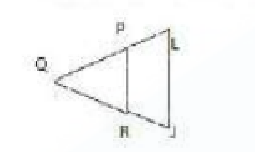
If the length of side \(QJ\) is 10 cm and \(QR\) is 5 cm, what is the ratio of their total areas?- In $\Delta ABC$ $\overline{PQ} \parallel \overline{AB}$. P and Q are on BC and CA respectively. If CQ : QA = 1 : 3 and CP = 4, then what is the value of BC?



