
Consider the following inequalities in respect of any triangle ABC: 1. AC - AB < BC 2. BC - AC < AB 3. AB - BC < AC
1, 2 and 3
Understanding Triangle Inequalities
The question asks us to identify which of the given inequalities hold true for any triangle ABC. These inequalities relate the lengths of the sides of a triangle. Let the lengths of the sides BC, AC, and AB be denoted by \(a\), \(b\), and \(c\) respectively.
The Triangle Inequality Theorem
A fundamental principle in geometry is the Triangle Inequality Theorem. It states that the sum of the lengths of any two sides of a triangle must be greater than the length of the third side. For triangle ABC with side lengths \(a\), \(b\), and \(c\), the theorem can be written as:
- \(a + b > c\)
- \(a + c > b\)
- \(b + c > a\)
Difference Inequality derived from Triangle Inequality
A direct consequence of the Triangle Inequality Theorem is that the difference between the lengths of any two sides of a triangle must be less than the length of the third side. We can see this by rearranging the basic inequalities.
Consider the inequality \(a + c > b\). If we subtract \(c\) from both sides, we get \(a > b - c\). This tells us that side \(a\) (BC) is greater than the difference between side \(b\) (AC) and side \(c\) (AB). This can also be written as \(b - c < a\).
Similarly, from \(b + c > a\), subtracting \(c\) from both sides gives \(b > a - c\), or \(a - c < b\). And from \(a + b > c\), subtracting \(b\) from both sides gives \(a > c - b\), or \(c - b < a\).
We must also consider the absolute difference, because the order of subtraction matters for the sign. For example, \(|b-c| < a\). However, the inequalities given in the question do not use absolute values. Let's analyze the given statements based on the derived inequalities \(b - c < a\), \(a - b < c\), and \(c - a < b\).
Analyzing the Given Inequalities
1. AC - AB < BC
In terms of side lengths \(a, b, c\), this inequality is \(b - c < a\).
From the Triangle Inequality Theorem, we have \(a + c > b\). Subtracting \(c\) from both sides gives \(a > b - c\). This is exactly the inequality \(b - c < a\). So, this statement is correct.
2. BC - AC < AB
In terms of side lengths \(a, b, c\), this inequality is \(a - b < c\).
From the Triangle Inequality Theorem, we have \(b + c > a\). Subtracting \(b\) from both sides gives \(c > a - b\). This is exactly the inequality \(a - b < c\). So, this statement is correct.
3. AB - BC < AC
In terms of side lengths \(a, b, c\), this inequality is \(c - a < b\).
From the Triangle Inequality Theorem, we have \(a + b > c\). Subtracting \(a\) from both sides gives \(b > c - a\). This is exactly the inequality \(c - a < b\). So, this statement is correct.
All three given inequalities are correct deductions from the Triangle Inequality Theorem.
| Sides Compared | Sum Inequality | Difference Inequality | Corresponding Given Inequality |
|---|---|---|---|
| AB, AC vs BC (\(c, b\) vs \(a\)) | \(c + b > a\) | \(|c - b| < a\) or \(c - b < a\) and \(b - c < a\) | AC - AB < BC (\(b - c < a\)) - Statement 1 |
| BC, AC vs AB (\(a, b\) vs \(c\)) | \(a + b > c\) | \(|a - b| < c\) or \(a - b < c\) and \(b - a < c\) | BC - AC < AB (\(a - b < c\)) - Statement 2 |
| AB, BC vs AC (\(c, a\) vs \(b\)) | \(c + a > b\) | \(|c - a| < b\) or \(c - a < b\) and \(a - c < b\) | AB - BC < AC (\(c - a < b\)) - Statement 3 |
Based on the analysis, all three inequalities (1, 2, and 3) are correct for any triangle ABC.
Revision Table: Triangle Side Relationships
| Theorem | Relationship | Explanation |
|---|---|---|
| Triangle Inequality (Sum Form) | Sum of any two sides > Third side | Example: \(AB + AC > BC\) (\(c + b > a\)) |
| Triangle Inequality (Difference Form) | Difference of any two sides < Third side | Example: \(|AC - AB| < BC\) (\(|b - c| < a\)) which implies \(b-c < a\) and \(c-b < a\). |
Additional Information on Triangle Properties
The triangle inequality is a fundamental concept that helps define what can form a triangle. If the sum of the lengths of two sides is equal to or less than the length of the third side, the three segments cannot form a triangle; they would either form a degenerate triangle (collinear points) or not connect at all.
The difference form of the triangle inequality, \(|x - y| < z\), where \(x, y, z\) are side lengths, is often taught as a combined rule. This single inequality \(|x - y| < z\) is equivalent to stating both \(x - y < z\) and \(y - x < z\). The statements in the question are specific forms of the difference inequality focusing on one order of subtraction, which are directly derived from the sum form.
Similar Questions
ABC is a triangle right angled at A and AD is perpendicular to BC, If BD = 8 cm and DC = 12.5 cm, then what is AD equal to?
If ABC is a right-angled triangle with AC as its hypotenuse, then which one of the following is correct?
In the figure given below, ABC is a triangle with AB perpendicular to BC. Further BD is perpendicular to AC. If AD = 9 cm and DC = 4 cm, then what is the length of BD?
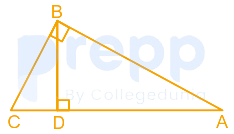
ABC is a triangle right angled at B. If AB = 5 cm and BC = 10 cm, then what is the length of the perpendicular drawn from the vertex B to the hypotenuse?
Which one of the following is correct in respect of a right-angled triangle?
Consider the following statements:
1. The perimeter of a triangle is greater than the sum of its three medians.
2. In any triangle ABC, if D is any point on BC, then AB + BC + CA > 2AD.
Which of the above statements is/are correct?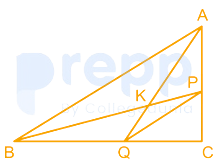
ABC is a triangle right angled at C as shown in the figure below. Which one of the following is correct?
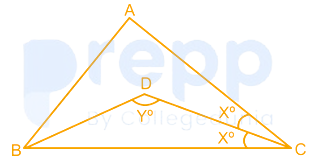
In the figure given below, ∠A = 80° and ∠ABC = 60°, BD and CD bisects angles B and C respectively. What are the values of x and y respectively?
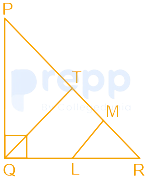
In the figure given below, PQR is a non-isosceles right-angles triangle, right angled at Q. If LM and QT are parallel and QT = PT, then what is ∠RLM equal to?
In an equilateral triangle ABC, BD is drawn perpendicular to AC. What is BD 2equal to?
Important Questions from Triangles, Congruence and Similarity
In a $\Delta ABC$, $\angle C = (9/4) \angle B = (3/2) (\angle A+\angle B)$. Find the measure of the angles.
- The areas of two similar triangles $\Delta$XYZ and $\Delta$LMN are 49 cm$^2$ and 9 cm$^2$, respectively. If LM = 9 cm, then the length of XY is:
Triangles \(PQR\) and \(ABC\) are similar triangles. Triangle \(ABC\) have the following sides
\(AB = 12 \text{ cm}\),
\(AC = 15 \text{ cm}\),
\(CB = 21 \text{ cm}\).
Triangle \(PQR\) have the following sides:
\(PQ = 4 \text{ cm}\),
\(RQ = 7 \text{ cm}\).
What is the length of side \(PR\)?
For a pair of similar triangles, the angles made at \(Q\) is same in both the triangles \(PQR\) and \(LQJ\).
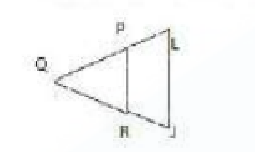
If the length of side \(QJ\) is 10 cm and \(QR\) is 5 cm, what is the ratio of their total areas?- In $\Delta ABC$ $\overline{PQ} \parallel \overline{AB}$. P and Q are on BC and CA respectively. If CQ : QA = 1 : 3 and CP = 4, then what is the value of BC?



