
1. Gajapati – Name of a powerful Dynasty in Orissa
2. Ashvapati – Deccan Sultans
3. Narapati – Rayas of Vijayanagara
Which of the above pairs is/are correctly matched?
Historical Titles: Gajapati, Ashvapati, and Narapati
This question requires matching specific historical titles – Gajapati, Ashvapati, and Narapati – with the corresponding rulers or dynasties they represent. Let's analyze each pair:
1. Gajapati – Name of a powerful Dynasty in Orissa
The title 'Gajapati' literally translates to 'Lord of Elephants' (Gaja means elephant, Pati means lord). This title was famously associated with the ruling dynasties of the historical region of Orissa (modern-day Odisha). Notably, the Suryavanshi Gajapati dynasty ruled this region from the 15th century onwards, and the title emphasized their military strength, particularly their large elephant corps. Therefore, this match is correct.
2. Ashvapati – Deccan Sultans
The title 'Ashvapati' means 'Lord of Horses' (Ashva means horse, Pati means lord). Horses were vital for cavalry warfare during medieval times. The Deccan Sultanates, which emerged after the decline of the Bahmani Sultanate, relied significantly on well-trained cavalry. While not a universal title for all Deccan Sultans, it represents a relevant aspect of their military power and regional significance where horse breeding and cavalry were prominent. Thus, this association is considered correct in a broader historical context.
3. Narapati – Rayas of Vijayanagara
'Narapati' translates to 'Lord of Men' (Nara means man/human, Pati means lord). This title was often used for powerful emperors who ruled over vast territories and numerous subjects. The Rayas of the Vijayanagara Empire, a dominant power in South India from the 14th to the 17th century, were indeed rulers of men and commanded large populations and armies. Therefore, this match is also accurate.
Conclusion on Matched Pairs
Based on the historical significance and common usage of these titles:
- Gajapati accurately refers to rulers associated with powerful dynasties in Orissa.
- Ashvapati correctly relates to the importance of cavalry and horses, relevant to the military structure of the Deccan Sultans.
- Narapati is a fitting title for the Rayas, the rulers of the expansive Vijayanagara Empire.
Since all three pairs are historically justifiable associations, the correct conclusion is that all the given pairs are correctly matched.
Similar Questions
- Which one of the following rivers is also known by the name of "Dihang" in Northeast India ?
Which one of the following statements regarding S-waves is not correct?
What is the correct sequence of the following mountain ranges as one moves from North towards South?
- 1. Karakoram
- 2. Kunlun
- 3. Ladakh
- 4. Zaskar
Select the answer using the code given below :
- Which of the following statements regarding Arc Volcanoes is/are correct?
1. Arc volcanoes are found near divergent plate boundaries.
2. Some of the world's classical examples of cone-shaped stratovolcanoes, such as Mount Fuji in Japan, Mayon in the Philippines are Arc volcanoes.
3. Some of the highest volcanoes on Earth are of the Arc type, notably Nevado Ojos del Salado in the Chilean Andes.
Select the answer using the code given below:
Important Questions from Drainage System of India
With reference to river Teesta, consider the following statements:
1. The source of river Teesta is the same as that of Brahmaputra but it flows through Sikkim.
2. River Rangeet originates in Sikkim and it is a tributary of river Teesta.
3. River Teesta falls into Bay of Bengal at the border of India and Bangladesh.
Which of the statements given above is/are correct?
Consider the following rivers:
(1) Barak
(2) Lohit
(3) Subansiri
Which of the above flows/flow through Arunachal Pradesh?
Consider the following pairs:
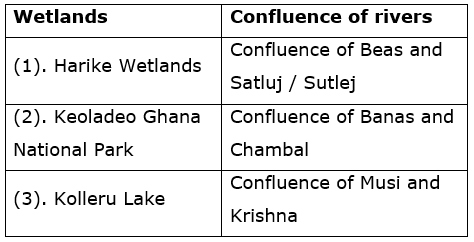
Which of the above pairs is/are correctly matched?
- Which river system is known for forming gorges in the Himalayan region?
- Which of the following rivers originates in the Western Ghats?



