
Which one of the following statements regarding S-waves is not correct?
Understanding Seismic S-waves
Seismic waves are vibrations that travel through the Earth, usually caused by earthquakes, volcanic eruptions, or other explosions. There are two main types of body waves that travel through the Earth's interior: P-waves (Primary waves) and S-waves (Secondary waves). This question asks us to identify the statement about S-waves that is *not correct*.
Analyzing S-wave Properties and Behavior
Let's examine each statement:
-
Statement 1: S-waves are slower than P-waves.
This statement is correct. P-waves are the fastest seismic waves and arrive first at seismograph stations. S-waves are slower and arrive after the P-waves. P-waves typically travel about 1.7 times faster than S-waves.
-
Statement 2: During an earthquake S-waves are less destructive to structures like buildings and highway overpasses.
This statement is not correct. S-waves cause the ground to move side-to-side or up-and-down, perpendicular to the direction the wave is traveling. This type of shearing motion is much more damaging to buildings and infrastructure than the compressional motion of P-waves. Buildings are generally designed to withstand vertical forces but are less stable when subjected to strong horizontal shaking caused by S-waves. Therefore, S-waves are often *more* destructive than P-waves.
-
Statement 3: S-waves can travel only through solids and cannot travel through the Earth's outer core.
This statement is correct. S-waves are shear waves, meaning they require a solid medium to propagate because the particles must be able to resist shear forces. Liquids and gases cannot support shear forces, so S-waves cannot travel through them. The Earth's outer core is known to be liquid.
-
Statement 4: Seismologists have concluded that the Earth's outer core must be liquid or fluid.
This statement is correct. The observation that S-waves (which cannot travel through liquids) do not pass through the Earth's deep interior, while P-waves (which can travel through solids and liquids) do, provided key evidence that the Earth's outer core is liquid.
Conclusion on Incorrect S-wave Statement
Based on the analysis, the statement that is incorrect regarding S-waves is the claim that they are less destructive. In reality, the side-to-side shaking caused by S-waves poses a significant threat to structures during earthquakes.
Similar Questions
- Consider the following pairs :
1. Gajapati – Name of a powerful Dynasty in Orissa
2. Ashvapati – Deccan Sultans
3. Narapati – Rayas of Vijayanagara
Which of the above pairs is/are correctly matched? - Which one of the following rivers is also known by the name of "Dihang" in Northeast India ?
What is the correct sequence of the following mountain ranges as one moves from North towards South?
- 1. Karakoram
- 2. Kunlun
- 3. Ladakh
- 4. Zaskar
Select the answer using the code given below :
- Which of the following statements regarding Arc Volcanoes is/are correct?
1. Arc volcanoes are found near divergent plate boundaries.
2. Some of the world's classical examples of cone-shaped stratovolcanoes, such as Mount Fuji in Japan, Mayon in the Philippines are Arc volcanoes.
3. Some of the highest volcanoes on Earth are of the Arc type, notably Nevado Ojos del Salado in the Chilean Andes.
Select the answer using the code given below:
Important Questions from Drainage System of India
With reference to river Teesta, consider the following statements:
1. The source of river Teesta is the same as that of Brahmaputra but it flows through Sikkim.
2. River Rangeet originates in Sikkim and it is a tributary of river Teesta.
3. River Teesta falls into Bay of Bengal at the border of India and Bangladesh.
Which of the statements given above is/are correct?
Consider the following rivers:
(1) Barak
(2) Lohit
(3) Subansiri
Which of the above flows/flow through Arunachal Pradesh?
Consider the following pairs:
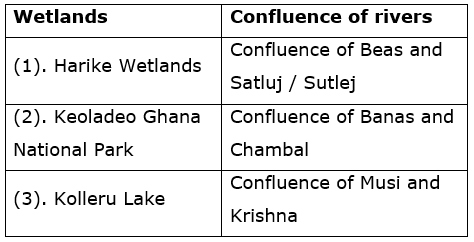
Which of the above pairs is/are correctly matched?
- Which river system is known for forming gorges in the Himalayan region?
- Which of the following rivers originates in the Western Ghats?



