
Triangles \(PQR\) and \(ABC\) are similar triangles. Triangle \(ABC\) have the following sides \(AB = 12 \text{ cm}\), \(AC = 15 \text{ cm}\), \(CB = 21 \text{ cm}\). Triangle \(PQR\) have the following sides: \(PQ = 4 \text{ cm}\), \(RQ = 7 \text{ cm}\). What is the length of side \(PR\)?
Similar Triangles: Finding Side PR Length
We are given two similar triangles, \(PQR\) and \(ABC\). The side lengths for triangle \(ABC\) are \(AB = 12 \text{ cm}\), \(AC = 15 \text{ cm}\), and \(CB = 21 \text{ cm}\). The side lengths for triangle \(PQR\) are \(PQ = 4 \text{ cm}\) and \(RQ = 7 \text{ cm}\). We need to find the length of side \(PR\).
Similarity Ratios
Since triangles \(PQR\) and \(ABC\) are similar (denoted as \(PQR \sim ABC\)), their corresponding sides are in proportion. The correspondence is \(P \leftrightarrow A\), \(Q \leftrightarrow B\), and \(R \leftrightarrow C\). Therefore, the ratios of corresponding sides are equal:
\(\frac{PQ}{AB} = \frac{QR}{BC} = \frac{PR}{AC}\)
Calculating the Ratio Factor
We can use the known sides to find the scale factor between the two triangles.
- Ratio using sides \(PQ\) and \(AB\):
\(\frac{PQ}{AB} = \frac{4 \text{ cm}}{12 \text{ cm}} = \frac{1}{3}\)
- Ratio using sides \(RQ\) (which is the same as \(QR\)) and \(CB\) (which is the same as \(BC\)):
\(\frac{RQ}{CB} = \frac{7 \text{ cm}}{21 \text{ cm}} = \frac{1}{3}\)
Both ratios confirm the scale factor is \(\frac{1}{3}\). Triangle \(PQR\) is smaller than triangle \(ABC\).
Finding the Length of PR
Now we use the similarity ratio involving the side \(PR\) and its corresponding side \(AC\):
\(\frac{PR}{AC} = \frac{1}{3}\)
Substitute the known length of \(AC = 15 \text{ cm}\):
\(\frac{PR}{15 \text{ cm}} = \frac{1}{3}\)
To find \(PR\), multiply both sides by \(15 \text{ cm}\):
\(PR = \frac{1}{3} \times 15 \text{ cm}\)
\(PR = 5 \text{ cm}\)
Thus, the length of side \(PR\) is \(5 \text{ cm}\).
Similar Questions
- The areas of two similar triangles $\Delta$XYZ and $\Delta$LMN are 49 cm$^2$ and 9 cm$^2$, respectively. If LM = 9 cm, then the length of XY is:
For a pair of similar triangles, the angles made at \(Q\) is same in both the triangles \(PQR\) and \(LQJ\).
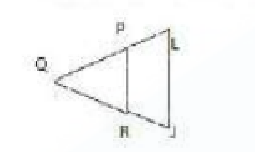
If the length of side \(QJ\) is 10 cm and \(QR\) is 5 cm, what is the ratio of their total areas?- \(\Delta OPQ\) is similar to \(\Delta RST\). If the ratio of OP : RS is 3 : 5 and if PQ = 6 cm, then the length of ST is:
- Which of the following is the property of similar triangle?
- If in triangle \(\Delta\text{ABC}\) \(\text{AB}= 2\text{cm}\), \(\text{BC}=4\text{cm}\), and \(\text{AC}= 5\text{ cm}\) and in triangle \(\Delta\text{PQR}\) \(\text{PQ}= 12\text{cm}\), \(\text{QR}= 24\text{ cm}\), and \(\text{PR}=30\text{ cm}\), then triangles are:
- Two triangle are called similar if
- The areas of two similar triangles \(\Delta XYZ\) and \(\Delta LMN\) are \(49\ cm^2\) and \(9\ cm^2\), respectively. If LM = 9 cm, then the length of XY is:
Important Questions from Triangles, Congruence and Similarity
In a $\Delta ABC$, $\angle C = (9/4) \angle B = (3/2) (\angle A+\angle B)$. Find the measure of the angles.
- The areas of two similar triangles $\Delta$XYZ and $\Delta$LMN are 49 cm$^2$ and 9 cm$^2$, respectively. If LM = 9 cm, then the length of XY is:
For a pair of similar triangles, the angles made at \(Q\) is same in both the triangles \(PQR\) and \(LQJ\).
If the length of side \(QJ\) is 10 cm and \(QR\) is 5 cm, what is the ratio of their total areas?- In $\Delta ABC$ $\overline{PQ} \parallel \overline{AB}$. P and Q are on BC and CA respectively. If CQ : QA = 1 : 3 and CP = 4, then what is the value of BC?
- The altitudes of two similar triangles are 4 cm and 6 cm. If the area of the larger triangle is $36\text{ cm}^2$, what will be the area of the other one?



