
Solving Similar Triangles Length Problem
The problem states that \(\Delta OPQ\) is similar to \(\Delta RST\). This means their corresponding sides are in the same ratio.
Triangle Similarity Properties
- Similarity implies that the ratio of corresponding sides is equal.
- Given: \(\Delta OPQ \sim \Delta RST\).
- Given ratio of corresponding sides: \(\frac{OP}{RS} = \frac{3}{5}\).
- The corresponding sides are OP \(\leftrightarrow\) RS, PQ \(\leftrightarrow\) ST, and OQ \(\leftrightarrow\) RT.
Calculating the Length of ST
Since the triangles are similar, the ratio of sides PQ and ST must be equal to the ratio of sides OP and RS:
\(\frac{PQ}{ST} = \frac{OP}{RS}\)We are given:
- PQ = 6 cm
- \(\frac{OP}{RS} = \frac{3}{5}\)
Substitute the known values into the proportion:
\(\frac{6 \text{ cm}}{ST} = \frac{3}{5}\)To solve for ST, cross-multiply:
\(6 \text{ cm} \times 5 = 3 \times ST\) \(30 \text{ cm} = 3 \times ST\)Now, divide by 3 to find ST:
\(ST = \frac{30 \text{ cm}}{3}\) \(ST = 10 \text{ cm}\)Therefore, the length of ST is 10 cm.
Similar Questions
- The areas of two similar triangles $\Delta$XYZ and $\Delta$LMN are 49 cm$^2$ and 9 cm$^2$, respectively. If LM = 9 cm, then the length of XY is:
Triangles \(PQR\) and \(ABC\) are similar triangles. Triangle \(ABC\) have the following sides
\(AB = 12 \text{ cm}\),
\(AC = 15 \text{ cm}\),
\(CB = 21 \text{ cm}\).
Triangle \(PQR\) have the following sides:
\(PQ = 4 \text{ cm}\),
\(RQ = 7 \text{ cm}\).
What is the length of side \(PR\)?
For a pair of similar triangles, the angles made at \(Q\) is same in both the triangles \(PQR\) and \(LQJ\).
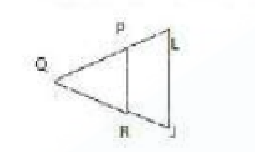
If the length of side \(QJ\) is 10 cm and \(QR\) is 5 cm, what is the ratio of their total areas?- Which of the following is the property of similar triangle?
- If in triangle \(\Delta\text{ABC}\) \(\text{AB}= 2\text{cm}\), \(\text{BC}=4\text{cm}\), and \(\text{AC}= 5\text{ cm}\) and in triangle \(\Delta\text{PQR}\) \(\text{PQ}= 12\text{cm}\), \(\text{QR}= 24\text{ cm}\), and \(\text{PR}=30\text{ cm}\), then triangles are:
- Two triangle are called similar if
- The areas of two similar triangles \(\Delta XYZ\) and \(\Delta LMN\) are \(49\ cm^2\) and \(9\ cm^2\), respectively. If LM = 9 cm, then the length of XY is:
Important Questions from Triangles, Congruence and Similarity
G is the centroid of the equilateral triangle ABC. If AB = 8√ 3 cm, then the length of AG is equal to:
If sides of a triangle are 12 cm, 15 cm and 21 cm, then what is the inradius (in cm) of the triangle?
What is the area of quadrilateral ABCD?
It is given that ΔABC ~ ΔXYZ and Area ΔABC : Area ΔXYZ = 81 : 25. If AB = 18 cm, BC = 10 cm, CA = 15 cm, then what is the side XZ (in cm)?
Sides of two similar triangles are in the ratio 4 ∶ 9. Area of these triangles are in the ratio:



