
Understanding Similar Triangles
Two triangles are considered similar if their corresponding angles are equal and the ratio of their corresponding sides is constant. This means they have the same shape but not necessarily the same size.
Angle-Angle (AA) Similarity Criterion
A fundamental rule for determining similarity is the Angle-Angle (AA) criterion. This rule states that if two angles in one triangle are equal to two corresponding angles in another triangle, then the triangles must be similar.
For example, consider two triangles, \(\triangle ABC\) and \(\triangle DEF\). If:
- \(\angle A = \angle D\)
- \(\angle B = \angle E\)
Then, because the sum of angles in any triangle is \(180^\circ\), the third angles must also be equal (\(\angle C = \angle F\)). Consequently, \(\triangle ABC\) is similar to \(\triangle DEF\) (\(\triangle ABC \sim \triangle DEF\)).
Evaluating the Options
-
Option 1: No angles of two triangles are equal
This is incorrect. For similarity, corresponding angles must be equal.
-
Option 2: One angle and one side is equal to another triangle angle and side
This condition relates to triangle congruence (like SAS or ASA criteria), not similarity. Similarity requires angle equality and side proportionality.
-
Option 3: The two angles of one triangle are equal to the two angles of the other triangle
This directly matches the Angle-Angle (AA) similarity criterion. Having two equal corresponding angles is sufficient to establish similarity.
-
Option 4: No sides are equal
This is incorrect. While sides don't have to be equal in length for similarity, they must be proportional (i.e., the ratio of corresponding side lengths must be constant).
Based on the AA similarity postulate, the correct condition for two triangles to be similar is that two pairs of corresponding angles are equal.
Similar Questions
- The areas of two similar triangles $\Delta$XYZ and $\Delta$LMN are 49 cm$^2$ and 9 cm$^2$, respectively. If LM = 9 cm, then the length of XY is:
Triangles \(PQR\) and \(ABC\) are similar triangles. Triangle \(ABC\) have the following sides
\(AB = 12 \text{ cm}\),
\(AC = 15 \text{ cm}\),
\(CB = 21 \text{ cm}\).
Triangle \(PQR\) have the following sides:
\(PQ = 4 \text{ cm}\),
\(RQ = 7 \text{ cm}\).
What is the length of side \(PR\)?
For a pair of similar triangles, the angles made at \(Q\) is same in both the triangles \(PQR\) and \(LQJ\).
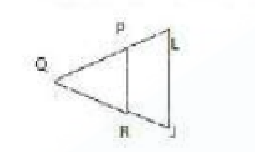
If the length of side \(QJ\) is 10 cm and \(QR\) is 5 cm, what is the ratio of their total areas?- \(\Delta OPQ\) is similar to \(\Delta RST\). If the ratio of OP : RS is 3 : 5 and if PQ = 6 cm, then the length of ST is:
- Which of the following is the property of similar triangle?
- If in triangle \(\Delta\text{ABC}\) \(\text{AB}= 2\text{cm}\), \(\text{BC}=4\text{cm}\), and \(\text{AC}= 5\text{ cm}\) and in triangle \(\Delta\text{PQR}\) \(\text{PQ}= 12\text{cm}\), \(\text{QR}= 24\text{ cm}\), and \(\text{PR}=30\text{ cm}\), then triangles are:
- The areas of two similar triangles \(\Delta XYZ\) and \(\Delta LMN\) are \(49\ cm^2\) and \(9\ cm^2\), respectively. If LM = 9 cm, then the length of XY is:
Important Questions from Triangles, Congruence and Similarity
G is the centroid of the equilateral triangle ABC. If AB = 8√ 3 cm, then the length of AG is equal to:
If sides of a triangle are 12 cm, 15 cm and 21 cm, then what is the inradius (in cm) of the triangle?
What is the area of quadrilateral ABCD?
It is given that ΔABC ~ ΔXYZ and Area ΔABC : Area ΔXYZ = 81 : 25. If AB = 18 cm, BC = 10 cm, CA = 15 cm, then what is the side XZ (in cm)?
Sides of two similar triangles are in the ratio 4 ∶ 9. Area of these triangles are in the ratio:



