
Similar Triangle Property Explained
Similar triangles share the same shape, meaning their corresponding angles are equal and their corresponding sides are proportional. Understanding their specific properties is key in geometry.
Evaluating Properties of Similar Triangles
-
Option 1: All angles are double to corresponding angles.
This is incorrect. A defining characteristic of similar triangles is that their corresponding angles are equal, not doubled. -
Option 2: All sides in both triangles are equal.
This describes congruent triangles. Similar triangles have sides that are proportional, meaning one triangle's sides are a constant multiple of the other's, but not necessarily equal. -
Option 3: The ratio of the area of both triangles is proportional to the square of the ratio of their corresponding sides.
This is a correct and fundamental property. If two triangles are similar, the ratio of their areas equals the square of the ratio between any pair of corresponding sides. The formula is expressed as:\(\frac{\text{Area}_1}{\text{Area}_2} = \left(\frac{\text{Side}_1}{\text{Side}_2}\right)^2\)
This statement accurately reflects this geometric theorem. -
Option 4: The areas of both triangles are equal.
This is not a necessary property of similar triangles. While their areas can be equal (if they are also congruent), they are generally different and related by the ratio of the squares of their sides.
Identifying the Correct Similar Triangle Property
The essential property distinguishing similar triangles among the choices provided is the relationship between their areas and the squares of their corresponding sides.
Similar Questions
- The areas of two similar triangles $\Delta$XYZ and $\Delta$LMN are 49 cm$^2$ and 9 cm$^2$, respectively. If LM = 9 cm, then the length of XY is:
Triangles \(PQR\) and \(ABC\) are similar triangles. Triangle \(ABC\) have the following sides
\(AB = 12 \text{ cm}\),
\(AC = 15 \text{ cm}\),
\(CB = 21 \text{ cm}\).
Triangle \(PQR\) have the following sides:
\(PQ = 4 \text{ cm}\),
\(RQ = 7 \text{ cm}\).
What is the length of side \(PR\)?
For a pair of similar triangles, the angles made at \(Q\) is same in both the triangles \(PQR\) and \(LQJ\).
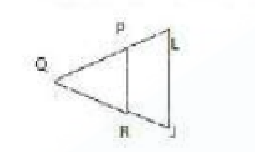
If the length of side \(QJ\) is 10 cm and \(QR\) is 5 cm, what is the ratio of their total areas?- \(\Delta OPQ\) is similar to \(\Delta RST\). If the ratio of OP : RS is 3 : 5 and if PQ = 6 cm, then the length of ST is:
- If in triangle \(\Delta\text{ABC}\) \(\text{AB}= 2\text{cm}\), \(\text{BC}=4\text{cm}\), and \(\text{AC}= 5\text{ cm}\) and in triangle \(\Delta\text{PQR}\) \(\text{PQ}= 12\text{cm}\), \(\text{QR}= 24\text{ cm}\), and \(\text{PR}=30\text{ cm}\), then triangles are:
- Two triangle are called similar if
- The areas of two similar triangles \(\Delta XYZ\) and \(\Delta LMN\) are \(49\ cm^2\) and \(9\ cm^2\), respectively. If LM = 9 cm, then the length of XY is:
Important Questions from Triangles, Congruence and Similarity
G is the centroid of the equilateral triangle ABC. If AB = 8√ 3 cm, then the length of AG is equal to:
If sides of a triangle are 12 cm, 15 cm and 21 cm, then what is the inradius (in cm) of the triangle?
What is the area of quadrilateral ABCD?
It is given that ΔABC ~ ΔXYZ and Area ΔABC : Area ΔXYZ = 81 : 25. If AB = 18 cm, BC = 10 cm, CA = 15 cm, then what is the side XZ (in cm)?
Sides of two similar triangles are in the ratio 4 ∶ 9. Area of these triangles are in the ratio:



