
In a $\Delta ABC$, $\angle C = (9/4) \angle B = (3/2) (\angle A+\angle B)$. Find the measure of the angles.
$\angle A=22^{\circ}$, $\angle B = 44^{\circ}$, $\angle C=114^{\circ}$
Triangle Angle Relationships: Given Conditions
We are given a triangle, $\Delta ABC$, with the following angle relationships:
- Condition 1: $\angle C = \frac{9}{4} \angle B$
- Condition 2: $\angle C = \frac{3}{2} (\angle A+\angle B)$
- Fundamental Property: The sum of angles in any triangle is $180^{\circ}$, so $\angle A + \angle B + \angle C = 180^{\circ}$.
Solving Angle Equations for ΔABC
First, let's express $\angle B$ in terms of $\angle C$ using Condition 1:
$\angle C = \frac{9}{4} \angle B \implies \angle B = \frac{4}{9} \angle C$
Next, rearrange Condition 2:
$\frac{2}{3} \angle C = \angle A + \angle B$
Substitute the expression for $\angle B$ (from Condition 1) into this rearranged equation:
$\frac{2}{3} \angle C = \angle A + \frac{4}{9} \angle C$
Now, isolate $\angle A$ by moving the $\angle B$ term to the other side:
$\angle A = \frac{2}{3} \angle C - \frac{4}{9} \angle C$
To subtract, find a common denominator:
$\angle A = \frac{6}{9} \angle C - \frac{4}{9} \angle C = \frac{2}{9} \angle C$
Calculating Angle C Value
Utilize the Triangle Sum Property: $\angle A + \angle B + \angle C = 180^{\circ}$. Substitute the expressions we found for $\angle A$ and $\angle B$ in terms of $\angle C$:
$\frac{2}{9} \angle C + \frac{4}{9} \angle C + \angle C = 180^{\circ}$
Combine the terms with $\angle C$:
$(\frac{2}{9} + \frac{4}{9} + \frac{9}{9}) \angle C = 180^{\circ}$
$\frac{15}{9} \angle C = 180^{\circ}$
Simplify the fraction $\frac{15}{9}$ to $\frac{5}{3}$:
$\frac{5}{3} \angle C = 180^{\circ}$
Solve for $\angle C$:
$\angle C = 180^{\circ} \times \frac{3}{5} = 36^{\circ} \times 3 = 108^{\circ}$
Finding Angles A and B
With the value of $\angle C$, we can now find $\angle B$ using its relationship with $\angle C$:
$\angle B = \frac{4}{9} \angle C = \frac{4}{9} \times 108^{\circ} = 4 \times 12^{\circ} = 48^{\circ}$
Similarly, find $\angle A$ using its relationship with $\angle C$:
$\angle A = \frac{2}{9} \angle C = \frac{2}{9} \times 108^{\circ} = 2 \times 12^{\circ} = 24^{\circ}$
Final Angle Measures for ΔABC
The measures of the angles in $\Delta ABC$ are:
$\angle A = 24^{\circ}$
$\angle B = 48^{\circ}$
$\angle C = 108^{\circ}$
Verification: $24^{\circ} + 48^{\circ} + 108^{\circ} = 180^{\circ}$. The sum is correct.
Important Questions from Triangles, Congruence and Similarity
- The areas of two similar triangles $\Delta$XYZ and $\Delta$LMN are 49 cm$^2$ and 9 cm$^2$, respectively. If LM = 9 cm, then the length of XY is:
Triangles \(PQR\) and \(ABC\) are similar triangles. Triangle \(ABC\) have the following sides
\(AB = 12 \text{ cm}\),
\(AC = 15 \text{ cm}\),
\(CB = 21 \text{ cm}\).
Triangle \(PQR\) have the following sides:
\(PQ = 4 \text{ cm}\),
\(RQ = 7 \text{ cm}\).
What is the length of side \(PR\)?
For a pair of similar triangles, the angles made at \(Q\) is same in both the triangles \(PQR\) and \(LQJ\).
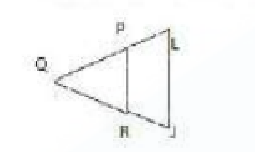
If the length of side \(QJ\) is 10 cm and \(QR\) is 5 cm, what is the ratio of their total areas?- In $\Delta ABC$ $\overline{PQ} \parallel \overline{AB}$. P and Q are on BC and CA respectively. If CQ : QA = 1 : 3 and CP = 4, then what is the value of BC?
- The altitudes of two similar triangles are 4 cm and 6 cm. If the area of the larger triangle is $36\text{ cm}^2$, what will be the area of the other one?


