
ABC is an isosceles right angle triangle. Angle ABC = 90 degree and AB = 12 cm. What is the ratio of the radius of the circle inscribed in it to the radius of the circle circumscribing triangle ABC ?
Solving the Isosceles Right Angle Triangle Problem
We are given an isosceles right angle triangle ABC, where the angle at B is 90 degrees, and the side AB is 12 cm. In an isosceles right angle triangle, the two sides forming the right angle are equal in length. Therefore, BC must also be equal to AB.
- Given: $\angle ABC = 90^\circ$
- Given: $AB = 12$ cm
- Since triangle ABC is isosceles and right-angled at B, $BC = AB = 12$ cm.
Calculating the Hypotenuse Length
To find the radii of the inscribed and circumscribing circles, we first need to find the length of the hypotenuse AC. We can use the Pythagorean theorem since it's a right-angled triangle.
According to the Pythagorean theorem:
$\quad AC^2 = AB^2 + BC^2$
Substituting the values of AB and BC:
$\quad AC^2 = 12^2 + 12^2$
$\quad AC^2 = 144 + 144$
$\quad AC^2 = 288$
Now, we find the square root of 288:
$\quad AC = \sqrt{288} = \sqrt{144 \times 2} = 12\sqrt{2}$ cm.
So, the length of the hypotenuse AC is $12\sqrt{2}$ cm.
Determining the Radius of the Inscribed Circle (Inradius)
For a right-angled triangle with legs of length 'a' and 'b' and hypotenuse 'c', the radius of the inscribed circle (inradius), denoted by 'r', is given by the formula:
$\quad r = \frac{a + b - c}{2}$
In our triangle ABC, the legs are AB = 12 cm and BC = 12 cm, and the hypotenuse is AC = $12\sqrt{2}$ cm.
Substituting these values into the formula:
$\quad r = \frac{12 + 12 - 12\sqrt{2}}{2}$
$\quad r = \frac{24 - 12\sqrt{2}}{2}$
Now, divide both terms in the numerator by 2:
$\quad r = 12 - 6\sqrt{2}$ cm.
Determining the Radius of the Circumscribing Circle (Circumradius)
For a right-angled triangle, the center of the circumscribing circle (circumcenter) is located exactly at the midpoint of the hypotenuse. The radius of the circumscribing circle (circumradius), denoted by 'R', is half the length of the hypotenuse.
The hypotenuse AC is $12\sqrt{2}$ cm.
The formula for the circumradius of a right-angled triangle is:
$\quad R = \frac{\text{Hypotenuse}}{2}$
Substituting the length of AC:
$\quad R = \frac{12\sqrt{2}}{2}$
$\quad R = 6\sqrt{2}$ cm.
Calculating the Ratio of Inradius to Circumradius
We need to find the ratio of the radius of the inscribed circle (r) to the radius of the circumscribing circle (R), which is r : R.
We found that $r = 12 - 6\sqrt{2}$ and $R = 6\sqrt{2}$.
The ratio is: $(12 - 6\sqrt{2}) : (6\sqrt{2})$
To simplify this ratio, we can divide both parts by the greatest common divisor of the coefficients, which is 6.
Divide the first part by 6: $\frac{12 - 6\sqrt{2}}{6} = \frac{12}{6} - \frac{6\sqrt{2}}{6} = 2 - \sqrt{2}$.
Divide the second part by 6: $\frac{6\sqrt{2}}{6} = \sqrt{2}$.
So, the simplified ratio is $(2 - \sqrt{2}) : \sqrt{2}$.
Let's check the given options:
Option 1: $6 - \sqrt{2} : 3\sqrt{2}$
Option 2: $2 - \sqrt{2} : \sqrt{2}$
Option 3: $6 - 3\sqrt{2} : 1\sqrt{2}$ (Can be simplified by dividing by 3: $2 - \sqrt{2} : \frac{\sqrt{2}}{3}$) - Incorrect
Option 4: $6 - 3\sqrt{2} : 6\sqrt{2}$ (Can be simplified by dividing by 3: $2 - \sqrt{2} : 2\sqrt{2}$) - Incorrect
Our calculated ratio $(2 - \sqrt{2}) : \sqrt{2}$ matches Option 2.
Revision Table: Formulas for Right-Angled Triangles
| Concept | Formula (Legs a, b; Hypotenuse c) |
|---|---|
| Pythagorean Theorem | $a^2 + b^2 = c^2$ |
| Inradius (r) | $r = \frac{a + b - c}{2}$ |
| Circumradius (R) | $R = \frac{c}{2}$ |
Additional Information: Incenter and Circumcenter
- The incenter of any triangle is the point where the angle bisectors meet. It is the center of the inscribed circle.
- The circumcenter of any triangle is the point where the perpendicular bisectors of the sides meet. It is the center of the circumscribing circle.
- For a right-angled triangle:
- The incenter is inside the triangle.
- The circumcenter is always at the midpoint of the hypotenuse.
- For an isosceles right-angled triangle, the incenter lies on the altitude from the right angle to the hypotenuse (which is also the median and angle bisector).
Similar Questions
If sides of a triangle are 12 cm, 15 cm and 21 cm, then what is the inradius (in cm) of the triangle?
In ΔPQR, PQ = PR and S is a point on QR such that ∠PSQ = 96° + ∠QPS and ∠QPR = 132°. What is the measure of ∠PSR?
If ∆ABC ~ ∆EDF such that AB = 6 cm, DF = 16 cm and DE = 8 cm, then the length of BC is:
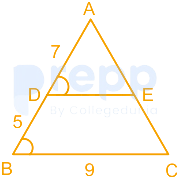
In ΔABC, D and E are the points on sides AB and AC, respectively such that ∠ADE = ∠B. If AD = 7 cm, BD = 5cm and BC = 9 cm, then DE (in cm) is equal to:
In triangle ABC, P and Q are the mid points of AB and AC, respectively. R is a point on PQ such that PR : RQ = 3 : 5 and QR = 20 cm, then what is the length (in cm) of BC?
ΔABC is similar to ΔPQR and AB : PQ = 2 : 3. AD is the median to the side BC in ΔABC and PS is the median to the side QR in ΔPQR. What is the value of (BD/QS) 2?
In a triangle ABC, AB = 12, BC = 18 and AC = 15. The medians AX and BY intersect sides BC and AC at X and Y respectively. If AX and BY intersect each other at O, then what is the value of OX?
Let Δ ABC ∼ Δ RPQ and \(\frac{ar(\Delta ABC)}{ar(\Delta RPQ)}=\frac{16}{25}\) . If PQ = 4 cm, QR = 6 cm and PR = 7 cm, then AC (in cm) is equal to:
In ΔABC, ∠C = 90°, Point P and Q are on the sides AC and BC, respectively, such that AP : PC = BQ : QC = 1 : 2 then, \(\frac{AQ^2+BP^2}{AB^2}\) is equal to:
The area of a ΔABC is one unit. DE is a straight line parallel to BC, joining the points D and E on AB and AC respectively such that AD : DB = 1 : 6. The ratio of the areas of ΔADE and ΔABC is:
Important Questions from Triangles, Congruence and Similarity
G is the centroid of the equilateral triangle ABC. If AB = 8√ 3 cm, then the length of AG is equal to:
If sides of a triangle are 12 cm, 15 cm and 21 cm, then what is the inradius (in cm) of the triangle?
What is the area of quadrilateral ABCD?
It is given that ΔABC ~ ΔXYZ and Area ΔABC : Area ΔXYZ = 81 : 25. If AB = 18 cm, BC = 10 cm, CA = 15 cm, then what is the side XZ (in cm)?
Sides of two similar triangles are in the ratio 4 ∶ 9. Area of these triangles are in the ratio:



