Women’s Share In Assemblies Less Than 10% In 20 States
Relevance: GS1 - Role of women and women’s organization; GS2 - Parliament and State legislatures—structure, functioning, conduct of business, powers & privileges and issues arising out of these.
(Source: The Hindu, 09/21/2023)
Click here for Daily Current Affairs
Why in the news?
- Recently, India’s Parliament took a major step toward reserving 33% of the seats in its lower house and in state legislatures for women to ensure more equal representation.
- Women comprise over 48% of India’s more than 1.4 billion people but have 15.1% representation in Parliament, compared to the international average of 24%.
- In India’s state legislatures, women hold about 10% of the seats.
Table of Contents
- What is 128th Constitutional Amendment Bill 2023?
- Implementation of the Bill
- Journey of Women Reservation Bill
- Share of Women Members in Lok Sabha
- Share of Women in State Legislative Assemblies
- Party-Wise Share of Women Legislators in India
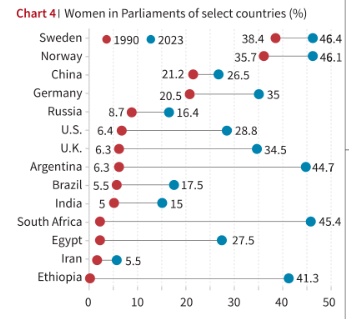
- Share of Women in Parliaments of BRICS and Other Nations
- Why is delimitation required?
- FAQs
What is 128th Constitutional Amendment Bill 2023?
- As per the 128th constitutional amendment bill 2023 or the Nari Shakti Vandan Adhiniyam, a third of the seats in the Lok Sabha and state assembly is proposed to be reserved for women.
- Under the legislation, the reservation of seats for women would continue for 15 years and could be extended by Parliament.
- There will be a quota for SC/STs within the reserved seats for women.
- Reserved seats may be allotted by rotation to different constituencies in the state or union territory.
- The bill establishes a connection between women's reservation and the disputed delimitation process.
Implementation of the Bill
- The reservation for women will be implemented after the delimitation exercise based on the first Census conducted following the passage of the Bill, which means this will likely occur around 2029.
- The Bill specifies that women's reservation will be in effect for 15 years from the commencement of the Act, and Parliament has the authority to extend this period if needed.
- The rotation of seats reserved for women will occur following subsequent delimitation exercises, which will be determined by Parliament through legislation.
Journey of Women Reservation Bill
- The Women’s Reservation Bill was first introduced in the Lok Sabha as the 81st Amendment Bill by then prime minister HD Deve Gowda’s-led United Front government on 12 September, 1996.
- But the bill failed to get passed by the lower house as the Lok Sabha was dissolved.
- After two years, the Atal Bihari Vajpayee-led National Democratic Alliance (NDA) government introduced the Bill in the 12th Lok Sabha. But the bill did not receive adequate support, and lapsed once more.
- It was subsequently reintroduced in 1999, 2002, and 2003 by the Vajpayee government but did not muster the support required to become law.
- In 2010, the UPA government managed to get the bill passed in the Upper House but couldn’t bring it into the Lok Sabha under pressure from allies.
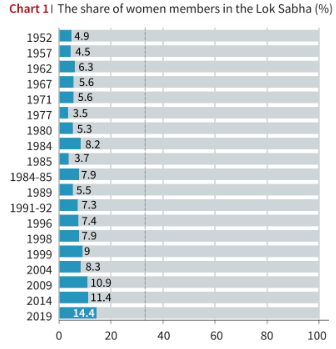
Share of Women Members in Lok Sabha
- The share of women parliamentarians has never exceeded the 15% mark in over 70 years of India's electoral history.
- When considered as a share of total candidates who participated in the 2019 general election, the share is even lower at 9%. The share of women candidates has never exceeded the 9% mark ever.
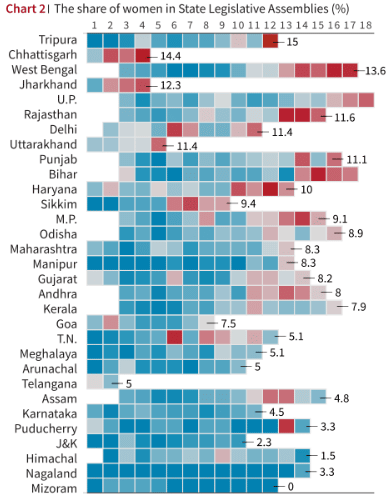
Share of Women in State Legislative Assemblies
- In the case of the sitting State Legislative Assemblies, the share of women MLAs is far lower with just one state Tripura touching the 15% mark.
- Several state assemblies have less than 10% women representation, including Andhra Pradesh, Arunachal Pradesh, Assam, Goa, Gujarat, Himachal Pradesh, Karnataka, Kerala, Madhya Pradesh, Maharashtra, Manipur, Meghalaya, Odisha, Sikkim, Tamil Nadu, Telangana, Tripura and Puducherry.
- According to the government data of December 2022, Bihar, Haryana, Punjab, Rajasthan, Uttrakhand, Uttar Pradesh and Delhi had 10-12% women MLAs.
- Chattisgarh, West Bengal and Jharkhand led the charts with 14.44%, 13.7% and 12.35% women MLAs, respectively.
- In the 2023 election, Nagaland got its first two women MLAs.
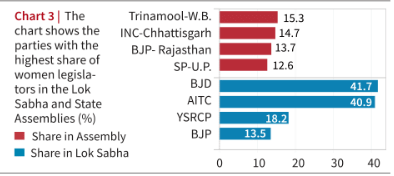
Party-Wise Share of Women Legislators in India
Share of Women in Parliaments of BRICS and Other Nations
Why is delimitation required?
- Equitable Representation: Delimitation is needed to ensure equitable representation in legislative bodies, such as the Lok Sabha and state Assemblies. It aims to make sure that the votes of every person carry similar weight by adjusting the number and boundaries of constituencies.
- Population Balance: Delimitation ensures that the ratio of the number of constituencies to the population of a state is broadly similar, both for Lok Sabha and state Assemblies. This helps in reflecting changes in population over time.
- Fair Division of Geographic Areas: It seeks to achieve a fair division of geographical areas into seats, preventing gerrymandering, which is the manipulation of seat boundaries to give one political party an unfair advantage over others.
(*Click this link to read prelims specific weekly current affairs articles)
FAQs
Question: What is the Women’s Reservation Bill?
Answer:
The Constitution 108th Amendment Bill, 2008 seeks to reserve one-third (33%) of the total number of seats in state legislative Assemblies and Parliament for women.
Question: What is Delimitation?
Answer:
Delimitation means the act or process of fixing limits or boundaries of territorial constituencies in a country or a province having a legislative body. It is done to reflect the demographic changes in a state, Union Territory or at the national-level.
Question: What is the rank of India in the Gender Gap Report?
Answer:
India has ranked 127 out of 146 countries in terms of gender parity in the World Economic Forum's annual Gender Gap Report for 2023. On political empowerment, India has registered 25.3% parity, with women representing 15.1% of parliamentarians, which is the highest for the country since the inaugural report in 2006.
UPSC Mains Practice Question:
|
Download the PREPP App and attempt FREE IAS Exam Mock Tests and get complete study material!

Full Test - 04: UPSC CSE Prelims CSAT (Paper-II)
Full Test - 03: UPSC CSE Prelims CSAT (Paper-II)
UPSC CSE Prelims 2026 GS Paper 1 Question Paper (24-May-2026)
UPSC CSE Prelims 2026 CSAT Paper 2 Question Paper (24-May-2026)

17 February 2025 | The Hindu Must Read Articles | Current Affairs

16 February 2026 | The Hindu Must Read Articles | Current Affairs

13 February 2026 | The Hindu Must Read Articles | Current Affairs









Comments