Extreme Weather Events Impact Global River Water Quality: Study
Relevance: GS3 - Conservation, environmental pollution and degradation, environmental impact assessment. Disaster and disaster management.GS1 - Distribution of key natural resources across the world (including South Asia and the Indian subcontinent);
(Source: Down To Earth, 09/21/2023)
Click here for Daily Current Affairs
Why in the news?
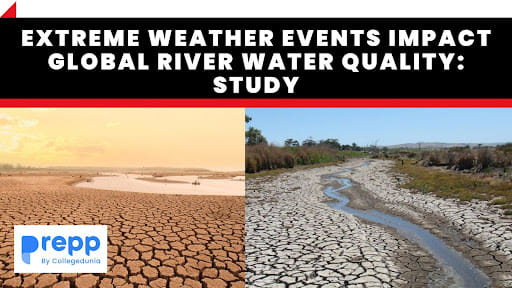
Recently, a new study led by researchers from Utrecht University indicated that extreme weather events have led to an increase in the salinity and concentration of pollutants in the world’s river systems.
Table of Contents
Study on deteriorating water quality
- Researchers reviewed 965 studies relating to the impact of drought, heat waves, rainstorms, and flooding on river water quality.
- The team also assessed the impact of multi-decadal climate change between 2000 and 2022.
- It assessed water quality criteria such as:
- Temperature
- Salinity
- Dissolved oxygen levels,
- Algal blooms and
- Pollutant concentrations
- The study mostly analyzed rivers and streams from the North American and European regions.
- This was most likely due to the highly fragmented water quality monitoring data available in regions like Africa and Asia.
What are the findings of the study?
Effect of droughts and heatwaves
- Water quality: The researchers found that droughts, heatwaves, and compound drought-heatwave events had resulted in the deterioration of water quality in 68% of the case studies.
- Temperature and algae: In 56% of the case studies, there has been an increase in water temperatures and algae levels as a result of long-term or multi-decadal climate change.
- Stronger increases in temperature were also caused by the declining river flow during summers.
- Dissolved oxygen: The increased algae levels have contributed to a decline in the dissolved oxygen concentrations in river water.
- Pollutants: Droughts and heatwaves have caused the salinity and concentration levels of pollutants like pharmaceuticals to rise.
- Species loss: The study found that nearly 5 million fish died between 2018 and 2019 in the River Darling (Australia) due to the low dissolved oxygen during a hydrological drought.
- Most affected regions: According to the researchers, the largest increases in water temperature were likely to occur in the Southeastern USA, Southern Europe, Eastern Asia, and the southern regions of Africa and Australia.
Effect of rainstorms and floods
- Water quality: Under the effect of floods and rainstorms, the overall water quality of rivers and streams was found to have declined in 51% of cases.
- Pollutants: Rainstorms and floods lead to an increase in the concentration of pollutants in the river systems.
- This includes pollutants such as suspended sediments, plastics, nutrients in particulate form, metals, microorganisms, etc.
- River water quality and driving mechanisms were also adversely affected by the sequence of different weather events, i.e. floods after drought, etc.
Water quality
- Water quality is a measure of the suitability of water for any specific use.
- It is determined on the basis of various physical, chemical, and biological characteristics of water such as pH, ions, temperature, and the presence of organic and inorganic components.
- These characteristics help determine whether the water quality is suitable for drinking, life processes, industrial use, etc.
Major indicators of water quality
- Dissolved Oxygen: The concentration of dissolved oxygen, or DO, in the water indicates its suitability for drinking or for aquatic life.
- High levels of DO can be harmful to aquatic animals.
- Temperature: The temperature of water affects the DO concentration, the species present, pollution levels, diseases, etc.
- pH: pH values above or below the average value of 7 can be caused by acid rain, pollution, agricultural runoff, etc.
- This can lead to loss of biodiversity, affect fish behavior, and disrupt the food chain.
- Specific Conductance: Specific conductance is the ability of water to conduct or pass electric current which can be impacted by the presence of organic and inorganic materials.
- An increase in ion concentration can increase the ability of water to conduct electricity.
- Nutrients: The level of organic and inorganic nutrients in water determines the survival of the aquatic ecosystem but may affect water quality if in excess.
- For example, large amounts of nitrogen could lead to an increase in algal growth and toxicity.
- Industrial Chemicals: Water contains industrial chemicals suitable for agriculture, manufacturing, pharmaceutical, and chemical processes.
- In some cases, the concentration of these chemicals can be toxic for aquatic ecosystems.
- Metals: Various metals such as manganese, zinc, and copper must be present in water to sustain biochemical processes
- However, high concentrations of these metals can be toxic for aquatic life and for humans.
Significance of Maintaining Water Quality
- Ecosystem sustainability: Water quality should be optimal to ensure that aquatic ecosystems can be sustained.
- If the quality of water is poor, the ecosystem will begin to shrink and eventually lead to its extinction.
- Drinking water: Humans and animals depend on rivers and ponds for drinking water.
- A decrease in the quality of drinking water may lead to the spread of various diseases.
- Commercial uses: Wate quality must be maintained in order to ensure that the agricultural systems in the country flourish and to prevent industrial accidents.
(*Click this link to read prelims specific weekly current affairs articles)
FAQs
Question: What is a hydrological drought?
Answer:
Hydrological drought is described as a scarcity of water for routine and specific requirements due to an inadequate supply of surface and subsurface water. There are 2 types of Hydrological Droughts - Surface water Drought (drying of rivers, streams, etc.) and Groundwater Drought (fall in groundwater level). The major causes of Hydrological Drought are large-scale deforestation, hazardous mining, and excessive pumping of groundwater.
Question: What is dissolved oxygen?
Answer:
Dissolved oxygen (DO) refers to the amount of oxygen present in water. It is crucial for all forms of life and is an excellent criterion to assess water quality. Aquatic life is stressed when dissolved oxygen levels fall below 5.0 mg/L. The decrease in the level of dissolved oxygen is known as Biological Oxygen Demand (BOD).
UPSC Mains Practice Question:
|
MCQs
Question: Consider the following statements :
- 36% of India’s districts are classified as “overexploited” or “critical” by the Central Ground Water Authority (CGWA).
- CGWA was formed under the Environment (Protection) Act.
- India has the largest area under groundwater irrigation in the world.
Which of the statements given above is/are correct? (UPSC CSE 2020)
(a) 1 only
(b) 2 and 3 only
(c) 2 only
(d) 1 and 3 only
Answer: (d) See the Explanation
- As per a report prepared by the Niti Aayog, around 15% of India’s districts are classified as overexploited or critical by the Central Ground Water Authority. Hence statement 1 is incorrect.
- The Central Ground Water Authority (CGWA) was established under Section 3(3) of the Environment (Protection) Act 1986. Hence statement 2 is correct.
- India has the world’s largest groundwater well-equipped irrigation system ahead of China, USA, Pakistan, and Bangladesh respectively. Hence statement 3 is correct.
Therefore, option (d) is the correct answer.
Question: Which of the following is/are the possible consequences of heavy mining in riverbeds?
- Decreased salinity in the river
- Pollution of groundwater
- Lowering of the water table
Select the correct answer using the code given below: (UPSC CSE 2018)
(a) 1 only
(b) 2 and 3 only
(c) 1 and 3 only
(d) 1, 2 and 3
Answer: (b) See the Explanation
- Heavy sand mining in riverbeds leads to an increase in the velocity of flowing water and as a consequence the erosion of the river bank.
- Sand on the riverbeds helps maintain the water level, which means excessive mining can lead to a depletion of the water table. Hence statement 3 is correct.
- Heavy mining at the riverbed site can lead to the pollution of the river. Hence statement 2 is correct.
- Sand mining increases the risk of saline water entering the freshwater body. Hence statement 1 is incorrect.
Therefore, option (b) is the correct answer.
Download the PREPP App and attempt FREE IAS Exam Mock Tests and get complete study material!

Full Test - 04: UPSC CSE Prelims CSAT (Paper-II)
Full Test - 03: UPSC CSE Prelims CSAT (Paper-II)
UPSC CSE Prelims 2026 GS Paper 1 Question Paper (24-May-2026)
UPSC CSE Prelims 2026 CSAT Paper 2 Question Paper (24-May-2026)

17 February 2025 | The Hindu Must Read Articles | Current Affairs

16 February 2026 | The Hindu Must Read Articles | Current Affairs

13 February 2026 | The Hindu Must Read Articles | Current Affairs









Comments