Devastating Libya Floods Were 50 Times More Likely, 50% More Intense Due To Warming Planet
Relevance: GS3 - Conservation, environmental pollution and degradation, environmental impact assessment. Disaster and disaster management. GS1 - Important Geophysical phenomena such as earthquakes, Tsunami, Volcanic activity, cyclone etc
(Source: Down To Earth, 09/21/2023)
Click here for Daily Current Affairs
Why in the news?
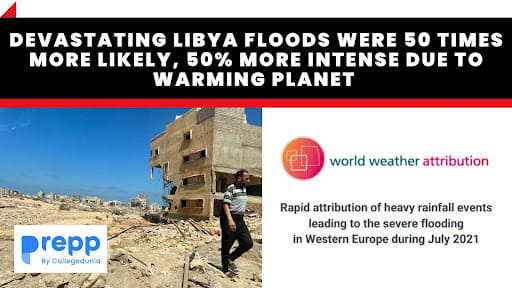
- Recently, a new study by World Weather Attribution (WWA) revealed that the recent floods in Libya were made 50 times more likely and 50% more intense due to the effects of global warming.
- The Libyan floods were caused by a Medicane, Daniel, which also caused floods in other Mediterranean countries like Greece, Turkiye, and Bulgaria.
Table of Contents
WWA study on the Libya floods?
- Global warming caused by anthropogenic causes has facilitated the Libya floods and contributed to increasing its intensity.
Methodology
- The authors defined separate rainfall events to study the return times, i.e. the period in which such a rainfall event occurs, and the impacts of climate change on them.
- A 24-hour event was considered for Spain and Libya, while four-day events were considered for the remaining European countries - Greece, Turkiye, and Bulgaria.
Findings
- The extreme rainfall event in Spain was a once-in-10 to 40-year event.
- The floods in Spain were due to the heavy rains caused by a separate low-pressure system that got cut off from the northern hemisphere jet stream.
- Over 75,000 hectares of agricultural lands were flooded in Central Greece, in a once in 80 to 250-year event.
- The floods in Greece were triggered by the 760 mm of rainfall experienced by the region in this period.
- The two systems were connected by a zone of abnormally high pressure above the Netherlands, which was associated with an omega-blocking event.
- The same event had also led to heatwaves in France and the UK in September.
- Impact of the Conflict: The effects of the flooding in Libya were worsened by the conflict and the lack of a robust state apparatus.
- This fragility had also impacted maintenance work in the country and led to the deterioration of dam infrastructure, which posed a greater risk to the lives and property of the people living there.
- The conflict also compromised the country’s ability to implement planning, adaptation, and coordination activities to respond to wider climate threats such as water scarcity and extreme weather events.
- For example, the Libyan National Meteorological Centre had issued prior warnings about Medicine Daniel but there was a lack of clarity about its impact and whether the relevant information reached the general public and rescue personnel.
- Impact on European countries:
- The floods in Greece, Turkiye, and Bulgaria were made 10 times more likely and 40% more intense as compared to a situation in which the climate was 1.2°C cooler.
Omega-blocking events
- An omega block is a high-pressure pattern that blocks and diverts the jet stream, a high-velocity, high-altitude, and constantly moving river of air that governs weather over Western Europe.
- When an omega-shaped wave is present on the jet stream, a mass of warm and dry air flows up from northern Africa and the Iberian peninsula.
- This results in temperatures rising higher than normal.
- An omega event occurs when a high-pressure system is trapped between one or two low-pressure systems and persists for a long time.
- This can lead to extreme weather events such as storms, floods, and heatwaves.
- Omega-blocking events have been linked to other extreme weather events such as the Pakistan floods (2011), extreme rainfall in northwestern Iran (2008), and the heatwaves in France and Germany (019).
- However, it is difficult to forecast such events, which makes mitigating and preventing them much more difficult.
Libya floods
- The Mediterranean storm Daniel has caused devastating flash floods impacting large parts of Libya in North Africa.
- Daniel was formed in Greece and caused floods and deaths in Spain, Turkey, and Bulgaria in September.
- Daniel deposited 440 millimeters (15.7 inches) of rain on east Libya in a short span, possibly overwhelming the country’s infrastructure and causing the failure of the dam.
- As a result of the storm and consequent flash floods, two dams and four bridges in Derna collapsed.
- According to city officials of Derna, the floods have resulted in the destruction of at least 20% of the city.
- The Red Crescent claimed that around 10,000 people have been reported missing.
- More than 30,000 people have been displaced as a result of the flooding with experts claiming that the death toll may double.
What are the main factors behind the damage?
Extreme weather
- According to the WMO, Derna received more than 150 mm of rainfall between September 10-11, where average monthly rainfall for September is less than 1.5 mm.
- The rains were accompanied by strong winds of up to 80 kph, both of which were produced by Storm Daniel.
Vulnerable geography
- Derna, which was the worst affected city in Libya is a coastal city with around 100,000 inhabitants.
- Derna is situated at the end of a valley and is bisected by the Wadi Derna, a seasonal river that flows from mountains to the sea in the south.
- The city is normally protected from flooding by dams.
- However, the dams outside the city collapsed during the storm resulting in flash floods down Wadi Derna.
- Derna has two dams - one about 12 km upstream from the city where two river valleys converge and another on the southern edge of the city.
- The floodwater breached the two dams and entered the city causing widespread destruction.
Crumbling infrastructure
- As a result of the civil war in the country, there has been a lack of focus on the socio-economic development of the country including the proper development and maintenance of critical infrastructure.
- This is evidenced in the collapse of the two dams in Derna.
- Dams, desalination plants, electrical grids, and roads have not been repaired or properly maintained.
Way forward
- The recent occurrence of extreme rainfall in central Greece and its disastrous impact has highlighted the need for a fundamental rethink of early warning systems.
- Steps that can be taken include:
- Transitioning towards impact-based alerts
- Enhancing the Civil Protection response capacity
- Designing climate change-resilient infrastructure
- As the Mediterranean region is subject to escalating risks induced by climate change, it is necessary to take steps to reduce vulnerability and improve resilience to extreme weather events in order to safeguard human lives.
World Weather Attribution
|
(*Click this link to read prelims specific weekly current affairs articles)
FAQs
Question: What is a medicane?
Answer:
Medicanes are extra-tropical hurricanes that are observed over the Mediterranean Sea. They are similar to hurricanes and have a central eye-like structure, which is the strongest part of the storm. However, they are smaller in size, carry less moisture, and have less swift winds in comparison to tropical cyclones.
Question: What is a jetstream?
Answer:
Jet streams are relatively narrow bands of strong wind in the upper atmosphere that generally blow from west to east, but the flow frequently shifts to a north-to-south direction. The flow of jetstreams is affected by landmasses and the Coriolis force.
UPSC Mains Practice Question:
|
MCQs
Question: Consider the following statements:
- Jet streams occur in the Northern Hemisphere only.
- Only some cyclones develop an eye.
- The temperature inside the eye of a cyclone is nearly 10°C lesser than that of the surroundings.
Which of the statements given above is/are correct? (UPSC CSE 2020)
(a) 1 only
(b) 2 and 3 only
(c) 2 only
(d) 1 and 3 only
Answer: (c) See the Explanation
- Jetstreams occur in both the northern and southern hemispheres. Hence statement 1 is incorrect.
- Some extra-tropical cyclones do not have an eye. Hence statement 2 is correct.
- The temperature inside the eye of the cyclone is warmer than the temperature of its surroundings. Hence statement 3 is incorrect.
Therefore, option (c) is the correct answer.
Download the PREPP App and attempt FREE IAS Exam Mock Tests and get complete study material!

Full Test - 04: UPSC CSE Prelims CSAT (Paper-II)
Full Test - 03: UPSC CSE Prelims CSAT (Paper-II)
UPSC CSE Prelims 2026 GS Paper 1 Question Paper (24-May-2026)
UPSC CSE Prelims 2026 CSAT Paper 2 Question Paper (24-May-2026)

17 February 2025 | The Hindu Must Read Articles | Current Affairs

16 February 2026 | The Hindu Must Read Articles | Current Affairs

13 February 2026 | The Hindu Must Read Articles | Current Affairs









Comments