Why Gaza Is Known As The World’s Biggest ‘Open Air Prison’?
Relevance: GS2- Effect of policies and politics of developed and developing countries on India’s interests Prelims - Current events of international importance
(Source: The Hindu, 10/12/2023)
Click here for Daily Current Affairs
Why in the news?
- Recently, the Defence minister of Israel, Yoav Gallant, ordered a “complete siege” of the Gaza Strip in which electricity, food, and water will be denied.
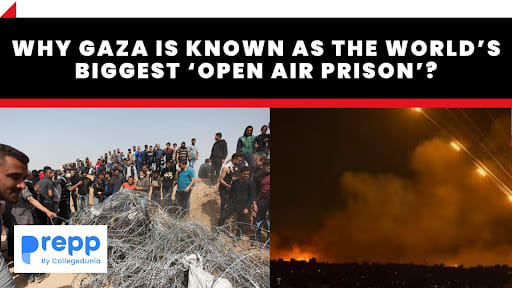
- Gaza which is home to more than 20 lakh Palestinians has been described by world leaders, activists, and media persons as the world’s largest open-air prison.
Table of Contents
Why is it called an open-air prison?
- According to Francesca Albanese, the UN Special Rapporteur on human rights in the occupied territories, the region is an open-air prison.
- She claimed that Israel has imposed a by-default apartheid on the people in the Gaza Strip by restricting their movement, and access to supplies and essentials.
- The term has previously been used by former British Prime Minister David Cameron and celebrated linguist Noam Chomsky.
- 80% of Gazans live in poverty, with little access to clean water and electricity,
- According to the UNRWA, 95% of Gaza's population lacks access to clean water.
- Unemployment in the region is at 46% with over 80% of the population dependent on aid.
- The hospitals lack healthcare professionals, equipment, and medicine, putting the people at increased risk of death.
The beginning of the Gaza blockade
- Israel captured Gaza during the Six-Day War in 1967 and began its military occupation.
- Between 1967 and 2005, Israel built 21 settlements in Gaza and used coercive measures including financial and other incentives to convince locals to leave the territory.
- Although Israel withdrew its settlements in 2005, the United Nations and other international organizations still consider Gaza an occupied territory.
- Israel later imposed temporary blockades on the movement of people and goods into and out of Gaza on multiple occasions.
- In 2007, Hamas, a militant group, assumed power in Gaza which led to Israel making the blockade permanent with the support of Egypt, which shares a border crossing with Gaza.
- As a result, people could not move in or out of Gaza while the movement of goods and aid was also highly restricted.
Gaza
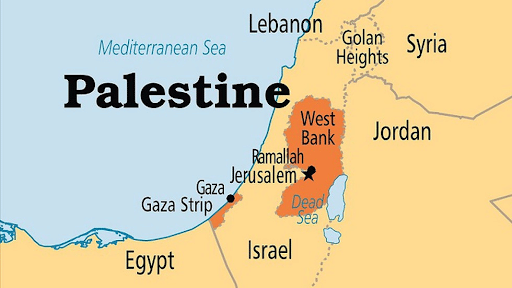
- The Gaza Strip or Gaza, is a Palestinian enclave on the east coast of the Mediterranean Sea.
- Border: Egypt on the southwest, Israel on the east and north, and the Mediterranean Sea on the west.
- The Gaza Strip has been claimed by the de jure sovereign State of Palestine.
- It falls under the jurisdiction of the Palestinian Authority but has been governed by Hamas, a militant, Palestinian, fundamentalist Islamic organization, since 2007.
- Consequently, Israel, the U.S.A., and their allies have placed the strip under an economic and political boycott since 2007.
- Muslims form the majority of the population, and there is a tiny minority Christian community.
- More than 60 percent of Gaza's people are refugees from what is currently Israel.
Border walls around Gaza
- The Gaza Strip is surrounded by walls on three sides and the Mediterranean on the other.
- North and East: A sophisticated border fence has been erected between Israel and Gaza with heavily armed security patrols and underground walls.
- South: Egypt has, with U.S. aid built a steel barrier on the border with Gaza which also has underground walls to prevent tunneling.
- West: The sea route into Gaza is controlled by Israel, which has prohibited its use for the transfer of goods or people.
Hamas
|
(*Click this link to read prelims specific weekly current affairs articles)
FAQs
Question: What is a blockade?
Answer:
A Blockade is an act of war in which one party blocks entry to or departure from a defined part of an enemy’s territory.
Question: Who are Special Rapporteur on human rights?
Answer:
Special rapporteurs (or Independent experts) are independent human rights experts whom the United Nations relies on to report or advise on human rights from a thematic or country-specific perspective.
MCQs
Question: The term "two-state solution" is sometimes mentioned in the news in the context of the affairs of (UPSC CSE 2018)
(a) China
(b) Israel
(c) Iraq
(d) Yemen
Answer: (b) See the Explanation
The two-state solution demands the creation of the Palestine state in the Gaza Strip and West Bank, alongside the state of Israel as a solution to the conflict in the region.
Therefore, option (b) is the correct answer.
Download the PREPP App and attempt FREE IAS Exam Mock Tests and get complete study material!

Full Test - 04: UPSC CSE Prelims CSAT (Paper-II)
Full Test - 03: UPSC CSE Prelims CSAT (Paper-II)
UPSC CSE Prelims 2026 GS Paper 1 Question Paper (24-May-2026)
UPSC CSE Prelims 2026 CSAT Paper 2 Question Paper (24-May-2026)

17 February 2025 | The Hindu Must Read Articles | Current Affairs

16 February 2026 | The Hindu Must Read Articles | Current Affairs

13 February 2026 | The Hindu Must Read Articles | Current Affairs









Comments