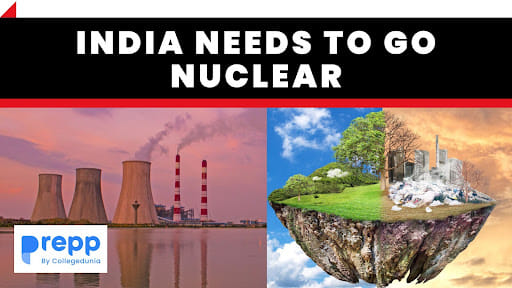
India Needs to go Nuclear
Relevance: GS3, Environment, Infrastructure and Energy, Science & Technology, India's development goals, Adoption of nuclear energy, Sustainable development
(Source: The Indian Express, 12/10/2023)
Click here for Daily Current Affairs
Why in the news?
- This article is based on ‘Going Nuclear’ which was published in ‘The Indian Express’ on 12/10/2023.
- The rise of India's economy is being observed, and it is predicted to be leapfrogged to the third position globally by the end of the decade.
- The primary energy consumption of India is currently ranked third globally, with a primary reliance on fossil energy.
- It discusses the need for India to rapidly adopt nuclear energy in order to meet its growing energy demands, counter climate change, and achieve net-zero emissions.
Table of Contents
What is Global Warming?
- Global Warming refers to the long-term increase in Earth's average surface temperature due to human-made greenhouse gas emissions.
- Certain gases in Earth's atmosphere, like carbon dioxide (CO₂), methane (CH₄), and nitrous oxide (N₂O), trap heat. These are called greenhouse gases. They exist naturally in the atmosphere and are critical for maintaining temperatures suitable for life.
- The burning of fossil fuels (like coal, oil, and natural gas) for energy, deforestation, industrial processes, and certain agricultural practices release significant amounts of greenhouse gases into the atmosphere, intensifying the greenhouse effect and causing temperatures to rise.
- Global warming leads to various environmental changes, including rising sea levels due to the melting of polar ice caps and glaciers, more frequent and severe extreme weather events, disruption of ecosystems and biodiversity, etc.
- Fossil fuels contribute significantly to global warming, posing an existential threat.
- Global consensus emphasizes deep emission cuts, transitioning to net-zero emissions by 2045-2070.
Global Warming and Climate Change
What is Net Zero?
|
India's Unique Challenge
- Existential Crisis: Fossil fuel consumption is driving global warming, posing a significant threat to humanity.
- Global Target: Worldwide consensus to achieve net zero emissions before the 2045–2070 timeframe.
- Massive Transformation Required: Introduction and adaptation of new technologies.
- Comprehensive restructuring of energy systems, both at supply and demand ends.
- Substantial financial costs involved in the transition.
- Dual Challenge for India: As a large developing nation, India's journey to net zero is particularly challenging.
- Developmental aspirations demand a significant increase in per-capita energy consumption.
- Balancing this growth while transitioning to net-zero greenhouse gas (GHG) emissions is pivotal.
- Potential Outcomes: Failure to manage this balance could lead to:
- Compromising developmental goals.
- Missing the globally set timeframe for achieving net zero emissions.
- Possibly both setbacks occurring simultaneously.
Limitations of Renewable Energy
- Intermittency and Reliability: Solar and wind energy are intermittent sources; they are not consistently available throughout the day or year.
- Land Acquisition: Large-scale solar parks and wind farms require vast tracts of land. In densely populated India, acquiring land can be a complex and contentious process.
- Infrastructure and Grid Integration: The current power grid infrastructure may not be fully equipped to handle large influxes of renewable energy, necessitating upgrades and expansions.
- Financial Challenges: While the costs of solar and wind installations have dropped significantly, the initial capital expenditure remains high for many potential adopters.
- Technological Limitations: There's a dependency on imports, especially for solar photovoltaic cells and modules, as a significant portion comes from countries like China.
- Environmental Concerns: While renewables are environmentally friendly compared to fossil fuels, they aren't without concerns. For example, large solar farms can affect local fauna and flora, and wind turbines can impact bird life.
- Policy and Regulatory Hurdles: While India has set ambitious renewable targets, regulatory clarity, policy consistency, and effective implementation can sometimes lag, affecting project viability and investor confidence.
What is Nuclear Energy?
- Nuclear energy is the energy released during nuclear reactions (either fission or fusion).
- In the context of electricity generation, it typically refers to the use of nuclear fission, wherein atomic nuclei of heavy elements like uranium or plutonium are split into smaller nuclei, releasing a tremendous amount of energy in the process.
- This energy heats water to produce steam, which then drives turbines connected to generators, producing electricity.
Importance of Nuclear Energy for India
- Growing Energy Demand: As one of the world's most populous countries with a rapidly growing economy, India's demand for electricity is increasing. Nuclear energy can be a significant source to meet this demand.
- Energy Security: India has limited domestic reserves of fossil fuels like coal, oil, and natural gas. Relying on imports poses economic and strategic vulnerabilities. Nuclear energy can reduce this dependence.
- Low Greenhouse Gas Emissions: Nuclear power plants emit negligible amounts of greenhouse gases during operation, making them an essential tool in the fight against climate change.
- Base Load Power Source: Unlike solar and wind energy, which are intermittent, nuclear power plants provide consistent, base load power, ensuring stability in the power grid.
- Thorium Reserves: India has one of the world's largest reserves of thorium. Developing thorium-based nuclear reactors can further enhance India's energy security.
- Three-Stage Nuclear Program: India's indigenous three-stage nuclear program aims to utilize its vast thorium reserves by transitioning from Pressurized Heavy Water Reactors (PHWRs) to Fast Breeder Reactors (FBRs) and eventually thorium-based reactors.
- Limited Land Footprint: Compared to large solar or wind farms, nuclear power plants require less land to produce equivalent power, an essential consideration given India's population density.
- Economic Growth and Development: Reliable energy supply is critical for industrialization and overall economic growth. Nuclear energy can play a pivotal role in supporting India's development aspirations.
- Technological Advancements: Investments in nuclear energy can foster research and development in related technologies, leading to innovation and potential economic spin-offs.
- Integration in the Energy Mix: A diverse energy mix is crucial for any nation's energy security. Including nuclear energy ensures that India is not overly reliant on any single energy source.
Six-Pronged Strategy for Nuclear Energy in India
A six-pronged national strategy is proposed to rapidly scale up nuclear energy.
- Indigenous 700 MWe PHWR
- Should be the primary source for base load electrical capacity addition.
- First unit is already commercially operational.
- 15 more units are under construction in fleet mode.
- Advocated to initiate more fleets involving multiple PSUs besides NPCIL.
- Indigenous SMRs
- Build Small Modular Reactors (SMRs) on sites of retiring coal plants.
- Importing large PWRs is cost-prohibitive for electricity generation.
- NTPC, India's largest coal plant owner, should partner in this process.
- Involvement of more industrial partners is encouraged.
- 220 MWe PHWR as Captive Units
- Offer these well-established units as partially owned captive units for industries like metals, chemicals, and fertilisers.
- AHWR300-LEU by BARC can be included after a successful prototype demonstration.
- High Temperature Reactor
- Aimed at producing hydrogen directly without electrolysis.
- This will make green hydrogen production more affordable and decrease the pressure on electrifying the country's energy system.
- Bhabha Atomic Research Centre (BARC) is capable of this development.
- Thorium Energy Potential
- Prioritize second and third stage nuclear-power programme development.
- Unlock the thorium energy potential in line with existing plans for a sustainable energy source.
- Nuclear Energy for Emerging Economies
- Rapidly deploy new nuclear energy capacities in emerging economies, where energy consumption growth is expected to be high.
- Address global climate change issues.
- India's PHWRs are competitive in performance and capital cost, making them suitable for global needs.
- Thorium-HALEU fuel can enhance reactor appeal in economics, safety, waste management, and proliferation resistance.
- India should seize the opportunity to lead international cooperation for global climate change solutions through nuclear energy.
Conclusion
As India rapidly ascends in global economic rankings, its energy demand will grow commensurately. While renewable sources like solar and wind are valuable, they alone cannot bridge the vast energy gap India faces. Nuclear energy presents a viable, clean, and efficient solution. Modern nuclear technology is safer and more eco-friendly than ever before. By pursuing a multi-faceted strategy that champions indigenous technologies and leverages existing infrastructure, India can harness the power of nuclear energy.
(*Click this link to read prelims specific weekly current affairs articles)
FAQs
Question: What is Net Zero?
Answer:
Net Zero refers to achieving a balance between the amount of greenhouse gas emissions produced and the amount removed from the atmosphere. In a net zero scenario, a country, company, or individual would be effectively adding no carbon to the atmosphere, either by eliminating emissions entirely or by offsetting emissions through removal processes.
Question: What is the significance of transitioning to net zero emissions for India?
Answer:
Transitioning to net zero emissions is crucial for India due to the global consensus to achieve this goal by the timeframe of 2045-2070. This transition will help address the existential crisis of global warming. For a vast developing nation like India, achieving this target is a complex challenge since it requires balancing increased energy demands for development while simultaneously transitioning to net-zero greenhouse gas emissions.
Question: Is global warming the same as climate change?
Answer:
The terms "global warming" and "climate change" are sometimes used interchangeably, but they have distinct meanings. Global warming refers specifically to the rising temperatures, while climate change encompasses the broader range of changes happening to our planet, including rising sea levels, melting ice caps, and shifts in weather patterns.
UPSC Mains Practice Question:
|
MCQs
Question: To meet its rapidly growing energy demand, some opine that India should pursue research and development on thorium as the future fuel of nuclear energy. In this context, what advantage does thorium hold over uranium? (UPSC 2012)
- Thorium is far more abundant in nature than uranium.
- On the basis of per unit mass of mined mineral, thorium can generate more energy compared to natural uranium.
- Thorium produces less harmful waste compared to uranium.
Which of the statements given above is/are correct?
(a) 1 only
(b) 2 and 3 only
(c) 1 and 3 only
(d) 1, 2 and 3
Answer: (d) See the Explanation
Thorium is four times more plentiful in nature than uranium and is found all across the Earth's crust. Hence, statement 1 is correct.
Thorium fuel produces no new bomb-usable material in the waste profile; the waste is composed of the radioisotope Uranium-233, or U233, which is nearly impossible to weaponize. Hence, statement 2 is correct.
Thorium fuel will provide around 30 times more energy per unit mass than uranium fuel. Hence, statement 3 is correct.
Therefore, option (d) is the correct answer.
Download the PREPP App and attempt FREE IAS Exam Mock Tests and get complete study material!

Full Test - 04: UPSC CSE Prelims CSAT (Paper-II)
Full Test - 03: UPSC CSE Prelims CSAT (Paper-II)
UPSC CSE Prelims 2026 GS Paper 1 Question Paper (24-May-2026)
UPSC CSE Prelims 2026 CSAT Paper 2 Question Paper (24-May-2026)

17 February 2025 | The Hindu Must Read Articles | Current Affairs

16 February 2026 | The Hindu Must Read Articles | Current Affairs

13 February 2026 | The Hindu Must Read Articles | Current Affairs









Comments