Global Framework On Chemicals
Relevance: GS3 - Conservation, environmental pollution and degradation, environmental impact assessment
(Source: DTE, 10/01/2023)
Click here for Daily Current Affairs
Why in the news?
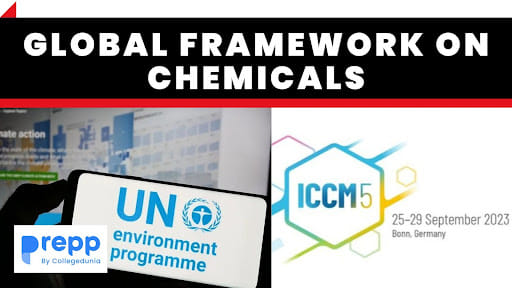
- Recently, delegates at the 5th session of International Conference on Chemicals Management (ICCM5) in Bonn, Germany (from September 25 to 29, 2023) adopted a new global framework to address environmental risks associated with chemicals and waste.
- This framework also known as the Global Framework on Chemicals, establishes concrete targets and guidelines for managing chemicals throughout their lifecycle.
Table of Contents
Key Highlights of Global Framework on Chemicals
- Concrete Targets: The framework is based around 28 targets, designed to improve responsible management of chemicals and waste. These targets also aim to establish stronger connections with other important global agendas, including climate change, biodiversity, human rights and health.
- Government Policies: The governments have pledged to create policies and regulations to reduce chemical pollution by 2030 and promote safer alternatives. Industry Responsibility: Industries also committed to managing chemicals more responsibly to reduce pollution and its adverse effects. Notably, the framework aims to phase out dangerous agricultural pesticides by 2035.
- Bonn Declaration: In addition to the Global Framework, the Conference also adopted the Bonn Declaration. It focuses on preventing exposure to harmful chemicals, phasing out the most harmful substances, and enhancing the safe management of necessary chemicals.
- Dedicated Trust Fund: It is planned to be established and overseen by the United Nations Environment Programme. This fund will be open to contributions from governments, the private sector, non-governmental organizations, and foundations, in addition to the initial pledge of EUR 20 million made by Germany.
International Conference on Chemicals Management (ICCM)
- It serves as a global platform, held every five years by the United Nations Environment Programme (UNEP) and the Inter-Organization Programme for the Sound Management of Chemicals (IOMC), to address the responsible management of chemicals and waste.
- It plays a crucial role in advancing the implementation of the Strategic Approach to International Chemicals Management (SAICM), a voluntary framework aimed at ensuring the safe handling of chemicals throughout their entire lifecycle.
- ICCM also serves as a venue for governments and other stakeholders to engage in negotiations regarding new international agreements related to the management of specific chemicals and waste streams.
Other Efforts Regarding Harmful Chemicals And Wastes
- Basel Convention: It was adopted in 1989 by the Conference of Plenipotentiaries in Basel, Switzerland, the ‘Basel Convention on the Control of Trans-boundary Movements of Hazardous Wastes and their Disposal.’ It directs a “Prior Consent Approval” method to control the transboundary movements of harmful and other wastes to reduce their adverse effects on the environment. India is a party to the Basel Convention.
- Rotterdam Convention: It was adopted in 1998 by a Conference of Plenipotentiaries in Rotterdam, the Netherlands. The Convention entered into force in 2004. It covers pesticides and industrial chemicals that have been banned or severely restricted for health or environmental reasons. On May 24, 2005, India became a party to the Rotterdam Convention.
- Minamata Convention: The Minamata Convention on Mercury is a global treaty to protect human health and the environment from the adverse effects of mercury and its compounds. It was agreed at the fifth session of the Intergovernmental Negotiating Committee in Geneva, Switzerland 2013. India has ratified this convection.
- Stockholm Convention: It is an international treaty established in 2001 and became effective on May 17, 2004. Its primary purpose is to safeguard human health by addressing persistent organic pollutants (POPs) that can remain suspended in the air for extended periods. The convention is designed to encourage member states to take proactive steps to minimize or eradicate the utilization of POPs. It was ratified by India in 2006.
Conclusion
- The fifth session of ICCM marked a significant milestone by adopting Global Framework on Chemicals (GFC) as a fresh international agreement with the explicit goal of safeguarding both human health and the environment from the negative consequences of chemicals and waste.
- The GFC serves as a comprehensive framework addressing every stage of the chemical lifecycle, from production and utilization to disposal and waste management. Its overarching vision is to create a world where chemicals and waste no longer pose harm, fostering a future that is secure, healthy, and environmentally sustainable.
(*Click this link to read prelims specific weekly current affairs articles)
FAQs
Question: What is the International Conference on Chemicals Management (ICCM)?
Answer:
It serves as a global platform, held every five years by the United Nations Environment Programme (UNEP) and the Inter-Organization Programme for the Sound Management of Chemicals (IOMC), to address the responsible management of chemicals and waste.
Question: What are POPs?
Answer:
POPs are hazardous substances made up of organic (carbon-based) chemical compounds and combinations. Organochlorine pesticides like DDT, industrial chemicals, and polychlorinated biphenyls (PCB), as well as unintended byproducts of numerous industrial processes, including polychlorinated dibenzo-p-dioxins (PCDD) and dibenzofurans (PCDF), often known as dioxins, are the most frequently encountered POPs.
Question: What is UNEP?
Answer:
The United Nations Environment Programme is responsible for coordinating responses to environmental issues within the United Nations system. It was established after the United Nations Conference on the Human Environment in Stockholm in June 1972.
MCQ
Question: With reference to International Conference on Chemicals Management (ICCM), consider the following statements:
- The ICCM is responsible for guiding and monitoring the Strategic Approach to International Chemicals Management (SAICM) process.
- The SAICM is a policy framework to foster the sound management of chemicals.
Which of the statements given above is/are correct?
(a) 1 only
(b) 2 only
(c) Both 1 and 2
(d) Neither 1 nor 2
Answer: (c) See the Explanation
- International Conference on Chemicals Management (ICCM) is responsible for guiding and monitoring the Strategic Approach to International Chemicals Management (SAICM) process. Hence, statement 1 is correct.
- The SAICM is a policy framework to foster the sound management of chemicals. It was adopted by the First International Conference on Chemicals Management (ICCM1) in 2006 as a policy framework to promote chemical safety around the world. Hence, statement 2 is correct.
Therefore, option (c) is the correct answer.
Download the PREPP App and attempt FREE IAS Exam Mock Tests and get complete study material!

Full Test - 04: UPSC CSE Prelims CSAT (Paper-II)
Full Test - 03: UPSC CSE Prelims CSAT (Paper-II)
UPSC CSE Prelims 2026 GS Paper 1 Question Paper (24-May-2026)
UPSC CSE Prelims 2026 CSAT Paper 2 Question Paper (24-May-2026)

17 February 2025 | The Hindu Must Read Articles | Current Affairs

16 February 2026 | The Hindu Must Read Articles | Current Affairs

13 February 2026 | The Hindu Must Read Articles | Current Affairs









Comments