What Does India’s First Gig Workers’ Rights Bill Stipulate?
Relevance: GS 2 - Government policies and interventions for development in various sectors and issues arising out of their design and implementation. GS 3 - Employment
(Source: The Hindu, 07/25/23)
Click here for Daily Current Affairs
Why in the news?
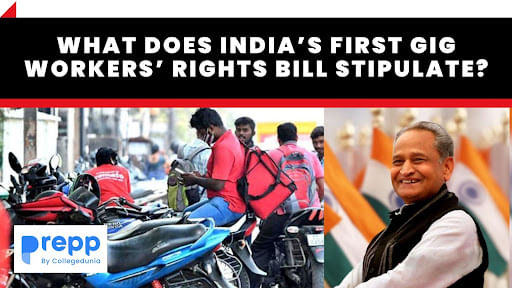
- Recently, the Rajasthan government passed the Rajasthan Platform-Based Gig Workers (Registration and Welfare) Bill, 2023. It is the first legislation of its kind in India.
- The legislation aims to address social security and welfare measures for 3 lakh gig workers in the state of Rajasthan.
- According to a report by, India’s gig workforce comprises 15 million workers employed across industries such as software, shared services and professional services.
Table of Contents
What did the Bill propose?
- Application: The Bill applies to “aggregators”- digital intermediaries connecting buyers and sellers and “primary employers”- individuals or organizations engaging platform-based workers.
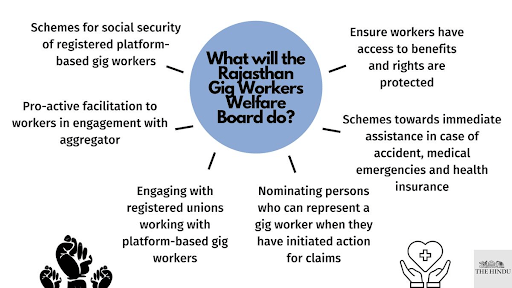
- Welfare Board: Under the proposed Bill, a Welfare Board is to be established, comprising State officials, five representatives each from gig workers and aggregators, and two others from civil society.
- Functions
- Set up a welfare fund
- register platform-based gig workers, aggregators and primary employers,
- facilitate guarantee of social security to platform-based gig workers and
- provide for matters connected therewith or incidental thereto.
- Maintain a database of companies and workers. A unique ID will be assigned to each worker that shall be valid in perpetuity.
- Source of Social Security and Welfare Fund: The welfare fund will be funded by contributions made by individual workers, State government aids, other sources, and a ‘welfare cess' imposed on each transaction by aggregator companies.
- The rate of the welfare cess will be between 1% and 2% of each transaction value, and aggregators must submit the amount within the first five days of each month.
- Workers’ grievances: Gig workers can raise grievances about entitlements and benefits under the Act. They can file petitions physically or online. Employers can object within 90 days before an 'Appellate Authority.'
- Aggregator duties: An aggregator’s duties under the Bill include
- depositing welfare cess on time,
- updating the database of gig workers, and
- documenting any variations in numbers within one month of such changes.
- Failure to comply may result in fines, with the aggregator facing up to ₹5 lakh for the first offense and ₹50 lakh for subsequent violations. Primary employers may be fined up to ₹10,000 for the first offense and ₹2 lakh for further violations.
Benefits of Gig Economy
Employees
- Flexibility to work: Gig workers help employees in attaining work-life balance by providing them with flexibility.
- Employment opportunities because of the changing nature of work and penetration of the internet have resulted in employment opportunities in the digital space.
Companies
- Companies do not have to undergo complex procedures during recruitment or lay off thereby promoting ease of business.
- Optimum use of resources: Small businesses benefit the most from the gig economy because they do not need to offer office space, equipment, or perks.
- Project-based recruitment: They can save time and money by not having to establish healthcare or HR processes and instead hiring individuals to undertake small chores that need to be completed at the moment.
(*Click this link to read prelims specific weekly current affairs articles)
FAQs
Question: Who are Gig Workers?
Answer:
Gig workers are independent contractors or freelancers who typically do short-term work for multiple clients. The work may be project-based, hourly or part-time, and can either be an ongoing contract or a temporary position.
Question: What is Social Security?
Answer:
According to the International Labor Organisation Social security is the protection that a society provides to individuals and households to ensure access to health care and to guarantee income security, particularly in cases of old age, unemployment, sickness, invalidity, work injury, maternity or loss of a breadwinner.
Question: What are digital Intermediaries?
Answer:
Digital intermediaries currently include internet service providers, cloud service providers, consumer-facing social media platforms and video-sharing websites.
MCQ
Question: Consider the following statements:
- Gig workers are independent contractors or freelancers who typically do short-term work for multiple clients.
- Rajasthan is the first state to pass bill that addresses social security and welfare measures for gig workers.
Which of the above statements is/are correct?
(a) 1 only
(b) 2 only
(c) Both 1 and 2
(d) Neither 1 nor 2
Answer: (c) See the Explanation
- Gig workers are independent contractors or freelancers who typically do short-term work for multiple clients. Hence, statement 1 is correct.
- Rajasthan is the first state to pass bill that addresses social security and welfare measures for gig workers. Hence, statement 2 is correct.
- Therefore, option (c) is the correct answer.
Download the PREPP App and attempt FREE IAS Exam Mock Tests and get complete study material!

Full Test - 04: UPSC CSE Prelims CSAT (Paper-II)
Full Test - 03: UPSC CSE Prelims CSAT (Paper-II)
UPSC CSE Prelims 2026 GS Paper 1 Question Paper (24-May-2026)
UPSC CSE Prelims 2026 CSAT Paper 2 Question Paper (24-May-2026)

17 February 2025 | The Hindu Must Read Articles | Current Affairs

16 February 2026 | The Hindu Must Read Articles | Current Affairs

13 February 2026 | The Hindu Must Read Articles | Current Affairs









Comments