Govt Launches Meri Maati, Mera Desh Campaign
Relevance: GS2 - Government Policies And Interventions For Development In Various Sectors, Prelims
(Source: The Hindu, 07/25/2023)
Click here for Daily Current Affairs
Why in the news?
- Recently, the Union government has launched the 'Meri Maati Mera Desh' campaign as a culmination of the 'Azadi Ka Amrit Mahotsav' celebration.
- The campaign aims to honor and remember those who made the supreme sacrifice for the nation.
Table of Contents
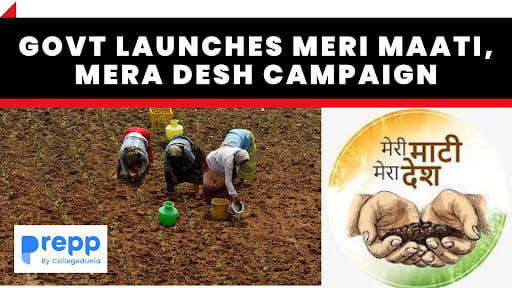
About the Campaign
- Under the campaign, soil collected from various parts of the country will be utilized to develop a garden called the Amrit Vatika along the Kartavya Path in Delhi.
- At the panchayat-level programs, it will involve the installation of a shilaphalakam (memorial plaque) engraved with the names of the bravehearts who sacrificed their lives for the country.
- The Mahatma Gandhi National Rural Employment Guarantee Act (MGNREGA) will be employed to ensure the participation of local communities and resources.
- As part of 'Vasudha Vandhan,' every gram panchayat or village will renew Mother Earth by planting 75 saplings of indigenous species, creating an Amrit Vatika.
- Aim of the Campaign:
- The campaign aims to honor and remember the brave souls who made the ultimate sacrifice for the nation's freedom, unity, and integrity.
- It encourages communities to take responsibility for protecting Mother Earth and conserving biodiversity.
- By involving local communities, the campaign emphasizes grassroots engagement and active participation of citizens in building the nation's legacy.
What are the causes of Soil Exploitation?
- Excessive rain: It can spoil the soil by causing erosion, leaching essential nutrients, and promoting waterlogging, which deprives plants of oxygen.
- Overgrazing: It leads to soil compaction, reduced vegetation cover, and depletion of plant roots, resulting in erosion and decreased soil fertility. A 2019 global study indicated that overgrazing could account for 35.9% of soil degradation.
- Deforestation and Urbanization: It has resulted in the conversion of forests into agricultural lands and residential areas, which is significantly deteriorating soil health. Due to urbanization, water holding capacity of the soil decreases and runoff rate increases which in turn led to soil erosion.
- Overuse of Agrochemicals: It contributes to soil acidification, resulting in a reduction of organic matter in the soil, stunting plant growth and causing greenhouse gases to be released.
- Climate change: It can affect the soil by altering precipitation patterns, temperature, and extreme weather events, leading to increased erosion, soil degradation, and changes in soil nutrient availability.
Prevention of Soil Erosion
- In order for soil to be healthy, the right combination of water, air, minerals, and organic matter is required.
- Ensuring continuous ground cover, such as by planting cover crops, also aids in the binding of soil to roots.
- Afforestation is one of the best methods to conserve soil.
- Carbon farming methods of agriculture are needed that can help the land store more carbon and maintain soil health and atmospheric stability.
- Terracing is an extremely effective method of erosion control that has been used for thousands of years by people all over the world.
Soil Conservation Schemes in India
- Pradhan Mantri Krishi Sinchayee Yojana
- National Mission for Sustainable Agriculture (NMSA)
- Soil Health Card Scheme
- Rashtriya Krishi Vigyan Yojana (RKVY)
- NABARD Loan- Soil & Water Conservation Scheme under RIDF
(*Click this link to read prelims specific weekly current affairs articles)
FAQs
Question: What is the 'Meri Maati Mera Desh' campaign?
Answer:
‘Meri Maati Mera Desh' campaign is launched as a culmination of the 'Azadi Ka Amrit Mahotsav' celebration. Under the campaign, soil collected from various parts of the country will be utilized to develop a garden called the Amrit Vatika along the Kartavya Path in Delhi. The campaign aims to honor and remember those who made the supreme sacrifice for the nation.
Question: What is Azadi Ka Amrit Mahotsav?
Answer:
Azadi Ka Amrit Mahotsav is an initiative, by the Government of India, commemorating 75 years of independence and its progress.
Question: What is soil conservation?
Answer:
The goal of soil conservation is to stop the loss of the soil's topmost layer due to erosion or to stop the soil from becoming less fertile due to overuse, acidification, salinization, or other chemical soil contamination.
UPSC Mains Practice Question:
|
MCQ
Question: Consider the following statements: (UPSC 2017)
The nation-wide ‘Soil Health Card Scheme’ aims at
- expanding the cultivable area under irrigation.
- enabling the banks to assess the quantum of loans to be granted to farmers on the basis of soil quality.
- checking the overuse of fertilisers in farmlands.
Which of the above statements is/are correct?
(a) 1 and 2 only
(b) 3 only
(c) 2 and 3 only
(d) 1, 2 and 3
Answer: (b) See the Explanation
- It is a programme that the Department of Agriculture and Cooperation, a division of the Ministry of Agriculture and Farmers' Welfare, Government of India, is promoting and putting into action.
- With an SHC, the farmer receives the holding's soil nutrient status and gives guidance on the amount of fertiliser to use and any other soil amendments that are required in order to maintain the long-term health of the soil.
- The printed report known as the Soil Health Card (SHC) details the soil's nutrient status in relation to 12 nutrients: pH, Electrical Conductivity (EC), Organic Carbon (OC), Nitrogen (N), Phosphorus (P), Potassium (K), Sulphur (S), Zinc (Zn), Boron (B), Iron (Fe), Manganese (Mn), and Copper (Cu) of farm holdings.
- The SHC will specify the recommended fertilisers and soil amendments for the farm based on the status of the soil's nutrients. Hence, statement 3 is correct and statements 1 and 2 are not correct.
Therefore, option (b) is the correct answer.
Download the PREPP App and attempt FREE IAS Exam Mock Tests and get complete study material!

Full Test - 04: UPSC CSE Prelims CSAT (Paper-II)
Full Test - 03: UPSC CSE Prelims CSAT (Paper-II)
UPSC CSE Prelims 2026 GS Paper 1 Question Paper (24-May-2026)
UPSC CSE Prelims 2026 CSAT Paper 2 Question Paper (24-May-2026)

17 February 2025 | The Hindu Must Read Articles | Current Affairs

16 February 2026 | The Hindu Must Read Articles | Current Affairs

13 February 2026 | The Hindu Must Read Articles | Current Affairs









Comments