Utricularia or Bladderworts - Environment Notes
Utricularia is a genus of carnivorous plants with over 233 species that are generally known as bladderworts. Except for Antarctica, they are found as terrestrial or aquatic species in freshwater and moist soil. Small hollow sacs that actively collect and digest microscopic creatures including insect larvae, aquatic worms, and water fleas are characteristic of the bladderwort genus. Many bladderwort species are invasive species that have spread to new habitats, and they can be found in lakes, streams, and waterlogged soils all over the world. This article will explain to you about Utricularia or Bladderworts which will be helpful in preparing the Environment Syllabus for the UPSC Civil Service exam.
|
Table of Contents |
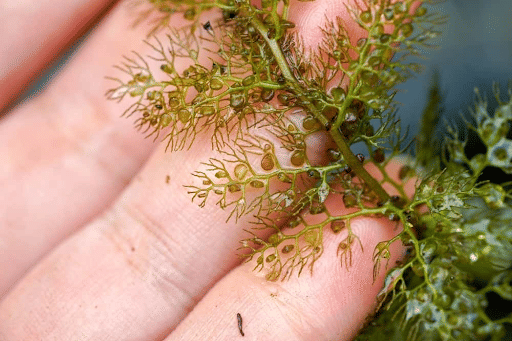
Utricularia
What are Insectivorous Plants?
- These plants are commonly referred to as insectivorous plants since they are excellent at trapping insects.
- They have a totally distinct way of nutrition from normal plants. However, they never prey on people or big animals.
- Based on how they get their food, insectivorous plants can be roughly categorized as either active or passive varieties.
- When insects settle on their leaf traps, the active ones can immediately seal them.
- The passive plants feature a device known as a "pitfall," which resembles a jar or pitcher and into which an insect can fall and finally be digested.
- The insectivorous plants frequently use a variety of lures, including vivid colors, delicious secretions, and other curiosities, to entice unwitting victims.
|
|
|
|---|---|
| Drosera or Sundew | Aldrovanda |
| Pinguicula or Butterwort | Nepenthes |
Utricularia - Distribution
- Utricularia may thrive practically at any place where there is fresh water for at least part of the year.
- But they are an exception to Antarctica and other marine islands, where there are no native species.
- In terms of the genus, South America and Australia both have high levels of species diversity.
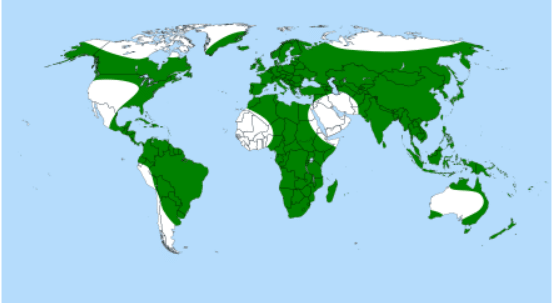
Distribution of Utricularia
Utricularia - Habitat
- Like the majority of carnivorous plants, they thrive in moist, low-dissolved-mineral soils where their carnivorous nature offers them an edge over rivals.
- Utricularia species native to the land frequently coexist with members of the carnivorous genus Sarracenia, Drosera, and others.
- The majority of the species, which include around 80% of all terrestrial life, live in damp or saturated soils, where their tiny bladders may be constantly exposed to water from the substrate.
- They are frequently observed in marshy regions when the water table is quite near the surface.
- Despite existing worldwide, tropical species make up the majority of terrestrial species. Twenty percent of these species are still aquatic.
Utricularia - Physical Description
- A bladderwort plant's primary structure is always found below the substrate's surface.
- There are occasionally a few photosynthetic leaf shoots produced by terrestrial plants.
- Regardless of whether their substrate is pond water or dripping moss in the canopy of a tropical rainforest, the majority of species develop long, slender, branching stems or stolons beneath the surface of their substrate.
- Both the photosynthetic leaf shoots and the bladder traps are linked to these stolons. The bladder-like traps are what the name bladderwort refers to.
- The largest and most visible bladders are found in the aquatic species of the genus.
Utricularia - Trapping Mechanism
- In contrast to Venus flytraps, waterwheels (Aldrovanda), and many sundews, the trapping mechanism of Utricularia is entirely mechanical; no reaction from the plant (irritability) is necessary for the presence of prey (Drosera).
- The continual pumping of water out through the bladder walls by active transport is the only active process involved.
- The walls of the bladder are drawn inward by the negative pressure produced as water is pushed out, and any dissolved substance inside the bladder concentrates as a result.
- The bladder's walls curve inward and store potential energy like springs.
- Once the bladder trap is "completely set," no additional water can be extracted.
- Many long bristle-stiff protuberances that are frequently referred to as trigger hairs or antennae protrude from the bottom of the trapdoor, although they bear little resemblance to the sensitive triggers found in Dionaea and Aldrovanda.
- These bristles are really just levers. The attachment of its flexible bottom to the soft-sealing velum resists the suction force that the primed bladder applies to the door.
- The flexible door lip will bend just enough to create a tiny gap, breaking the seal, with the slightest touch to one of the lever hairs, which literally depends on maintaining equilibrium.
- A column of water is drawn into the bladder once the barrier is broken, causing the bladder walls to rapidly rebound back to a more rounded form.
- The animal that touched the lever will inevitably be lured in if it is small enough, and after the trap is full, the door will return to its closed position.
- The entire process can be finished in less than one-hundredth of a second. Once within, digestive secretions break down the prey.
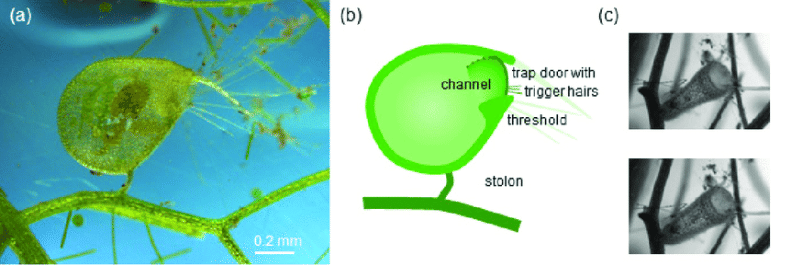
Trapping Mechanism in Utricularia
Utricularia - Microbial Relationships
- A mutualistic community of bacteria is frequently cultivated in the bladders of Utricularia, and this community may play a crucial role in the digestion of prey by Utricularia.
- Bacteria eat organic matter that has been dissolved but cannot be directly absorbed by larger species.
- The release of nutrients by bacteria when they take up dissolved organic matter promotes photo-autotrophic development.
- Additionally, a variety of microplankton and debris are frequently collected by Utricularia traps.
- Since these bacteria may have helped these plants obtain the necessary nutrients when they lost their roots and may have had difficulty acquiring phosphorus, mutualism may have been a significant relationship in the evolution of aquatic Utricularia traps.
Utricularia - Uses
- Common bladderwort is a food source for a variety of insects, animals, and waterfowl.
- Some species also use the stems as shelter or a site to lay eggs.
- Medicinal tea is brewed using the dried leaves of Utricularia.
- Although bladderwort is commonly used to cure kidney stones, UTIs, spasms, and other diseases, there isn't any solid scientific proof to back up these claims.
- Additionally, they use it to treat edema, and fluid retention, as well as to assist in weight loss and boost gallbladder discharges.
- For burns and swelling, bladderwort is occasionally applied straight to the skin (inflammation).
Utricularia - Threats
- One of the main factors contributing to their decline is gardening trading for medicinal benefits.
- The wetlands that support these plants are the principal victims of the increase in urban and rural habitation, which is another major cause of habitat degradation.
- Since insectivorous plants cannot tolerate high nutrient levels, pollution caused by effluents containing detergents, fertilizers, pesticides, sewage, etc. into the wetlands is another major factor in their decline.
- Additionally, polluted water bodies are dominated by prodigious water weeds, which eliminate the delicate insectivorous plants.
Conclusion
The trap of the bladderwort is one of the most complex and fascinating structures in all living things, yet it is still not fully understood. It has also been the focus of numerous studies that sought to understand the anatomical and genetic processes that lead to such a complicated structure. However, the species' wild populations have been in decline over the past few decades as a result of threats from human activities. While several programs have been put in place to preserve the plant, local communities' efforts are crucial to their success.
FAQs
Question: What are Utricularia or Bladderworts?
Answer: Utricularia, commonly known as bladderworts, are carnivorous plants found in aquatic and wetland environments. They capture small prey such as insects and protozoa using specialized bladder-like traps. These plants are distributed globally and play a crucial role in regulating aquatic ecosystems.
Question: How do bladderworts trap their prey?
Answer: Bladderworts use specialized traps called "utricles" or bladders, which create a vacuum. When prey touches the sensitive trigger hairs, the trap door opens, creating suction and pulling in the prey. The plant then digests the prey for nutrients like nitrogen and phosphorus.
Question: Why are Utricularia considered carnivorous plants?
Answer: Utricularia are classified as carnivorous plants because they capture and digest small animals such as insects, crustaceans, and protozoa. This adaptation helps them survive in nutrient-poor environments, particularly those lacking in nitrogen and phosphorus.
Question: Where are Utricularia species typically found?
Answer: Utricularia species are typically found in aquatic environments, including ponds, lakes, marshes, and slow-moving streams. Some species also thrive in wet, nutrient-poor soils, often in regions with high humidity, such as tropical and temperate climates.
Question: What ecological role do bladderworts play in their habitat?
Answer: Bladderworts help control the populations of small aquatic organisms by trapping and digesting them. This predatory behavior assists in maintaining the balance of aquatic ecosystems. They also contribute to nutrient cycling by absorbing nitrogen and phosphorus from their prey.
MCQs
1. What is the primary function of the bladder-like traps in Utricularia plants?
A) To store water
B) To attract pollinators
C) To trap and digest prey
D) To provide structural support
Answer: (C) See the Explanation
Explanation: The bladder-like traps in Utricularia (bladderworts) are specialized structures designed to trap small prey. They use suction to capture and digest organisms, providing essential nutrients like nitrogen and phosphorus to the plant in nutrient-poor environments.
2. Which of the following environments do Utricularia species thrive in?
A) Dry deserts
B) High-altitude mountains
C) Aquatic or wetland environments
D) Arid grasslands
Answer: (C) See the Explanation
Explanation: Utricularia species are typically found in aquatic environments such as ponds, lakes, marshes, and slow-moving streams. They are adapted to grow in wetland habitats where nutrients are often limited, making their carnivorous nature a beneficial adaptation.
3. Why are Utricularia plants considered important in nutrient cycling?
A) They help decompose organic matter
B) They absorb nutrients from the soil
C) They capture and digest small aquatic organisms, absorbing nutrients like nitrogen
D) They convert sunlight into chemical energy
Answer: (C) See the Explanation
Explanation: Utricularia plants contribute to nutrient cycling by capturing and digesting small aquatic organisms. The nutrients absorbed from their prey, such as nitrogen and phosphorus, are used for growth and are also released back into the ecosystem, benefiting other organisms.
4. What is the primary reason for Utricularia’s carnivorous adaptation?
A) To attract pollinators
B) To obtain nutrients in nutrient-poor environments
C) To defend against herbivores
D) To store energy
Answer: (B) See the Explanation
Explanation: Utricularia’s carnivorous adaptation allows them to obtain essential nutrients like nitrogen and phosphorus from prey, particularly in aquatic environments where such nutrients are scarce. This helps them survive and thrive in nutrient-poor habitats.
5. How does Utricularia capture its prey?
A) By producing sticky substances
B) By releasing a strong current
C) Through the suction action of bladder traps
D) By using venomous spikes
Answer: (C) See the Explanation
Explanation: Utricularia captures its prey using specialized bladder-like traps. These traps create a vacuum and, when triggered, open rapidly to suck in small aquatic organisms. The plant then digests the prey to absorb essential nutrients.
GS Mains Questions and Model Answers
Q1: Explain the ecological role of carnivorous plants like Utricularia in aquatic ecosystems.
Answer: Utricularia, or bladderworts, are important carnivorous plants in aquatic ecosystems. Their role includes controlling populations of small organisms, maintaining the balance of aquatic food webs, and contributing to nutrient cycling. By trapping and digesting small aquatic organisms, they help regulate the levels of nitrogen and phosphorus in water, which can otherwise lead to nutrient imbalances and eutrophication. This makes them crucial for maintaining the health and stability of their ecosystems.
Q2: Discuss the adaptations of Utricularia that enable it to thrive in nutrient-poor environments.
Answer: Utricularia plants are adapted to thrive in nutrient-poor aquatic environments through their carnivorous behavior. Their specialized bladder-like traps allow them to capture small aquatic organisms, such as insects and protozoa, which provide the necessary nutrients, including nitrogen and phosphorus. This adaptation is crucial for their survival in environments where soil or water is deficient in these essential nutrients. The ability to digest prey and absorb nutrients helps Utricularia plants survive and grow in competitive, nutrient-limited habitats.
Q3: How does the study of Utricularia contribute to our understanding of plant behavior and adaptation in extreme environments?
Answer: The study of Utricularia enhances our understanding of plant behavior and adaptation, particularly in extreme or nutrient-limited environments. Bladderworts have developed unique mechanisms, such as rapid suction traps, to capture prey and absorb vital nutrients. This adaptation highlights the extraordinary diversity of plant survival strategies. Studying such plants offers insights into how life can evolve under resource constraints and how ecosystems can function when nutrient cycling is altered. Utricularia's behavior also informs the development of new biological and technological innovations, such as bio-inspired designs in mechanical engineering and robotics.
Previous Year Questions on Utricularia or Bladderworts
UPSC CSE 2018
Question: "Discuss the significance of carnivorous plants like Utricularia in aquatic ecosystems. How do they contribute to ecological balance?"
Answer: Carnivorous plants like Utricularia, also known as bladderworts, play a critical role in maintaining ecological balance in aquatic ecosystems. These plants are adapted to nutrient-poor environments, where they capture small prey (such as insects and plankton) using specialized traps. By doing so, Utricularia helps control the population of these organisms, preventing overpopulation and competition for resources. Additionally, by absorbing nutrients from prey, these plants contribute to nutrient cycling, enriching the water and supporting other aquatic life. Their unique predatory behavior allows them to thrive in habitats where other plants may struggle, promoting biodiversity. Furthermore, Utricularia provide shelter and food for various small aquatic creatures, fostering a complex food web. Overall, the presence of carnivorous plants like Utricularia is crucial for sustaining the health and stability of aquatic ecosystems.
Download the PREPP App and attempt FREE IAS Exam Mock Tests and get complete study material!

Full Test - 04: UPSC CSE Prelims CSAT (Paper-II)
Full Test - 03: UPSC CSE Prelims CSAT (Paper-II)
UPSC CSE Prelims 2026 CSAT Paper 2 Question Paper (24-May-2026)
UPSC CSE Prelims 2026 GS Paper 1 Question Paper (24-May-2026)

17 February 2025 | The Hindu Must Read Articles | Current Affairs

16 February 2026 | The Hindu Must Read Articles | Current Affairs

13 February 2026 | The Hindu Must Read Articles | Current Affairs









Comments