Important Tribal Paintings of India - Art and Culture Notes
Tribal Paintings are those paintings which are made by tribal People having religious or cerimonial values. Trbal paintings are also known as Primitive Paintings. Tribal Painting shows the creative energy prevalent in rural areas, which serves as an echo of the tribal people's artistry. These include a wide range of mediums such as wall murals, tribal dances, tribal music, and many more. Some of the famous tribal paintings of India are Warli Painting, Gond Painting, Madhubani Painting, Pattachitra, Pithora Painting, Rajasthani Miniature Paintings, etc. This article will explain various Tribal Paintings of India which will be helpful in Indian Art and Culture preparation for the UPSC CSE/ IAS Examination.
|
Table of Contents |
What are Tribal Paintings?
- Tribal Paintings describe the theme and craftsmanship of items from tribal civilizations and typically have rural origins.
- Archaeologists can use these paintings to analyse the cultural, religious, and geographical influences on a group.
- They also help in researching the tribes' habits, traditions, and way of life.
- Indian paintings date back to 30000 BCE and can be seen in caves throughout Central India.
Famous Tribal Paintings of India
Warli Painting
- Maharashtra is the home of Warli folk art. It is frequently practised by the Warli tribes in the Northern Sahyadri region.
- The Warli tribe is one of India's largest tribes that has shunned modern culture.
- The focal points of Warli folk art are natural elements. The Warli paintings do not depict any legendary stories.
- This kind of painting is done with a mixture of rice paste, gum, and water. The brush is made out of a bamboo stick.
- Initially, only Warli women known as Savasini painted the Varli paintings, but as time went on, males began to participate as well.
- 'Chawk,' one of the most well-known paintings, depicts married ladies painting white on their kitchen walls.
- Goddess Palaghat (a fertility God) is painted in the centre of a rectangular space.
- Trees, men conducting daily chores, dancers, things utilised by women for a variety of occupations, and animals are painted around the Goddess.
- The tribesmen's various Warli art forms portray the basic existence they lived.
- When seeing Warli art, it is commonly assumed that the tribes believed in the time cycle, as portrayed in their spherical paintings.
- It is also possible to assume from Warli art that Warli tribes believe in joy, dance, and festivities, as demonstrated in the paintings of Warli dancers.
- The designs of flora, wildlife, and festivals highlight the closeness of Warli's Art to nature. Warli art makes you want to go back in time and look at prehistoric paintings since they have a similar rhythm.
- Warli art has become so popular over time that it is now drawn on paper and sold all throughout the country. On fabric and paper, the same warli art is drawn.
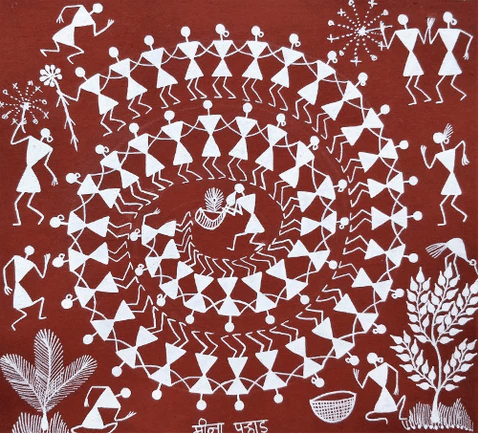
Warli Painting
*To know more about the topic, click this link Warli Painting
Gond Painting
- Gond Painting is practised by the Central Indian "Gond" tribe. As the central theme of art, Gond art includes life.
- The art form honours life, such as hills, streams, animals, and birds. Traditionally, the tribes painted on the mud walls of their homes.
- Paintings by Gond are best defined as 'online work.' The artist takes great care in drawing both the inner and outside lines so that the precision of the lines has an immediate impact on the observer.
- Lines are used in such a way that they give the static photos a sensation of movement.
- To convey a better sense of movement and improve the quantity of information, dots and dashes are added.
- The use of bright, vivid colours such as white, red, blue, and yellow is another remarkable feature of Gond art.
- Natural materials such as charcoal, coloured soil, plant sap, leaves, and even cow dung are used to make the paints.
- Yellow is derived from Chui mitti, a sort of local sand; brown is obtained from Gheru mitti, another type of sand; green is conveniently gotten from leaves, and red is obtained from the Hibiscus flower.
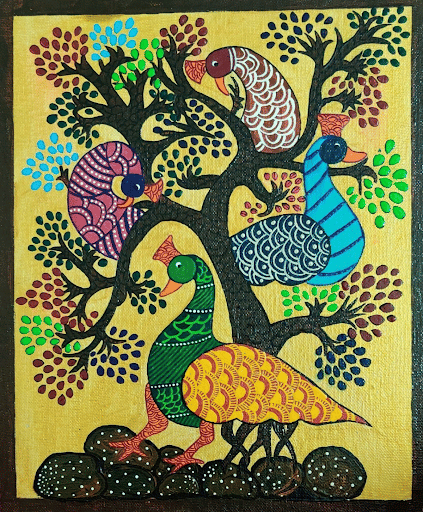
Gond Painting
Madhubani Painting
- Madhubani paintings originated in the Bihar village of Maithili. Painting is usually done using twigs, nibs, matchsticks, and fingers.
- Paints are made from natural dyes and pigments. Geometrical patterns, such as line drawings filled with brilliant colours, are prominent.
- Originally, the women of the village painted these murals on the walls of their homes to express their thoughts, hopes, and ideals.
- Later on, these paintings began to be used in celebrations and special occasions.
- Geometrical designs, and floral, animal, and avian themes are all part of the style.
- The colours are applied flat, with no shading, and no white space. The colours are typically dark and brilliant such as lampblack (a coal-derived pigment) and ochre (earthy yellow pigment).
- Artists now paint with brushes, nib pens, and synthetic colours as well.
- Themes: It is based on Hindu legendary characters such as Krishna, Rama, Lakshmi, Shiva, Durga, and Saraswati, and depicts their lives.
- The distinct styles of Madhubani painting are Godna, Kohbar, Tantrik, Bharani, and Katchni.
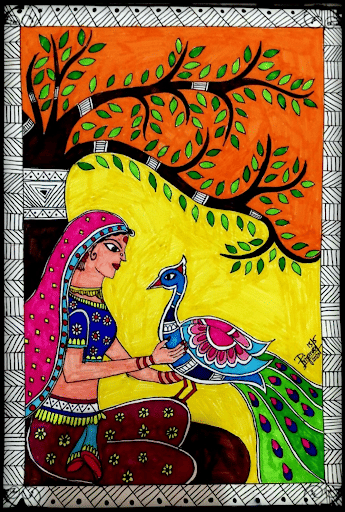
Madhubani Painting
*To know more about the topic, click this link Madhubani Painting
Pattachitra
- Pattachitra means "image on a cloth" in Sanskrit. Odisha is the state where it is traditionally practiced.
- Themes: Hindu mythology, religious stories, folklore, and deity figures are all shown in the artwork. Simple themes are created with natural paints on a fabric canvas.
- This type of art is directly linked to Shri Jagannath's religion and Puri's temple traditions. It is thought to have originated in the 12th century.
- Thia Badhia: representation of Lord Jagannath's temple; Krishna Lila – the dramatization of Jagannath as Lord Krishna demonstrating his powers as a child.
- Dasabatara Patti: Lord Vishnu's ten incarnations; Panchamukhi – depiction of Lord Ganesh as a five-headed deity.
- The majority of the materials utilized in this artwork are natural. It's a structured type of art with a set of guidelines and limitations.
- Around the paintings, a floral border is required, as is the usage of natural hues.
- The paintings are mostly done in profile, and the eyes are elongated.
- The paintings end up conveying harsh emotional expressions with remarkable clarity due to the usage of such prominent solid hues.
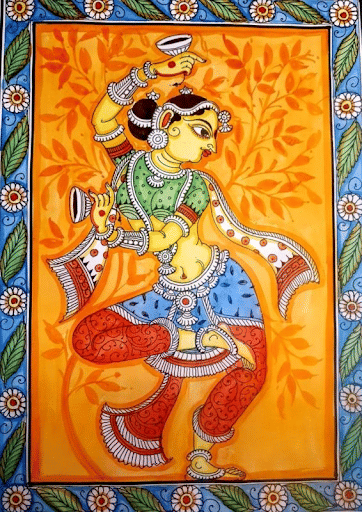
Pattachitra
Pithora Painting
- Pithora Painting is a highly ritualistic painting practiced by tribes in Central Gujarat such as the Rathwas and Bhilalas.
- It's a wall artwork that's mostly known for the seven horses. These seven horses are thought to represent the seven hills that surround the Gujarat-Madhya Pradesh border.
- The name 'Pithora painting' comes from the tribe's god, God Pithora (Pithora Baba).
- Lakhara refers to the well-trained Pithora artists who were responsible for the development of Pithora art.
- The Lakharas paint the Pithora wall mural during auspicious rituals. The popular idea is that by hanging the Pithora artwork on their walls, they are requesting God's blessings.
- Pithora Art is created in the house's roofed gallery (Verandah). The walls are prepared with a mixture of cow dung and dirt before the Pithora wall painting begins.
- Unmarried girls are usually in charge of preparing the walls for Pithora art.
- White (Clay), orange, green, blue, red, and yellow are the colours used in the Pithora painting.
- Within a rectangular space, the paintings are bordered. The paintings depict mythological or cherished events in the Rathwas' lives.
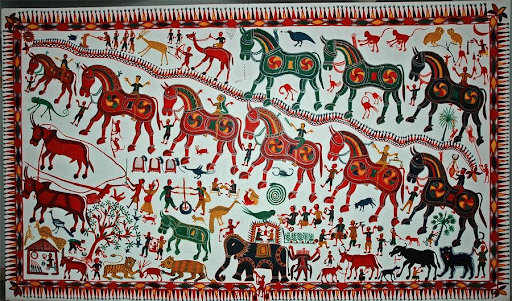
Pithora Painting
Rajasthani Miniature Paintings
- Rajasthani Miniature Paintings were brought to India by the Mughals.
- These artistic creations are constructed with the utmost care; every last detail is attended to; there are lines, particulars, and lovely vibrant hues placed in an amazing example.
- Many specialists now create miniature compositions on silk, ivory, cotton, and paper.
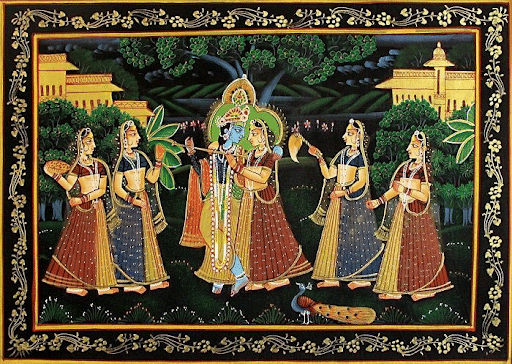
Rajasthani Miniature Paintings
Palam Qalam Painting
- The subject of Palam Qalam Painting is the daily life scenes of ordinary people.
- Palam Qalam Paintings are indeed small works of art.
- These artworks are dominated by male artists. There is also an Indo British influence in this style.
- Sevakram is a well-known painter who created these works.
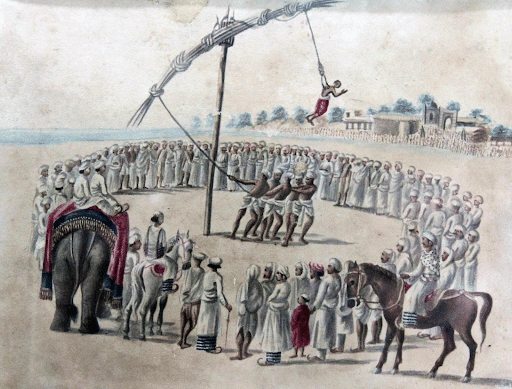
Palam Qalam Painting
Bazar Painting
- Bazar paintings are known as Bengali paintings. Bazar Painting originated in the 19th century in West Bengal.
- Because Roman and Greek figures are copied here, this style of painting has a European influence.
- Indian gods with multiple arms are also condemned since they do not conform to the human image.
- The theme of Bazar paintings is the everyday bazaar scene as well as female dancers dancing in front of British officers.
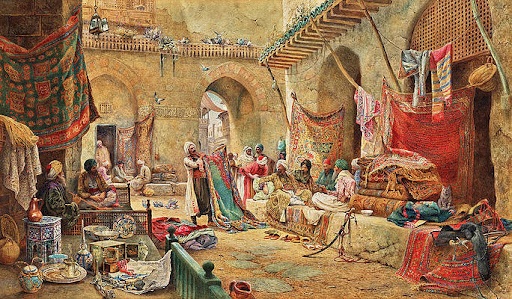
Bazar Painting
Kalamezhuthu
- Kalamezhuthu is a drawing similar to rangoli or kolam that is created at the entrances to temples and dwellings.
- The Kalamezhuthu painting has its origin in the Indian state of Kerala.
- It is carved work depicting the god in the sanctuary on the flooring and woodlands of the sanctuaries.
- The moment intricacies, measurements, and shading decisions are chosen in each painting in accordance with strict standards.
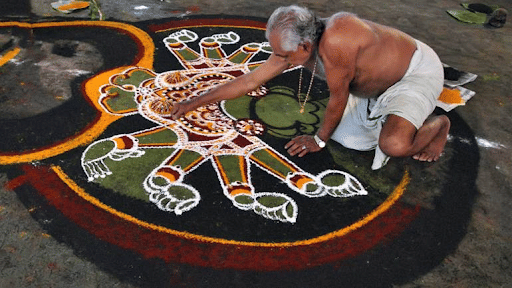
Kalamezhuthu
Conclusion
Since ancient times, India's tribal and rural populations have produced a wide variety of art and cultural forms that continue to demonstrate their incredible creative ability. In addition to their exceptional brilliance from an aesthetic standpoint, tribal/folk art and cultural forms have been crucial in developing humanity among the people of the nation, strengthening social solidarity, building communal harmony, and preserving national identity. Thus the diverse traditional history of tribal/folk arts and culture in India is unique and remarkable.
| Other Relevant Links | |
|---|---|
| Indian Art and Culture | Indian Handicrafts |
| Modern Indian Architecture | Architecture in Medieval India |
| Indo-Islamic Architecture | Indian Architecture |
FAQs
Question: What are the main types of tribal paintings in India?
Answer: The main types of tribal paintings in India include Warli art from Maharashtra, Madhubani painting from Bihar, Pithora painting from Gujarat, Gond art from Madhya Pradesh, and Saura painting from Odisha. These art forms reflect the cultural heritage and traditions of various tribal communities.
Question: What is the significance of Warli painting?
Answer: Warli painting, originating from the Warli tribe of Maharashtra, is significant for its simple yet profound depictions of daily life, nature, and social rituals. This art form uses basic geometric shapes to tell stories and convey messages, often focusing on themes like harvest, weddings, and dances.
Question: What materials are used in traditional Madhubani painting?
Answer: Traditional Madhubani painting uses natural materials such as plant-based colors, rice paste, and handmade paper or cloth. The artists use twigs, matchsticks, or fingers as painting tools to create intricate designs.
Question: How does Gond art reflect tribal life?
Answer: Gond art, practiced by the Gond tribe of Madhya Pradesh, reflects tribal life through vivid depictions of flora, fauna, deities, and folklore. The art often features intricate patterns and vibrant colors that represent their connection with nature and spirituality.
Question: What is unique about Saura painting?
Answer: Saura painting, created by the Saura tribe of Odisha, is unique due to its use of symbolic figures and motifs that narrate tribal stories and traditions. The paintings often depict scenes of daily life, religious rituals, and elements of nature, showcasing the Sauras' deep cultural beliefs.
MCQs
1. Which state is known for Warli painting?
A) Rajasthan
B) Maharashtra
C) Madhya Pradesh
D) Odisha
Answer: (B) See the Explanation
Explanation: Warli painting is a traditional tribal art form practiced by the Warli tribe in Maharashtra. It is characterized by simple geometric shapes and depictions of daily life and nature.
2. What is a common theme in Madhubani painting?
A) Political events
B) Harvest and festivals
C) Urban life
D) Scientific concepts
Answer: (B) See the Explanation
Explanation: Madhubani painting commonly features themes related to harvests, festivals, and religious rituals, showcasing the cultural life and beliefs of the people in Bihar.
3. Which tribal painting is known for depicting deities, animals, and nature with intricate patterns?
A) Pithora
B) Gond art
C) Saura
D) Warli
Answer: (B) See the Explanation
Explanation: Gond art from Madhya Pradesh is known for its intricate patterns and vibrant depictions of deities, animals, and nature, reflecting the tribe’s close relationship with their environment.
4. Which tribe is associated with Pithora painting?
A) Gond
B) Warli
C) Bhil
D) Saura
Answer: (C) See the Explanation
Explanation: Pithora painting is associated with the Bhil tribe, primarily found in Gujarat and parts of Madhya Pradesh. It is known for vibrant colors and depictions of deities, often painted during religious ceremonies.
5. What is a distinctive feature of Saura painting?
A) Use of dots and lines
B) Religious and social motifs
C) Metallic colors
D) Abstract symbols
Answer: (B) See the Explanation
Explanation: Saura painting is distinguished by its use of religious and social motifs, with symbolic figures that narrate stories related to daily life and rituals.
GS Mains Questions and Model Answers
Q1: Examine the cultural significance of tribal paintings in India and their contribution to preserving heritage.
Answer: Tribal paintings in India, such as Warli, Gond, Madhubani, Saura, and Pithora, play a crucial role in preserving the cultural heritage and traditions of various tribal communities. These art forms are not only aesthetic but also carry deep cultural meanings, representing rituals, religious beliefs, and everyday life. Warli painting, for instance, uses simple geometric shapes to depict social rituals and nature, symbolizing the tribe’s connection with their environment. Gond art is known for its vibrant depictions of flora, fauna, and deities, illustrating the tribe's folklore and beliefs. These paintings contribute to the documentation and continuation of oral traditions and are integral to festivals and religious ceremonies, thereby reinforcing community bonds. By promoting these art forms through exhibitions and educational programs, India can protect and celebrate its diverse cultural heritage while supporting the livelihoods of tribal artists.
Q2: Discuss how tribal art forms like Madhubani and Gond paintings have influenced modern art and design.
Answer: Tribal art forms like Madhubani and Gond paintings have significantly influenced modern art and design through their unique aesthetic and cultural narratives. Madhubani art, with its intricate patterns and use of natural colors, has inspired contemporary artists and designers to incorporate traditional motifs into modern art pieces, clothing, and home décor. Similarly, Gond art’s vivid depictions of animals, nature, and folklore have found expression in murals, illustrations, and fashion, showcasing the rich heritage of the tribe. These art forms have been embraced for their detailed storytelling and connection to nature, resonating with contemporary themes of sustainability and cultural identity. The integration of tribal art into mainstream design highlights the importance of preserving these traditions while making them relevant in today’s global art scene.
Q3: Analyze the challenges faced by tribal artists in preserving their traditional art forms in the face of modernization.
Answer: Tribal artists face several challenges in preserving their traditional art forms amidst modernization and globalization. One of the primary challenges is the lack of access to platforms that showcase their work, leading to limited recognition and financial stability. The influx of modern art and digital media has overshadowed traditional practices, making it difficult for tribal artists to compete. Additionally, the younger generation may be less inclined to learn traditional art due to a shift towards urban lifestyles and economic opportunities. Efforts to preserve these art forms require supportive measures such as government and NGO initiatives, workshops, and education programs that encourage the continuation of these traditions. Promoting tribal art through national and international exhibitions and creating sustainable market opportunities can help these artists thrive and keep their cultural heritage alive.
Previous Year Questions on Tribal Painting
1. UPSC CSE Prelims 2021:
Question: Which of the following art forms is associated with the Warli tribe?
A) Pithora
B) Gond
C) Warli
D) Madhubani
Answer: (C)
Explanation: The Warli painting is associated with the Warli tribe of Maharashtra and is known for its simple, geometric depictions of daily life and social activities.
2. UPSC CSE Mains 2019 (GS Paper 1):
Question: "Evaluate the significance of traditional tribal art forms in contributing to India’s cultural diversity."
Answer: Traditional tribal art forms such as Warli, Gond, Madhubani, and Pithora contribute immensely to India’s cultural diversity by preserving the rich heritage and unique traditions of various tribal communities. These art forms are not just decorative but are deeply embedded with social, religious, and ecological themes that reflect the tribes' way of life. For instance, Warli art depicts rituals, dances, and nature, highlighting the tribe’s connection to the environment. Gond art, with its vibrant colors and intricate patterns, tells stories of folklore and mythology. The significance of these art forms lies in their ability to maintain cultural narratives and support community identity. Promoting tribal art helps in preserving these traditions, enriching India's diverse artistic heritage, and providing economic support to tribal artists.
Download the PREPP App and attempt FREE IAS Exam Mock Tests and get complete study material!

Live Test : UPSC CSE Prelims CSAT (Paper-II) (Oct 20 - 23)
Full Test - 04: UPSC CSE Prelims CSAT (Paper-II)
Full Test - 03: UPSC CSE Prelims CSAT (Paper-II)
UPSC CSE Prelims 2026 GS Paper 1 Question Paper (24-May-2026)
UPSC CSE Prelims 2026 CSAT Paper 2 Question Paper (24-May-2026)

17 February 2025 | The Hindu Must Read Articles | Current Affairs

16 February 2026 | The Hindu Must Read Articles | Current Affairs

13 February 2026 | The Hindu Must Read Articles | Current Affairs









Comments