The Ultra-Careful Quest To Find The Shape Of The Electron’s Charge
Relevance: GS3 - Science and Technology- developments and their applications and effects in everyday life.
(Source: The Hindu, 07/26/2023)
Click here for Daily Current Affairs
Why in the news?
- Recently, researchers from the University of Colorado reported that they could not find evidence of new physics in an experiment involving electrons.
- New physics aims to address the deficiencies in the Standard Model of Physics.
Table of Contents
What is the Standard Model of Physics?
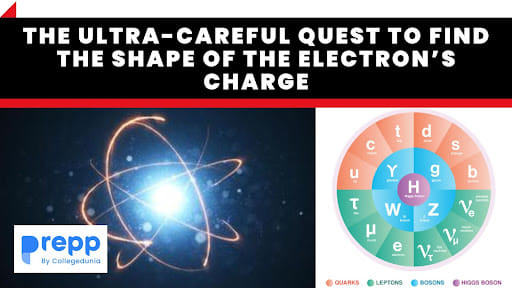
- The Standard Model of Physics aims to explain the interactions between the basic building blocks of matter, which are governed by four fundamental forces.
- It was developed in the early 1970s and successfully explained many phenomena and experimental results.
- It predicted the existence of various particles, including the Higgs Boson.
- However, it has not been able to explain what dark matter and dark energy are or why the Higgs Boson particle is heavy and gravity weaker than the other fundamental forces.
On Antimatter
- According to the Standard Model, there should have been equal quantities of matter and antimatter, at the point of time when the universe is created.
- The equal quantities of the two substances would have annihilated each other, releasing energy in the form of light.
- This would lead to the universe being filled with light.
- However, the quantities of matter and antimatter were not equal.
- Physicists have been conducting various experiments to identify any deficiencies in the Standard Model, which will help validate new theories.
Study on electrons
- The study conducted by researchers from the University of Colorado on electrons looked for evidence of ‘new physics’ with the highest precision.
- The apparatus used in the research study could fit on a table while the Large Hadron Collider at CERN, which also studies nature, costs about $4.75 billion to build and $1 billion to run annually.
- It examined whether the electric charge of an electron is located at its center.
- It measured the energy difference between the two states of an electron.
- When its spin is in the direction of an external electric field
- When its spin is aligned opposite to that of the field.
- Valence electrons in hafnium fluoride (HfF) molecules were studied as they can exert an electric field of 23 billion V/cm, which is around 10,000 times stronger than what is possible in the lab, even if it is only applicable over short distances.
- Thousands of HfF molecules were ionized and held in a trap in order to bring them to particular energy states.
- An external magnetic field was applied to negate noise and a small electric field was applied to orient the molecules.
- The energy difference between the electrons in the two states was measured using the Ramsey spectroscopy technique.
Findings
- New Physics: No evidence of new physics was found in the study.
- This indicates that alternative theories are feasible.
- Electric charge: If the electric charge is not in the center, the electron would have a dipole with a negative charge on one side and a positive charge on the other.
- The formation of such a dipole will oppose Time symmetry (T-symmetry).
- The dipole’s strength or dipole moment is impacted by how distant the dipole is from the center.
- If time was reversed, the electron’s spin would flip and the electric dipole moment would look fundamentally different from before.
- Energy Difference: In the absence of an electron electric dipole moment (eEDM), the energy difference should be zero.
- If an eEDM is present, then one of the electron states will have slightly more energy and the value can be created from the difference.
- An EDM measurement is more sensitive if the electric field is stronger, if the measure is coherent for longer, and if the signal-to-noise ratio is higher.
- The electron’s eEDM is lower than 4.1 × 10⁻³⁰e cm at a 90% confidence, as compared to the 10–38e cm limit in the Standard model.
- The result was found to be consistent with zero and is eight orders of magnitude above the limit that the Standard Model allows.
- When the eEDM is much higher than the limit of the Standard model, the model will collapse indicating the need for “new physics”.
- It revealed that the existence of particles with a mass less than 4 TeV was more improbable.
|
Sakharov conditions
- These are a set of conditions developed by Nobel laureate Andrei Sakharov in 1967 regarding the matter-antimatter symmetry problem.
- baryon number violation
- C- and CP-symmetry violation
- baryon production rate must be slower than the universe’s expansion rate.
First Condition
- Baryons are particles made of three quarks and have a baryon number assigned to them..
- Eg: Protons, neutrons
- Baryon number = number of quarks - number of anti-quarks
- 3
- Whenever a baryon interacts with other particles according to the Standard Model, the baryon number is conserved.
- This means that the baryon number is the same before and after the interactions between the particles.
- According to Sakharov’s first condition, this rule must be violated in an interaction i.e. more baryons should be produced than anti-baryons.
- This will ensure that matter dominates antimatter.
Second Condition
- Charge conjugation symmetry (C symmetry): Charge conjugation is the process of replacing a particle with its anti-particle, leading to a charge reversal.
- When C-symmetry is violated, baryon-producing processes will exceed non-baryon-producing processes.
- Parity symmetry (P symmetry): When an interaction between particles is valid, its mirror image should also be valid.
- CP-symmetry is an interaction that violates both C-symmetry and P-symmetry together.
Third Condition
- According to Sakharov’s third condition, the rate of expansion of the universe should be greater than the rate of production of baryons and anti-baryons.
- Consider a chemical reaction, A + B → C + D, in which the quantity of A and B gradually decreases and the quantity of C and D increases.
- This would cause a reversal of the reaction, which can be prevented by certain restricting conditions such as high temperature.
- As per the third condition, the rate of the expansion of the universe must be greater than the rate of baryon production to prevent a compensatory reverse process that increases the production of anit-baryons.
Impact
- The C- and CP-symmetry violations have been discovered by scientists only in particles that have quarks.
- As a result, the resulting matter-antimatter asymmetry cannot adequately explain matter’s dominance in the universe and indicates the need for a model of ‘new physics’ that permits more CP-symmetry violation.
Conclusion
The results from the research study will help frame the requirements for the development and operation of future high-energy particle colliders which could create time-symmetry-violating particles responsible for the matter-antimatter asymmetry in the early universe.
(*Click this link to read prelims specific weekly current affairs articles)
FAQs
Question: What is antimatter?
Answer:
Antimatter is the opposite of normal matter. More specifically, the sub-atomic particles of antimatter have properties opposite those of normal matter. Antimatter interacts with all four fundamental forces and is annihilated when matter and antimatter interact.
Question: What is the Higgs Boson particle?
Answer:
The Higgs boson or the God particle is the fundamental force-carrying particle of the Higgs field. It is 130 times more massive than a proton and is responsible for granting other particles their mass. It is chargeless and the only fundamental particle with spin.
MCQs
Question: Consider the following statements:
- Friction is one of the four fundamental forces.
- Gravitational force is the weakest of the four fundamental forces.
Which of the above statements is/are correct?
(a) Only 1
(b) Only 2
(c) All 3
(d) None
Answer: (b) See the Explanation
- The four fundamental forces in nature are Gravitational force, Weak Nuclear force, Electromagnetic force, and Strong Nuclear force.
- Friction is not a fundamental force. Hence statement 1 is incorrect.
- Gravitational Force is the weakest force but it has infinite range. Hence statement 2 is correct.
Therefore, option (b) is the correct answer.
Download the PREPP App and attempt FREE IAS Exam Mock Tests and get complete study material!

Full Test - 04: UPSC CSE Prelims CSAT (Paper-II)
Full Test - 03: UPSC CSE Prelims CSAT (Paper-II)
UPSC CSE Prelims 2026 GS Paper 1 Question Paper (24-May-2026)
UPSC CSE Prelims 2026 CSAT Paper 2 Question Paper (24-May-2026)

17 February 2025 | The Hindu Must Read Articles | Current Affairs

16 February 2026 | The Hindu Must Read Articles | Current Affairs

13 February 2026 | The Hindu Must Read Articles | Current Affairs









Comments