Final Orbit-Raising Manoeuvre Of Chandrayaan-3 Completed
(Source: The Hindu, 07/26/2023)
Click here for Daily Current Affairs
Why in the news?
- Recently, ISRO completed the fourth orbit-raising maneuver of the Chandrayaan-3 mission from ISTRAC, Bengaluru.
- Chandrayaan-3 is expected to complete its soft landing on the moon’s surface on 23rd August 2023.
Table of Contents
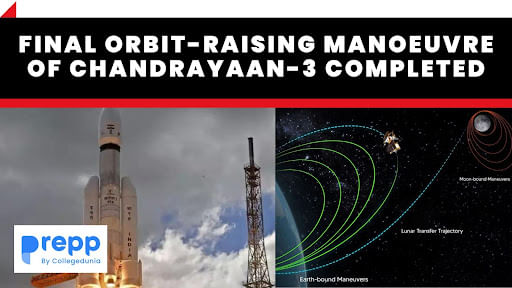
Orbit raising maneuvers
- The Chandrayaan-3 rocket is expected to attain an orbit of 1,27,609 km x 236 km following the successful completion of the fifth and final orbit-raising maneuver.
- As a result, the rocket is 236 km from Earth at its nearest and 1,27,609 km away at its farthest.
- The next step is the Translunar Injection which will slingshot the rocket toward the moon.
- All the orbit-raising maneuvers were performed by the ISRO Telemetry, Tracking and Command Network (ISTRAC), Bengaluru.
Other orbits
- First orbit raising maneuver (Earthbound firing-1): The spacecraft reached an orbit of 41762 km x 173 km.
- Second orbit raising maneuver (Earth-bound apogee firing): The spacecraft reached an orbit of 41603 x 226 km.
- Third orbit raising maneuver (Earth-bound perigee firing): The rocket reached an orbit of 51400 x 228 km.
- Fourth orbit raising maneuver (Earth-bound perigee firing): The rocket attained an orbit of 71351 x 233 km.
|
Why is Chandrayaan-3 taking so long to reach the moon?
- The Chandrayaan-3 Mission is expected to take around 41 days to reach the moon’s surface.
- In comparison, NASA’s Apollo 11 completed its flight in just 4 days in 1969.
- Trajectory:
- Apollo 11 used the Translunar Injection method to reach the moon aboard the powerful Saturn V launch vehicle.
- The spacecraft was propelled directly into Earth orbit and then directly sent to the moon through a single engine burn.
- Chandrayaan-3 has used a series of Earth orbits and engine burns to gradually increase the spacecraft's speed and position it to complete lunar insertion.
- This approach is necessary because of the use of the relatively less powerful GSLV Mark-III, which possesses a lower payload capacity compared to the Saturn V.
- Cost-effective:
- Chandrayaan-3’s longer route has been chosen to economize the entire journey.
- It is cost-effective in terms of the equipment(heavier rockets) and fuel expenses.
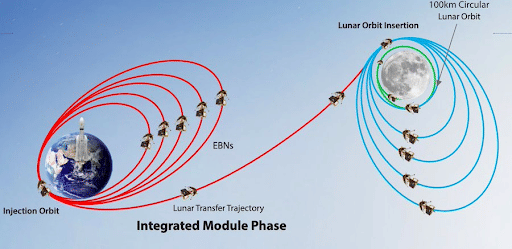
How will Chandrayaan-3 reach the moon?
- Using gravity:
- The elliptical orbital path used by Chandrayaan-3 allows it to achieve peak speed when at the perigee.
- Each time the perigee is approached, the rocket’s engines are activated, helping it gain momentum and energy as it climbs.
- When the module obtains the escape velocity required to escape Earth’s gravity, the orbit elongates allowing the rocket to enter into the Lunar Transfer Trajectory.
- Lunar insertion:
- Once the module reaches the intended point in the Lunar Transfer Trajectory, lunar orbit insertion is performed.
- This reduces the module’s speed allowing it to be pulled into a stable lunar orbit by the moon’s gravitational force.
- The module then orbits the moon in an elliptical path, gradually reducing its altitude until it reaches a circular orbit of 100 km.
- Landing:
- The Propulsion Module and Lander Module (Vikram) will then separate and deboost maneuvers performed before the power descent phase which involves the soft landing.
ISTRAC
- The ISRO Telemetry, Tracking, and Command Network (ISTRAC) is responsible for providing tracking support to all of ISRO’s satellite and launch vehicle missions.
- It carries out mission operations of all operational remote sensing and scientific satellites from launch vehicle lift-off to injection of satellite into orbit.
- It provides space operations support for Deep Space Missions of ISRO and undertakes radar systems development for launch vehicles.
- It is mandated to establish and operationalize the ground segment for the Indian Regional Navigational Satellite System (IRSNSS) and provide services such as Search & Rescue and Disaster Management.
- It also supports space-based services such as telemedicine, tele-education, and Village Resource Centers (VRC).
(*Click this link to read prelims specific weekly current affairs articles)
FAQs
Question: What is the launch vehicle used for Chandrayaan-3?
Answer:
The ISRO has used the Launch Vehicle Mark-III (LVM 3) to launch the Chandrayaan-3 mission. It is the most powerful configuration of the GSLV produced by India. It uses solid-fuel, liquid fuel, and cryogenic engines.
Question: What is the IRNSS?
Answer:
The IRNSS is an independent regional navigation satellite system developed by India that can provide accurate position information service to users in India as well as the region extending up to 1500 km from its boundary. It consists of 8 satellites, of which 7 are currently active.
MCQs
Question: Consider the following statements:
- Chandrayaan-3 has used the translunar injection method to directly reach the lunar orbit.
- It aims to land near the south pole of the moon.
Which of the above statements is/are correct?
(a) Only 1
(b) Only 2
(c) Both 1 and 2
(d) None
Answer: (b) See the Explanation
- Chandrayaan-3 has not used the translunar injection method to directly reach the lunar orbit. Instead, it follows a series of orbital raises and the use of gravity to reach the moon. Hence statement 1 is incorrect.
- Chandrayaan-3 aims to display its safe landing and roving capabilities on the lunar surface by landing near the south pole of the moon. Hence statement 2 is correct.
Therefore, option (b) is the correct answer.
Download the PREPP App and attempt FREE IAS Exam Mock Tests and get complete study material!

Full Test - 04: UPSC CSE Prelims CSAT (Paper-II)
Full Test - 03: UPSC CSE Prelims CSAT (Paper-II)
UPSC CSE Prelims 2026 GS Paper 1 Question Paper (24-May-2026)
UPSC CSE Prelims 2026 CSAT Paper 2 Question Paper (24-May-2026)

17 February 2025 | The Hindu Must Read Articles | Current Affairs

16 February 2026 | The Hindu Must Read Articles | Current Affairs

13 February 2026 | The Hindu Must Read Articles | Current Affairs









Comments