Semiconductor Tech: What Exactly Is India Going To Manufacture?
(Source: The Hindu, 07/22/2023)
Click here for Daily Current Affairs
Why in the news?
- Foxconn Technology Group recently withdrew its support from its joint venture with Vedanta, Ltd. to establish a semiconductor manufacturing plant in Gujarat.
- India aims to join the small, elite group of nations that have access to semiconductor technology which will allow it to generate thousands of highly skilled jobs.
- India’s present focus is on legacy nodes, which are used in sectors such as aerospace, robotics, defense, IoT, etc.
Table of Contents
What is a semiconductor chip?
- A semiconductor consists of transistors made from selected materials like silicon, gallium, arsenide, etc.
- They have a conductivity between that of conductors and insulators.
- The conductivity of semiconductors increases with an increase in temperature.
- Small amounts of impurities are added to pure semiconductors via doping, to increase their conductivity.
Legacy nodes
- Legacy or mainstream nodes are less advanced chips that have been developed using older technologies such as the 28 nm technique.
- They are not outdated technology and are regularly updated.
- They account for a significant portion of the revenue generated by most fabrication units.
- Applications: robotics, defense, aerospace, industry automation tools, automobiles, Internet of Things, and image sensors.
Why is India focussing on legacy nodes?
- Cheaper: They are cost-effective when compared to advanced nodes (10-5 nm) used in smartphones, laptops, and other devices.
- Widespread applications: Increase in demand for electric vehicles will lead to a complementary increase in the demand for electronic components like music players which are powered by legacy nodes.
- A report by McKinsey revealed that the value of semiconductor technology in the infotainment and user experience category in electric vehicles could grow from $11 billion (2019) to $30 billion by 2030.
- Competition with China: As China is the most prominent manufacturer of legacy nodes, it can in the future impose regulations on purchases which could adversely affect Indian and global industries.
- By developing domestic facilities, India can provide an alternative to China, from which countries are seeking to diversify due to geopolitical concerns.
- Industrial development: Focusing on legacy nodes at present will help India develop its nascent manufacturing sector from the base up and gradually upscale towards manufacturing advanced nodes.
Initiatives
- Modified Programme for the Development of Semiconductors and Display Manufacturing Ecosystems.
- Scheme for Promotion of Manufacturing of Electronic Components and Semiconductors (SPECS)
- Modified Special Incentive Package Scheme (M-SIPS)
- Semiconductor Wafer FAB Acquisition Program (SEWFAP)
- Modified Electronics Manufacturing Clusters (EMC 2.0) Scheme
What are the challenges faced by India in semiconductor manufacturing?
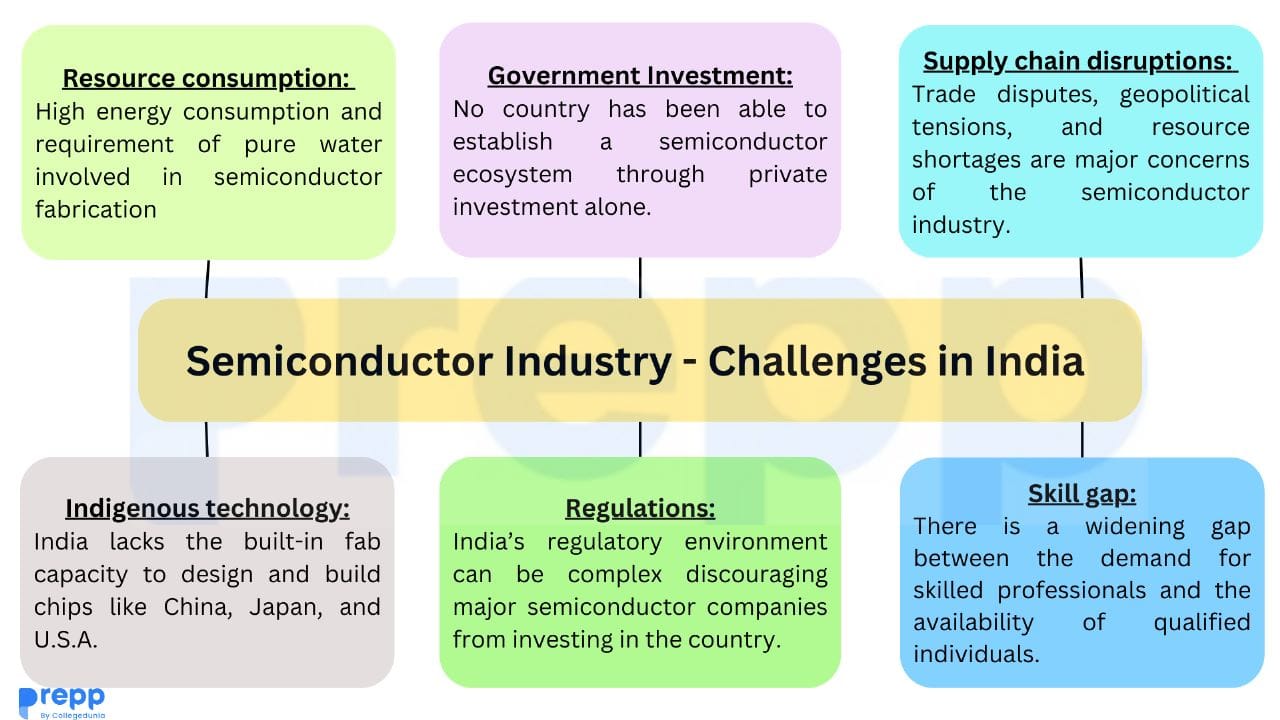
- Large costs: The establishment of semiconductor fabrication units is resource intensive and expensive.
- One semiconductor fab requires an estimated investment of $5-15 billion, whereas the approved outlay for the Indan Semiconductor programme is $10 billion.
- Raw material availability: The Indian semiconductor industry is reliant on China which possesses nearly 60% of the world’s germanium and 80% of global gallium deposits.
- Export restrictions imposed on gallium and germanium by China will harm Indian industry since India lacks adequate deposits of these metals.
- Water availability: Chip manufacturing requires a large amount of pure water.
- This could be difficult in India during droughts and impact the country’s groundwater reserves.
- Import dependency: In 2022, over 90% of the $27 billion semiconductor industry in India was imported from Japan, China, Taiwan, U.S.A., etc.
- Indigenous technology: India has excelled in chip design but lacks built-in fab capacity like China, Japan, and U.S.A. which can design and build chips.
- India requires significant R&D investments to be able to compete.
- Regulations: India’s regulatory environment can be complex and opaque, which discourages major semiconductor companies from investing in domestic facilities.
- India has struggled to access the necessary finance required to develop and upscale its semiconductor manufacturing capabilities.
- Workforce: It requires a highly trained and skilled workforce.
- India will have to invest in skilling and training and develop industry-academia links to produce a market-ready workforce.
Conclusion
- Chip manufacturing has become one of India’s top priorities as it aims to attract global companies.
- The domestic manufacturing of semiconductors will help achieve the government’s vision of a domestic electronics supply chain and reduce reliance on other countries like China.
- It is an opportunity for India to become an alternative to China as a source of semiconductors as countries seek to diversify their supply chains from China.
(*Click this link to read prelims specific weekly current affairs articles)
FAQs
Question: What is a transistor?
Answer:
A transistor is an electronic component that is used in circuits to either amplify or switch electrical signals or power. It is generally made of silicon and is a constituent of most electronic devices.
Question: What is the Internet of Things?
Answer:
The Internet of Things (IoT) is a computing concept in which common objects are connected to a network like the Internet. The devices can then communicate with each other and with the users.
MCQs
Question: Consider the following statements:
- The Digital India Corporation is a not-for-profit company under the Ministry of Information and Broadcasting.
- It is the nodal agency for the development of semiconductor and manufacturing ecosystem in India.
Which of the above statements is/are correct?
(a) Only 1
(b) Only 2
(c) Both 1 and 2
(d) None
Answer: (d) See the Explanation
- The Digital India Corporation, earlier known as Media Lab Asia, is a not-for-profit company under the Ministry of Electronics and Information Technology established under Section 8 of The Companies Act, 2013. Hence statement 1 is incorrect.
- India Semiconductor Mission, an Independent Business Division of the Digital India Corporation, is the nodal agency for efficient, coherent, and smooth implementation of the programme for the development of semiconductor and manufacturing ecosystem in India. Hence statement 2 is incorrect.
Therefore, option (d) is the correct answer.
Download the PREPP App and attempt FREE IAS Exam Mock Tests and get complete study material!

Full Test - 04: UPSC CSE Prelims CSAT (Paper-II)
Full Test - 03: UPSC CSE Prelims CSAT (Paper-II)
UPSC CSE Prelims 2026 GS Paper 1 Question Paper (24-May-2026)
UPSC CSE Prelims 2026 CSAT Paper 2 Question Paper (24-May-2026)

17 February 2025 | The Hindu Must Read Articles | Current Affairs

16 February 2026 | The Hindu Must Read Articles | Current Affairs

13 February 2026 | The Hindu Must Read Articles | Current Affairs









Comments