The Legacy Of The Voyager Mission
Relevance: GS 3 - Awareness in the fields of Space
(Source: Indian Express, 04/08/23)
Click here for Daily Current Affairs
Why in the news?
- Recently NASA reestablished communication with Voyager 2 spacecraft on August 1, after losing communication for over a week.
- Voyager 2, launched nearly 46 years ago, became the second spacecraft to venture into interstellar space, an area beyond the influence of the Sun's material and magnetic field.
Table of Contents
About Voyager 1 and Voyager 2
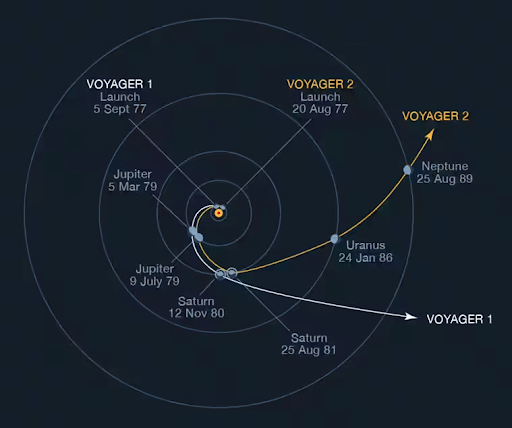
- The spacecraft were scheduled for a launch towards the end of the 1970s in order to take advantage of a rare alignment of Jupiter, Saturn, Uranus, and Neptune that occurs once every 175 years.
- The alignment enabled the spacecraft to utilize the gravitational forces of the planets, allowing them to transition from one planet to the next with minimal fuel consumption.
- The mission of two spacecraft was away from the sun therefore they relied on a small nuclear power plant that generates energy by breaking down plutonium, providing them with the power they need.
What are the notable achievements of the Voyager spacecraft?
- Voyager 2 was launched on August 20, 1977, followed by Voyager 1 on September 5.
- Voyager 1 was set on a course to reach Jupiter and Saturn before Voyager 2.
- The two probes have explored all the outer giant planets of our solar system and discovered over 40 moons and numerous rings.
- They have provided invaluable data on planetary astronomy and inspired many future space missions.
- Jupiter: Voyager 1’s discovery included an active moon named ‘Io’ with erupting volcanoes. Io is one of Jupiter's moons.
- Voyager 1 and Voyager 2 discovered three new moons of Jupiter: Thebe, Metis, and Adrastea
- Saturn: Voyager 1 explored Saturn and found that Titan's solid center was smaller than Jupiter's Ganymede.
- The spacecraft also noted that Titan’s atmosphere was composed of 90 per cent nitrogen, and it likely had clouds and rain of methane.
- Uranus: Voyager 2 arrived at Uranus in 1986, becoming the first human-made object to fly past the aquamarine planet. The spacecraft confirmed that the main constituents of Uranus are hydrogen and helium.
- It also discovered 10 new moons and two new rings in addition to the previously-known nine rings, among other significant findings.
- Neptune: Voyager 2 became the first human-made object to fly by Neptune in 1989.
- It discovered the new moons and rings, it also found that Neptune is more active than previously thought, winds on the planet blow at the speed of 1,100 kph.
- The spacecraft also observed the Great Dark Spot, which was essentially a huge spinning storm in the southern atmosphere of Neptune and it was about the size of the entire Earth.
- Interstellar space: Voyager 1 and Voyager 2 were sent out of our solar system. Voyager 1 left in August 2012, followed by Voyager 2 in November 2018.
- This was important for astronomers to locate the border of interstellar space, which is hard to measure from within our solar system. They found that it begins a bit over 18 billion kilometers from the sun.
- Scientists define the beginning of interstellar space as the place where the Sun's constant flow of material and magnetic field stop affecting its surroundings.
(*Click this link to read prelims specific weekly current affairs articles)
FAQs
Question: What is Deep Space Network?
Answer:
The Deep Space Network - or DSN - is NASA’s international array of giant radio antennas that supports interplanetary spacecraft missions, plus a few that orbit Earth. The DSN also provides radar and radio astronomy observations that improve our understanding of the solar system and the larger universe.
Question: Which Planet has rings?
Answer:
Saturn,Jupiter, Uranus and Neptune have rings. But Saturn's rings are the biggest and brightest.
Question: What is Kuiper belt?
Answer:
The Kuiper Belt is a doughnut-shaped ring of icy objects around the Sun, extending just beyond the orbit of Neptune
MCQ
Question: Which of the following pair(s) is/are correctly matched? (UPSC-2014)
| Spacecraft | Purpose |
|---|---|
| 1.Cassini-Huygens | Orbiting the Venus and transmitting data to the Earth |
| 2.Messenger | Mapping and investigating the Mercury |
| 3.Voyager | Exploring the outer solar system |
(a) 1 only
(b) 2 and 3 only
(c) 1 and 3 only
(d) 1, 2 and 3
Answer: (b) See the Explanation
- Cassini-Huygens was a joint NASA/ESA/ASI mission. NASA's Cassini spacecraft orbited Saturn, making an extensive survey of the ringed planet and its moons. Hence, pair 1 is incorrect.
- MESSENGER (Mercury Surface, Space Environment, Geochemistry and Ranging) was the seventh Discovery-class mission, and the first spacecraft to orbit Mercury. Hence, pair 2 is correct.
- The mission objective of the Voyager Interstellar Mission (VIM) is to extend the NASA exploration of the solar system beyond the neighborhood of the outer planets to the outer limits of the Sun's sphere of influence, and possibly beyond. Hence, pair 3 is correct
- Therefore, option (b) is the correct answer.
Download the PREPP App and attempt FREE IAS Exam Mock Tests and get complete study material!

Full Test - 04: UPSC CSE Prelims CSAT (Paper-II)
Full Test - 03: UPSC CSE Prelims CSAT (Paper-II)
UPSC CSE Prelims 2026 GS Paper 1 Question Paper (24-May-2026)
UPSC CSE Prelims 2026 CSAT Paper 2 Question Paper (24-May-2026)

17 February 2025 | The Hindu Must Read Articles | Current Affairs

16 February 2026 | The Hindu Must Read Articles | Current Affairs

13 February 2026 | The Hindu Must Read Articles | Current Affairs









Comments