Govt Imposes Curbs On Import Of Laptops, Tablets
Relevance: GS2 - Government policies and interventions; GS3 - Changes in industrial policy and their effects on industrial growth; Growth and Development
(Source: The Hindu, Indian Express, 08/04/2023)
Click here for Daily Current Affairs
Why in the news?
- Recently, the Indian government has implemented immediate restrictions on the import of various electronic devices such as personal computers, laptops, and data processing machines.
- The imports of computers and other items under the seven categories of HSN Code 8471 were restricted and their import would be allowed against a valid licence for restricted imports.
- This move is intended to boost domestic manufacturing and aligns with the government's Production-Linked Incentive (PLI) scheme for IT hardware.
Table of Contents

Key Highlights of Imports of Electronic Goods
- India has seen an increase in imports of electronic goods and laptops/computers in the last few years.
- During April-June 2023, the import of electronic goods increased to $6.96 billion from $4.73 billion in the year-ago period, with a share of 4-7 per cent in overall imports.
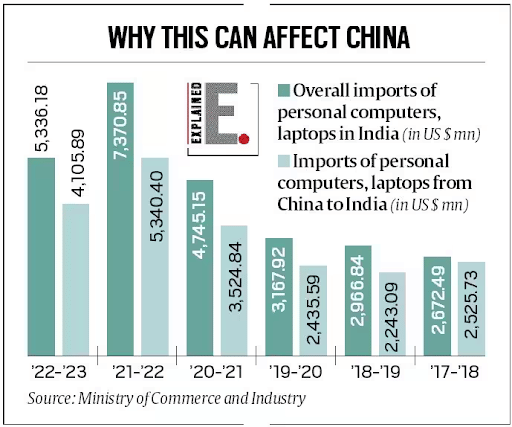
- Of the seven categories restricted for imports by India, the majority share of imports is from China.
- China accounts for roughly 70-80% of the share of India’s imports of personal computers, laptops.
Why have these restrictions been imposed?
- Boost domestic manufacturing: The recently imposed restrictions aim to boost domestic manufacturing of IT hardware through the production-linked incentive (PLI) scheme while also curbing the influx of these products from countries like China and Korea.
- Ensure security: It was stated that the main reason for these restrictions is to ensure the security of citizens. Certain hardware might pose security risks and could compromise sensitive and personal data. Therefore, these measures have been taken to address these potential security-related issues.
- The move is in line with the government's initiatives to boost manufacturing in India ‘Make In India’ programme. The curbs on import will give a boost to local manufacturers of electronic products such as laptops, computers, etc.
Impact of the move
- Impact on Industry Giants and Consumers: Companies like Apple, Samsung, and Acer could be affected by these restrictions, as they might need to increase local manufacturing and assembly to comply. Depending on licensing norms, consumer prices might rise due to potential supply disruptions.
- Impact on import data and China's Dominance: China holds a substantial share in the categories affected by these restrictions. In recent periods, China's imports in these categories were valued at millions.
- Half of India's restricted goods come from China, but their relationship has deteriorated due to border clashes in 2020. This has prompted India to take anti-China measures, including limiting investment and trade from its neighbor.
What is HSN Code 8471?
What is a Production Linked Incentive (PLI) scheme?
|
(*Click this link to read prelims specific weekly current affairs articles)
FAQs
Question: What is import in the context of trade?
Answer:
In the context of trade and economics, "import" refers to the act of bringing goods or services into one country from another country for the purpose of selling or using them.
Question: What is the Make in India initiative?
Answer:
Make in India is an initiative by the Government of India to create and encourage companies to develop, manufacture and assemble products made in India and incentivize dedicated investments into manufacturing.
Question: What is a Production Linked Incentive (PLI) scheme?
Answer:
It is a set of initiatives launched by the Government of India to boost domestic manufacturing and exports in various sectors. The schemes aim to provide financial incentives to eligible manufacturers based on their incremental production and sales over a base year.
UPSC Mains Practice Question:
|
MCQ
Question: Consider the following statements about Production Linked Incentives (PLI):
- It aims to provide financial incentives to manufacturers who meet specific production targets.
- The scheme is also applicable to the agriculture sector.
Which of the statements given above is/are correct?
(a) 1 only
(b) 2 only
(c) Both 1 and 2
(d) Neither 1 nor 2
Answer: (a) See the Explanation
- The Production Linked Incentive (PLI) scheme launched by the Government of India which aims to provide financial incentives to manufacturers who meet specific production targets. Hence, statement 1 is correct.
- The scheme is applicable to various sectors, including electronics, pharmaceuticals, automobiles, textiles, food processing, and more. Hence, statement 2 is not correct.
- The PLI scheme is expected to reduce dependence on imports and promote domestic manufacturing.
Therefore, option (a) is the correct answer.
Download the PREPP App and attempt FREE IAS Exam Mock Tests and get complete study material!

Full Test - 04: UPSC CSE Prelims CSAT (Paper-II)
Full Test - 03: UPSC CSE Prelims CSAT (Paper-II)
UPSC CSE Prelims 2026 GS Paper 1 Question Paper (24-May-2026)
UPSC CSE Prelims 2026 CSAT Paper 2 Question Paper (24-May-2026)

17 February 2025 | The Hindu Must Read Articles | Current Affairs

16 February 2026 | The Hindu Must Read Articles | Current Affairs

13 February 2026 | The Hindu Must Read Articles | Current Affairs









Comments