Himalayan Vulture Bred In Captivity For The First Time In India
Relevance: GS3 - Conservation, environmental pollution and degradation, environmental impact assessment GS1 - Geographical features and their location-changes in critical geographical features (including water-bodies and ice-caps) and in flora and fauna and the effects of such changes. Prelims
(Source: The Hindu, 08/04/2023)
Click here for Daily Current Affairs
Why in the news?
- Recently, researchers recorded the first captive breeding of a Himalayan vulture in India at the Assam State Zoo, Guwahati.
- All three vulture species found in India under the gyps vulture category are classified as critically endangered.
- Some Vulture species have displayed nearly 90% decline in population in India since the 1990s.
Table of Contents
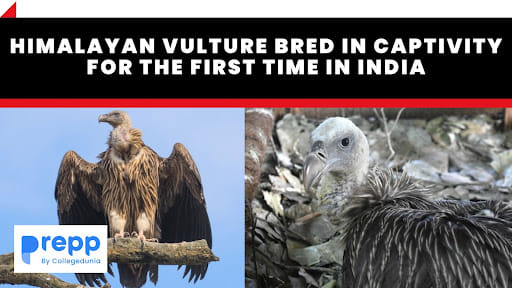
Himalayan Vulture
- The Himalayan vulture is the largest bird species native to India.
- Scientific name: Gyps himalayensis
- Features:
- It is sandy brown in color and has a pale, featherless head.
- It is seen in large groups and as single birds.
- Broad wings and short dark feathers.
- White neck ruff and yellow bill
- Habitat:
- Himalayan countries - India, Nepal, Bhutan, Mongolia, China
- Central Asian mountains - Kazakhstan, Afghanistan
- Migration: It is a common migrant to the Indian plains during the winters.
- Conservation Status:
- IUCN Red List: Near Threatened
- CITES: Appendix II
- WPA, 1972: Schedule IV
- Threats:
- Poisoning: Kidney failure induced by diclofenac and other toxic non-steroidal anti-inflammatory drugs is a major cause of the death of vulture species
- Electrocution: Vulture deaths have been reported due to contact with high-tension power distribution lines.
- Persecution: They have been persecuted by many communities as they are natural scavengers. This has led to their deaths due to deliberate poisoning or hunting.
- Forest Fires: Forest fires have destroyed the traditional nesting sites of these vultures leading to reduction in vulture populations.
Captive breeding of the Himalayan vulture
- The Himalayan vultures that were successfully bred were rescued in 2011-2012 from accidents and poisonings.
- The hatchling which was born in captivity was observed on March 14, 2022, and shifted to the artificial brooding facility on 15 March.
- During the first month, it was kept in a plastic box-based brooder with a mat for the grip.
- The temperature was maintained around 30-35°C and provided with a lamp, a water bowl, and a thermo-hygrometer for continuous monitoring.
- Although the vulture usually breeds in snow environments, it had acclimatized to the tropical environment of the zoo over its long stay there, which allowed it to breed successfully.
- India became the second country to successfully complete the captive breeding of the Himalayan vulture after France.
- The Bombay Natural History Society (BNHS) has previously bred three other vulture species—the white-rumped vulture, the Indian vulture, and the slender-billed vulture—in captivity for conservation and reintroduction purposes.
Other vulture species in India
- India is home to 8 other species of vulture - Oriental white-backed, Long-billed, Slender-billed, Red-headed, Egyptian, Bearded, Cinereous, and the Eurasian Griffon.
- The Bearded, Long-billed, Slender-billed, and Oriental white-backed are protected under Schedule-1 of the Wildlife Protection Act 1972 while the remaining are protected under ‘Schedule IV’.
Recent Central decision
- The Union Ministry of Health and Family Welfare banned the manufacture, sale, and distribution of ketoprofen and aceclofenac and their formulations for animal use under section 26A of the Drugs and Cosmetics Act, 1940 (23 of 40) in July 2023.
- Aceclofenac immediately converts into diclofenac in animals and remains in the body for longer periods.
- Ketoprofen, which is an anti-inflammatory drug (NSAID) used to treat pain, inflammation, swelling, stiffness, and joint pain, was found to be poisonous to the Himalayan vulture.
Vulture Action Plan
- The Ministry of Environment, Forests and Climate Change (MoEFCC) launched the Vulture Action Plan 2020-25 for the conservation of vultures in India.
- The MoEFCC launched the Action Plan for Vulture Conservation 2006 with the Drugs Controller General of India (DCGI) and banned the veterinary use of diclofenac in the same year.
- It incorporated the Vulture Recovery Plan (2004) which recommended banning the veterinary use of diclofenac, finding its substitute, and setting up conservation breeding centers for vultures.
Objectives
Drug control
- Ensure minimum use of Diclofenac and prevent the poisoning of cattle carcasses, which are the major food of vultures, with veterinary NSAIDs, by ensuring regulated and prescription-based sale of veterinary NSAIDs.
- Carry out safety testing of available NSAIDs on vultures and develop new ones which do not affect vultures.
- Ensure that DGCI must institute a system that automatically removes a drug from veterinary use if it is found to be toxic to vultures.
Upscaling conservation
- Establish Additional Conservation Breeding Centres and Vulture Conservation Centres
- Implement the Vulture Safe Zone programme
- Launch conservation and breeding plans for the Red-headed and Egyptian vultures.
- Declare a Vulture Safe Zone only when no toxic drugs are found in undercover pharmacy and cattle carcass surveys, for two consecutive years, and the vulture populations are stable and not declining.
- Build Four rescue centers spread across the country.
Other Efforts
- The Vulture Conservation Breeding Programme has been established by the CZA and BNHS.
- A Vulture Care Centre (VCC) was set up at Pinjore, Haryana in 2001 to study the cause of deaths of vultures in India.
- SAVE or Saving Asia’s Vultures from Extinction is a consortium of like-minded, regional, and international organizations that oversees and coordinates conservation, campaigning, and fundraising activities related to South Asian vultures.
Conclusion
- The successful captive breeding and the ban on aceclofenac and ketoprofen are game-changing initiatives for vulture conservation.
- However, the ban should be implemented efficiently and other NSAIDs like Nimesulide which are major threats to vultures must also be banned.
- Alongside introducing safer alternative drugs for vultures, similar steps should be taken to protect other raptor species in India.
To know more about vulture conservation, click the link.
(*Click this link to read prelims specific weekly current affairs articles)
FAQs
Question: What is captive breeding?
Answer:
Captive breeding is the process of breeding animals outside of their natural environment in restricted conditions in farms, zoos, or other closed facilities. Humans control the selection of animals and mating partners during this process which aims to conserve threatened species.
Question: What are NSAIDs?
Answer:
Non-steroidal anti-inflammatory drugs or NSAIDs are medicines that are used for pain relief, inflammation reduction, and temperature regulation. They are also to relieve symptoms like headaches. painful periods. sprains and strains. However, they can be toxic to certain species like vultures.
MCQs
Question: Vultures which used to be very common in Indian countryside some years ago are rarely seen nowadays. This is attributed to (UPSC CSE 2012)
(a) the destruction of their nesting sites by new invasive species
(b) a drug used by cattle owners for treating their diseased cattle
(c) scarcity of food available to them
(d) a widespread, persistent, and fatal disease among them
Answer: (b) See the Explanation
- In 2004, it was discovered that diclofenac was the cause of vulture deaths and that 97% of the population had been lost till then.
- Diclofenac is an NSAID used as an analgesic to reduce inflammation.
Therefore, option (b) is the correct answer.
Download the PREPP App and attempt FREE IAS Exam Mock Tests and get complete study material!

Full Test - 04: UPSC CSE Prelims CSAT (Paper-II)
Full Test - 03: UPSC CSE Prelims CSAT (Paper-II)
UPSC CSE Prelims 2026 GS Paper 1 Question Paper (24-May-2026)
UPSC CSE Prelims 2026 CSAT Paper 2 Question Paper (24-May-2026)

17 February 2025 | The Hindu Must Read Articles | Current Affairs

16 February 2026 | The Hindu Must Read Articles | Current Affairs

13 February 2026 | The Hindu Must Read Articles | Current Affairs









Comments