Southwest Monsoon Withdraws From India
Relevance: GS1 - Important Geophysical phenomena; Geographical Features & Their Location
(Source: The Hindu, 20/10/2023)
Click here for Daily Current Affairs
Why in the news?
- Recently, the India Meteorological Department (IMD) announced that the southwest monsoon has ended, and the northeast monsoon, or the 'retreating monsoon,' is expected to arrive.
Table of Contents
The Retreating Monsoon Season in India
- Retreating Monsoon Months: The South-West Monsoon starts retreating from northern India in early October. Hence, the months of October and November are known for the retreating monsoon.
- Temperature: During this phase, temperatures decrease significantly, and the skies become clearer. As the monsoon moves southward, the pressure gradient weakens, and local pressure conditions play a crucial role in influencing wind patterns.
- Emerging Cyclones: During this season, cyclones and depressions in the Bay of Bengal can cause heavy rainfall. It may lead to flooding and landslides in some areas. The retreating monsoon also marks the beginning of the winter season in India. The temperatures gradually decrease across the country.
- Rainfall: The Retreating Monsoon season is critical for many parts of India as it is the main source of rainfall for the southern peninsula. This particularly includes Tamil Nadu, Puducherry, and coastal Andhra Pradesh.
- Varied Rainfall Patterns: The retreating monsoon delivers varying amounts of rainfall to different regions of India, with some areas experiencing heavy precipitation while others receive meager rainfall.
- Agriculture and other related activities rely heavily on the retreating monsoon season. It is the time for harvesting crops and preparing for the winter season.
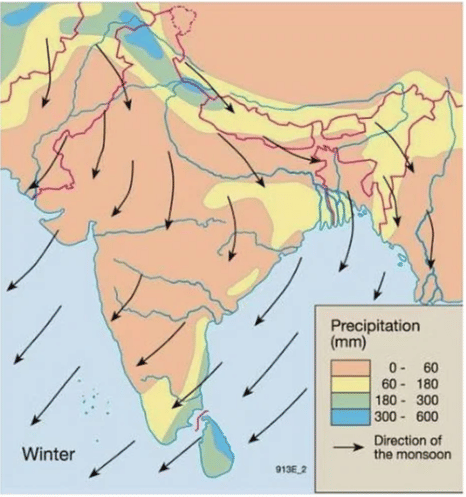
(Retreating Monsoon)
What is the forecast of IMD?
-
Northeast Monsoon Forecast: The IMD predicted a 'normal' northeast monsoon for the period from October to December. They anticipate 'normal to above-normal rainfall' in significant parts of north-west India and the southern peninsula.
- Tamil Nadu, Kerala, Karnataka, and parts of Andhra Pradesh heavily rely on the northeast monsoon, even though it constitutes only 11% of India's annual rainfall.
- Yearly Monsoon Variability: Historical records show considerable year-to-year variability. In 2015, Chennai faced heavy rainfall, while the northeast monsoon was weak in 2019, resulting in a severe water shortage.
- Low-Pressure Areas and Cyclone Potential: The IMD has reported the development of two low-pressure areas, which could be precursors to cyclones. These developments are observed in the Arabian Sea and the Bay of Bengal. The extent of their potential intensification remains uncertain.
Monsoon Withdrawal and Recent Rainfall Statistics
- The 2023 southwest monsoon season was the weakest in five years, and also marked by erratic distribution of rains.
- June received 9% below normal rainfall.
- July brought torrential downpour and floods across man regions in northern India.
- August was the driest month on record in 100 years, with 36% below normal rainfall.
- September saw some recovery with showers 13% above normal, but the four-month monsoon season ended with 6% below normal rainfall.
- The southwest monsoon began its withdrawal from Rajasthan on September 25, nearly a week behind its normal date of September 17.
- Though monsoon withdrawal begins from Rajasthan, it takes nearly until early to mid-October for it to fully withdraw and be replaced by the northeast monsoon.
- India officially considers rainfall from June 1 to September 30 as monsoon rainfall.
- As of September 30, India received 94% of the expected rain during the monsoon months, slightly below the forecasted 96%.
- This shortfall was due in part to the El Nino causing dry conditions in August, but September brought unexpected rains.
About Monsoon in India
South West Monsoon:
|

(*Click this link to read prelims specific weekly current affairs articles)
FAQs
Question: What is Monsoon?
Answer:
The term "monsoon" refers to the climate associated with the seasonal reversal of wind direction. The monsoons are a double system of seasonal winds that travel from the sea to the land in the summer and from the land to the sea in the winter.
Question: What is the Southwest Monsoon Season?
Answer:
The Southwest Monsoon Season, also called Rainy Season, is from June to September. This southwest monsoon is caused by an intense low-pressure system forming over the Tibetan Plateau as a result of intense heating during the summer season.
Question: What is El Nino?
Answer:
El Nino is a weather phenomenon that describes the anomalous warming of surface waters in the eastern tropical Pacific Ocean. It happens more often than La Nina. Fishermen off the coast of Peru noted El Nio as the presence of unusually warm water.
PYQ
Question: The seasonal reversal of winds is the typical characteristic of: (UPSC 2014)
(a) Equatorial climate
(b) Mediterranean climate
(c) Monsoon climate
(d) All of the above climates
Answer: (c) See the Explanation
Explanation: Monsoon climate is characterized by a seasonal reversal of winds. It has a distinct wet season and a dry season. The monsoon is a large-scale atmospheric circulation phenomenon that dominates the world's tropical and subtropical areas.
Therefore, option (c) is the correct answer.
Question: In the South Atlantic and South-Eastern Pacific regions in tropical latitudes, cyclones do not originate. What is the reason? (UPSC 2015)
(a) Sea surface temperatures are low
(b) Inter-Tropical Convergence Zone seldom occurs
(c) Coriolis force is too weak
(d) Absence of land in those regions
Answer: (b) See the Explanation
Explanation: The rare occurrence of the Inter-Tropical Convergence Zone (ITCZ) across the region is one of the most direct causes of the scarcity of cyclones in the South Atlantic and South Eastern Pacific oceans. The development of tropical cyclones becomes extremely difficult or practically impossible unless the ITCZ provides synoptic vorticity (a clockwise or counterclockwise spin in the troposphere) and convergence (i.e., large scale spin and thunderstorm activity).
Therefore, option (b) is the correct answer.
UPSC Previous Year Mains Questions:
- Why is the South-West monsoon called ‘Purvaiya’ (easterly) in Bhojpur Region? How has this directional seasonal wind system influenced the cultural ethos of the region? (UPSC 2023)
- What characteristics can be assigned to a monsoon climate that succeeds in feeding more than 50 percent of the won population residing in Monsoon Asia? (UPSC 2017)
- Discuss the nature and origin of the Indian monsoon and recent techniques of its prediction. (UPSC 2014)
- Discuss the mechanism and origin of Monsoon winds & explain the role of EI Nino on Monsoon circulation. (UPSC 2008)
- Which part of India receives more rainfall from the northeast monsoon than from the southwest monsoon? Explain why it is so? (UPSC 1994)
Download the PREPP App and attempt FREE IAS Exam Mock Tests and get complete study material!

Full Test - 04: UPSC CSE Prelims CSAT (Paper-II)
Full Test - 03: UPSC CSE Prelims CSAT (Paper-II)
UPSC CSE Prelims 2026 GS Paper 1 Question Paper (24-May-2026)
UPSC CSE Prelims 2026 CSAT Paper 2 Question Paper (24-May-2026)

17 February 2025 | The Hindu Must Read Articles | Current Affairs

16 February 2026 | The Hindu Must Read Articles | Current Affairs

13 February 2026 | The Hindu Must Read Articles | Current Affairs









Comments