Centre Says Measures In Place To Check Price Rise
Relevance: GS2 - Government Policies and Interventions; GS3 - Public Distribution System- objectives, functioning, limitations, revamping; Issues of buffer stocks and food security
(Source: The Hindu, 20/10/2023)
Click here for Daily Current Affairs
Why in the news?
- Recently, the Union Food Secretary assured that prices of essential food items will remain stable, offering relief to the millions of consumers who tend to increase their purchases during the festive season.
Table of Contents
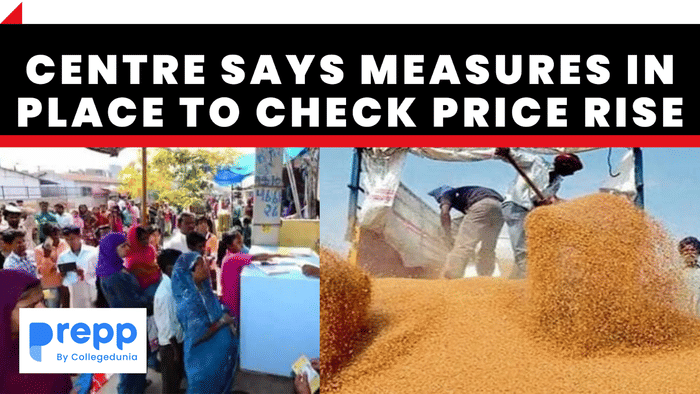
Government Measures to Ensure Price Stability for Essential Food Items
- Export Restrictions on Rice: The Government, in order to check the domestic prices and to ensure domestic food security, has taken several pre-emptive measures to restrict export of rice from India.
- India is the world's largest rice exporter, but in July there was ban on overseas shipments of non-basmati white rice and later imposed a 20% tax on parboiled rice cargoes to ensure sufficient supplies in the domestic market.
- The government has extended the 20% export duty on parboiled rice until March 31, 2024, to ensure ample availability in the domestic market. This move has significantly reduced parboiled rice exports by 65% in quantity and 56% in value.
- The export of broken rice has also been prohibited, and a 20% export duty has been imposed on non-basmati white rice.
- Wheat Availability: The government has initiated the Open Market Sale Scheme (domestic) through e-auction to release 50 lakh tonnes of wheat. The Food Corporation of India (FCI) has already sold 25.6 lakh tonnes under this scheme. These actions have increased the availability of wheat and helped stabilize its prices, with a retail inflation rate of approximately 3.6% over a year.
- Edible Oil Price Stability: The government stated that edible oil prices will remain stable during the festival season and expects no significant price hikes in the coming months.
- Sugar Export Restrictions: The government has extended restrictions on the export of various types of sugar, including raw, white, refined, and organic sugar, with no specified end date. New Delhi has also extended its restriction on sugar exports, as output is likely to drop due to patchy rains in top sugar cane producing states of Maharashtra and Karnataka.
What is an Open Market Sale Scheme?
What is FCI?
|
Significance of Government's move to Ensure Price Stability
- Consumer Relief: These measures aim to prevent significant price increases for essential food items like rice, wheat, and sugar during the festival season.
- Food Security: By maintaining adequate availability of these food items in the domestic market, the government is contributing to food security. This ensures that people have access to these necessities without experiencing shortages or unaffordable prices.
- Inflation Control: These actions can help control inflation, particularly in essential food items. By restricting exports and increasing domestic supply, the government can mitigate price spikes, which can have broader implications for overall inflation rates.
- Economic Impact: Stable food prices can positively impact the purchasing power of consumers and contribute to economic stability. When essential food items are affordable, households have more disposable income to spend on other goods and services.
Conclusion
These efforts underscore the government's commitment to addressing economic and nutritional concerns, particularly during festival seasons, and serve as a crucial component of broader food security and economic stability initiatives.
(*Click this link to read prelims specific weekly current affairs articles)
FAQs
Question: Why has India banned rice exports?
Answer:
Rice is a staple for more than half the Indian population. The country produces around 135 million tonnes of rice annually, more than enough to meet domestic demand of around 100-105 million tonnes. This includes the rice it distributes at subsidised rates to the country’s 800 million poor.
Question: What is the Open Market Sale Scheme?
Answer:
The Open Market Sale Scheme (OMSS) is a program in which the Food Corporation of India (FCI) periodically releases surplus food grains, primarily wheat and rice, from the central pool to various market stakeholders such as traders, bulk consumers, and retail chains.
Question: What is Food Corporation of India (FCI)?
Answer:
It is one of the largest corporations established by the Indian government and likely one of the largest supply chain management organizations in India.
It is a Public Sector Undertaking that reports to the Ministry of Consumer Affairs, Food and Public Distribution.
PYQs
Question: The economic cost of food grains to the Food Corporation of India is Minimum Support Price and bonus (if any) paid to the farmers plus: (UPSC 2019)
(a) Transportation cost only
(b) Interest cost only
(c) Procurement incidentals and distribution costs
(d) Procurement incidentals and charges for godowns
Answer: (c) See the Explanation
- The economic cost of food grains procured by the Food Corporation of India (FCI) is the sum of the Minimum Support Price and any bonus paid to farmers, plus procurement incidentals and distribution costs.
- The economic cost of FCI is made up of three major components: procurement cost, procurement price, and distribution cost.
- Procurement incidentals are the initial costs incurred when purchasing foodgrains.
- Distribution costs include freight, handling fees, storage fees, transit losses, and establishment costs.
Therefore, option (c) is the correct answer.
Question: With reference to foreign-owned e-commerce firms operating in India, which of the following statements is/are correct? (UPSC 2022)
- They can sell their own goods in addition to offering their platforms as marketplaces.
- The degree to which they can own big sellers on their platforms is limited.
Select the correct answer using the code given below:
(a) 1 only
(b) 2 only
(c) Both 1 and 2
(d) Neither 1 nor 2
Answer: (b) See the Explanation
Following Walmart's $16 billion purchase of Flipkart in 2018, the rules for foreign-owned e-commerce firms were tightened even further, with unexpected severity. There are two major constraints.
- First, foreign firms are prohibited from holding inventory or selling their own goods, which Amazon and Walmart do in other markets. They can only provide their platforms as "marketplaces" for other buyers and sellers. Hence, statement 1 is incorrect.
- Second, the extent to which they can own big sellers on their platforms is limited in order to prevent those sellers from acting covertly on their behalf. Hence, statement 2 is correct.
Therefore, option (b) is the correct answer.
Download the PREPP App and attempt FREE IAS Exam Mock Tests and get complete study material!

Full Test - 04: UPSC CSE Prelims CSAT (Paper-II)
Full Test - 03: UPSC CSE Prelims CSAT (Paper-II)
UPSC CSE Prelims 2026 GS Paper 1 Question Paper (24-May-2026)
UPSC CSE Prelims 2026 CSAT Paper 2 Question Paper (24-May-2026)

17 February 2025 | The Hindu Must Read Articles | Current Affairs

16 February 2026 | The Hindu Must Read Articles | Current Affairs

13 February 2026 | The Hindu Must Read Articles | Current Affairs









Comments