Reserve Bank India Act 1935 - Indian Economy Notes
The Reserve Bank of India Act (RBI Act), 1934, established the Reserve Bank of India. It was enacted on March 6, 1934. This law came into effect on April 1, 1935. It establishes a framework for bank oversight and other relevant issues. The RBI Act 1934 has given the RBI powers of supervision and control over the commercial banks.
The provisions of the RBI Act are important for UPSC IAS Exam to understand the powers and responsibilities of the RBI.
|
Table of Contents |
Key Objectives of RBI Act 1934
- Establishment of RBI: The RBI Act established the Reserve Bank of India as the central banking institution of the country.
- Monetary Policy: The Act provides the RBI with the authority to formulate and implement monetary policy to maintain price stability and promote economic growth.
- Currency Issuance: The RBI has the exclusive right to issue currency notes and coins in India.
- Banking Regulation: The Act empowers the RBI to regulate and supervise the banking and financial sector in India.
- Reserve Management: The RBI is responsible for maintaining and managing the country's foreign exchange reserves.
- Government Banker and Financial Advisor: The Act designated the RBI as the banker to the central and state governments.
- Financial Stability: The Act empowered the RBI to take measures to safeguard the stability of the financial system.
Provisions of RBI Act 1934
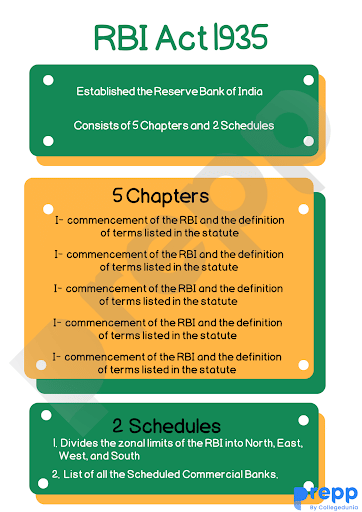
The RBI Act consists of 5 Chapters and 2 Schedules. It comprises 58 sections detailing the administrative rules of the RBI. Some of the main provisions are explained below.
Chapter I
- It consists of two sections detailing the commencement of the RBI and the definition of terms listed in the statute.
Chapter II: It provides details regarding Incorporation, Capital, Management, and Business. Section 3 to Section 19 is provided in this chapter.
- Section 3
- It establishes the Reserve Bank of India to take over the management of the currency from the Central Government and to carry out banking operations in accordance with the Act's requirements.
- Section 4
- It defines the RBI's capital, which is Rs. 5 crores.
- Section 7
- It gives the central government the authority to provide orders to the bank in the public interest from time to time, in conjunction with the RBI Governor.
- The Central Board of Directors also has superintendence and direction over the affairs and business of the RBI under this clause.
- Section 17
- This section discusses the RBI's operations. The RBI can accept interest-free deposits from the central and state governments.
- It has the ability to buy and sell bills of exchange from commercial banks. It has the ability to buy and sell foreign currency through banks.
- It has the ability to lend to banks and state-owned financial institutions.
- It can help the central government and state governments in development.
- It has the ability to buy and sell government securities.
- It has the ability to trade derivatives, repo, and reverse repo.
- Section 18
- This section discusses bank emergency loans.
Chapter III: It lists the Central Bank functions from Section 20 to Section 45.
- Section 21
- The RBI is tasked with acting as the central government's banker and managing public debt under this section.
- Section 22
- It empowers the Reserve Bank of India (RBI) to issue currency.
- Section 24
- The maximum denomination note allowed under this rule is ₹10,000.
- Section 28
- It authorizes the Reserve Bank of India (RBI) to create laws governing the exchange of damaged and faulty notes.
- Section 31
- This section states that the Reserve Bank of India and the Indian government can only issue and accept promissory notes that are due on request in India.
- Section 42(1)
- Every scheduled bank must maintain an average daily balance with the RBI, according to this provision.
- The Cash Reserve Ratio (CRR) requirement was established under this section.
Chapter IIIA: It empowers the central bank to collect and furnish credit information from Section 45A to 45G.
- Section 45B
- The bank can collect information regarding credit from banking companies.
Chapter IIIB: It provides provisions relating to Non-Banking Institutions receiving deposits and financial institutions from Section 45H to 45N.
- Section 45K
- The bank can collect information from non-banking institutions regarding deposits, statements and to give directions.
Chapter IIIC: It mentions the prohibition of acceptance of deposits by unincorporated bodies from section 45R to section 45T.
- Section 45S
- No unincorporated individual, firm, or association can accept deposits.
Chapter IIID: It gives information regarding the regulation of transactions in derivatives, money market instruments, securities, etc. from Section 45U to Section 45X.
- Section 45W
- The Bank in the public interest can regulate the financial system of the country to its advantage and determine the policy relating to interest rates or interest rate products and give directions on that behalf to all agencies.
Chapter IV - General Provisions from Section 46 to Section 58A
- Section 46
- The Central Government has to transfer a sum of Rs.5 crore to the Reserve Fund in the form of securities.
- Section 49
- The bank from time to time publishes the bank rate.
- Section 57
- The Companies Act doesn’t apply to the banks and the banks can’t be liquified under it.
Chapter V - Penalties from Section 58B to Section 58G
- Section 58C
- If a company defaults, then every person in charge of the company is responsible.
- Section 58G
- If the defaulting entity is a nonfinancial company then the company can impose fines.
| Other Relevant Links | |
|---|---|
| Monetary Aggregates | Function of RBI |
| Base Rate | MCLR |
| Quantitative Tools | Qualitative Methods |
| Narrow Money | Broad Money |
First Schedule
- This divides the zonal limits of the RBI into North, East, West, and South.
Second Schedule
- This lists down all the Scheduled Commercial Banks.
Conclusion
The Reserve Bank of India Act 1934 stands as a historic legislation that has guided India's financial and monetary landscape for decades. Its provisions have played a pivotal role in shaping the role and functions of the RBI, ensuring currency sovereignty, maintaining monetary stability, and promoting financial inclusion. The RBI Act 1934 gives a framework for the administration of the Reserve Bank of India. It is amended time and again to ensure that the central bank is equipped and can offer better services for the commercial banks and carry out an effective monetary policy.
| Other Relevant Links | |
|---|---|
| Indian Economics Notes | Monetary Policy |
| Monetary Policy Tools | Types of Monetary Policy |
| Money Supply | Reserve Bank of India |
| Monetary Policy Transmission | Monetary Policy Committee |
FAQs
Question: What is the Reserve Bank of India Act, 1935?
Answer: The Reserve Bank of India Act, 1935, is a legislative act that established the Reserve Bank of India (RBI) as the central banking institution of the country. This act outlines the structure, functions, and powers of the RBI, which include regulating currency issuance, managing foreign exchange, and supervising the financial system.
Question: When was the Reserve Bank of India (RBI) established?
Answer: The Reserve Bank of India was established on April 1, 1935, under the provisions of the RBI Act, 1935. It initially started as a private shareholders' bank and was later nationalized in 1949.
Question: What are the primary functions of the RBI as per the 1935 Act?
Answer: The primary functions of the RBI as outlined in the RBI Act, 1935, include regulating the issuance of currency, managing the country's foreign exchange reserves, acting as the banker to the government, supervising the financial sector, and ensuring monetary stability in the economy.
Question: How did the nationalization of RBI affect its structure?
Answer: The nationalization of the RBI in 1949 transformed it from a privately-owned entity into a government-owned institution. This change enhanced its role in implementing government policies and strengthened its position as the regulator of the Indian banking system.
Question: Why was the RBI Act of 1935 significant for India's economy?
Answer: The RBI Act of 1935 was significant as it laid the foundation for a structured and centralized banking system in India. It helped streamline monetary policies, regulate the issuance of currency, and maintain financial stability, which were essential for the economic growth and development of the country.
MCQs
1. When was the Reserve Bank of India established?
A) 1925
B) 1930
C) 1935
D) 1949
Answer: (C) See the Explanation
Explanation: The Reserve Bank of India was established on April 1, 1935, under the Reserve Bank of India Act, 1935. It was initially a privately-owned institution and later nationalized in 1949.
2. What was one of the main objectives of the RBI Act, 1935?
A) Regulating the export policies
B) Establishing the central monetary authority
C) Formulating trade agreements
D) Implementing fiscal policy
Answer: (B) See the Explanation
Explanation: The main objective of the RBI Act, 1935, was to establish the Reserve Bank of India as the central banking authority to regulate currency, manage monetary policy, and oversee the financial stability of the country.
3. In which year was the RBI nationalized?
A) 1935
B) 1947
C) 1949
D) 1952
Answer: (C) See the Explanation
Explanation: The Reserve Bank of India was nationalized in 1949, making it a government-owned institution and reinforcing its role as the main monetary authority in India.
4. What role does the RBI play according to the 1935 Act?
A) Issuing fiscal policies
B) Regulating foreign trade
C) Managing currency issuance and monetary policy
D) Overseeing taxation laws
Answer: (C) See the Explanation
Explanation: According to the RBI Act, 1935, the Reserve Bank of India is responsible for issuing currency, managing the country's monetary policy, and supervising the financial system.
5. What significant change occurred with the nationalization of the RBI in 1949?
A) It became a private bank
B) It started issuing trade policies
C) It became a government-owned institution
D) It stopped currency regulation
Answer: (C) See the Explanation
Explanation: The nationalization of the RBI in 1949 turned it into a government-owned institution, enhancing its role in implementing economic policies and acting as the primary regulator of the banking sector in India.
GS Mains Questions and Model Answers
Q1: Explain the significance of the Reserve Bank of India Act, 1935, in shaping India's monetary policy framework.
Answer: The Reserve Bank of India Act, 1935, played a pivotal role in establishing the framework for India's central banking system. It laid the foundation for the Reserve Bank of India (RBI) to function as the main monetary authority, tasked with regulating the issuance of currency and managing monetary policy. The Act empowered the RBI to oversee banking operations, maintain price stability, and manage foreign exchange reserves. This regulatory framework was critical for stabilizing the financial system and fostering economic growth. The nationalization of the RBI in 1949 further solidified its role as a government-controlled entity, enhancing its ability to implement policies that align with national interests.
Q2: Assess the impact of the RBI Act, 1935, on India's banking sector and economic development.
Answer: The RBI Act, 1935, had a profound impact on India's banking sector by establishing the Reserve Bank of India as the central authority responsible for regulating and supervising banks. This regulation ensured financial stability and fostered public confidence in the banking system. By managing currency issuance and monetary policy, the RBI was instrumental in controlling inflation and maintaining economic balance. The act also enabled the RBI to act as a banker to the government, facilitating public debt management and economic planning. These provisions were critical for India's economic development, especially in the post-independence period when financial stability was essential for growth and industrialization.
Q3: Discuss the challenges faced by the Reserve Bank of India in implementing its mandates under the RBI Act, 1935, in the current economic scenario.
Answer: Implementing mandates under the RBI Act, 1935, poses several challenges in the current economic scenario. One of the key challenges is maintaining monetary stability amid global economic fluctuations and inflationary pressures. The RBI must balance interest rate policies to curb inflation while fostering economic growth, which can be challenging in a dynamic and interconnected global market. Additionally, ensuring financial inclusion and managing digital innovations in banking pose regulatory challenges. The evolving financial landscape, characterized by fintech growth, cybersecurity risks, and shifting consumer expectations, requires the RBI to adapt its regulatory practices while staying true to the principles outlined in the 1935 Act. Addressing these issues requires robust policy frameworks and continuous adaptations to meet contemporary economic needs.
Previous Year Questions on Reserve Bank of India Act, 1935
1. UPSC CSE Prelims 2017:
Question: The Reserve Bank of India was established based on which of the following acts?
A) Government of India Act, 1935
B) Indian Currency Act, 1927
C) Reserve Bank of India Act, 1935
D) Banking Regulation Act, 1949
Answer: (C)
Explanation: The Reserve Bank of India was established under the Reserve Bank of India Act, 1935, which outlined its structure, powers, and functions as the central bank of India.
2. UPSC CSE Mains 2018 (GS Paper 3):
Question: "Critically examine the role of the Reserve Bank of India as outlined in the Reserve Bank of India Act, 1935, in promoting economic stability in contemporary India."
Answer: The Reserve Bank of India (RBI), established under the RBI Act, 1935, plays a crucial role in promoting economic stability in India. As the central monetary authority, it regulates the issuance of currency, manages monetary policy, and supervises financial institutions to ensure systemic stability. The RBI's role in controlling inflation, fostering economic growth, and managing foreign exchange reserves has been essential for maintaining economic stability. However, contemporary challenges such as fluctuating global markets, economic disruptions, and the rise of digital currencies require the RBI to continuously adapt its policies while upholding the principles set forth in the 1935 Act. Enhanced regulatory measures, strategic interest rate policies, and collaboration with other financial bodies are vital for sustaining stability and growth in the current economic landscape.
Download the PREPP App and attempt FREE IAS Exam Mock Tests and get complete study material!

Full Test - 04: UPSC CSE Prelims CSAT (Paper-II)
Full Test - 03: UPSC CSE Prelims CSAT (Paper-II)
UPSC CSE Prelims 2026 GS Paper 1 Question Paper (24-May-2026)
UPSC CSE Prelims 2026 CSAT Paper 2 Question Paper (24-May-2026)

17 February 2025 | The Hindu Must Read Articles | Current Affairs

16 February 2026 | The Hindu Must Read Articles | Current Affairs

13 February 2026 | The Hindu Must Read Articles | Current Affairs









Comments