Functions of RBI - Indian Economy Notes
The Reserve Bank of India Act of 1934 established the Reserve Bank which started its first operations in 1935. The Reserve Bank of India (RBI) performs a wide range of functions that are essential for the smooth functioning of the Indian economy such as regulator and supervisor of the financial system, banking to the central government, being in charge of monetary policy, currency management, and oversight of payment and settlement systems. In this article, let us see the functions of the RBI in brief.
|
Table of Contents |
What is RBI?
- The Reserve Bank of India (RBI) is the central banking institution of India, responsible for overseeing and regulating the country's monetary and financial systems.
- Established on April 1, 1935, under the Reserve Bank of India Act, 1934, the RBI serves as the custodian of the Indian rupee, the issuer of currency notes, and the manager of the country's foreign exchange reserves.
- It plays a crucial role in maintaining price stability, fostering financial stability, promoting economic growth, and ensuring the soundness of the banking sector.
- The Reserve Bank of India (RBI) is a national institution and a pillar of the rapidly growing Indian economy. It is also a member of the International Monetary Fund (IMF).
- The Reserve Bank of India concept was based on Dr. Ambedkar's strategies outlined in his book "The Problem of the Rupee – Its Origin and Solution."
- In 1926, the Royal Commission on Indian Currency & Finance recommended the establishment of this central banking institution.
- The Hilton Young Commission was another name for this commission.
- The Reserve Bank of India was nationalized in 1949 and became a member of the Asian Clearing Union.
- The Reserve Bank of India (RBI) oversees India's credit and currency systems.
- The RBI's primary goals are to maintain public trust in the system, protect depositors' interests, and provide people with cost-effective banking services such as cooperative banking and commercial banking.
| Other Relevant Links | |
|---|---|
| RBI Act 1935 | External Benchmarking |
| Base Rate | MCLR |
| Quantitative Tools | Qualitative Methods |
| Narrow Money | Broad Money |
Functions of RBI
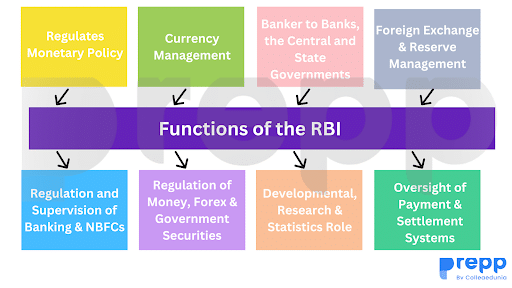
The functions of the RBI can be categorized as follows:
-
Monetary Policy
- RBI’s most important functions are the formulation and execution of monetary policy.
- As provided in the Preamble of the RBI Act 1934, the RBI can regulate the issue of banknotes and the keeping of reserves to ensure monetary stability in India.
- It can operate the currency and credit system to its advantage.
- Under this function, the RBI uses Quantitative and Qualitative tools for the execution of monetary policy.
-
Regulation and Supervision of the Banking and Non-banking Financial Institutions including Credit information companies
- The Reserve Bank's regulatory and supervisory area encompasses not just the Indian banking sector, but also DFIs, NBFCs, primary dealers, credit information businesses, and select segments of the financial markets.
- The Reserve Bank, as the banking system's regulator and supervisor, has a key responsibility to play in maintaining the system's continuous safety and soundness.
- This function's goal is to protect depositors' interests by establishing an efficient prudential regulatory framework for the orderly development and management of banking operations, as well as to maintain general financial stability through a variety of policy measures.
-
Regulation of money, forex, and government securities markets and also certain financial derivatives
- The Reserve Bank implements its monetary policy through government securities, foreign exchange, and money market operations.
- The Monetary operations include Open Market Operations, Liquidity Adjustment Facility, and Market Stabilisation scheme.
-
Management of Foreign Exchange Reserves
- As the custodian of the country's foreign exchange reserves, the Reserve Bank is responsible for managing its investment.
- The Reserve Bank of India Act, 1934, establishes the legislative framework for managing foreign exchange reserves.
- The Reserve Bank's reserves management function has expanded in relevance and sophistication in recent years for two key reasons.
- First, the Reserve Bank's foreign currency assets have expanded significantly on its balance sheet.
- Second, with growing worldwide market volatility in currency and interest rates, protecting the value of reserves and generating an acceptable return on them has become difficult.
- The Reserve Bank's strategies for managing foreign exchange reserves are based on three main principles: safety, liquidity, and returns.
-
Foreign Exchange Management—Current and Capital account management
- The Reserve Bank of India is in charge of the country's foreign exchange market.
- Through the provisions of the Foreign Exchange Management Act of 1999, it oversees and regulates it.
- The foreign currency market, like all markets, has evolved through time, and the Reserve Bank's approach to its role as market supervisor has changed as well.
-
Banker to Banks
- Banks are required to keep cash reserves with the Reserve Bank for a portion of their demand and time liabilities, requiring the need for maintaining accounts with the Reserve Bank.
- Banks must settle transactions among themselves in order to settle transactions between multiple consumers who have accounts with different banks. As a result, the settlement of interbank debts becomes crucial.
- Banks require a common banker in order to ensure a smooth inter-bank movement of funds, as well as to make payments and receive cash on their behalf.
- In order to achieve the aforementioned goals, the Reserve Bank of India allows banks to open accounts with it.
- This is the Reserve Bank's 'Banker to Banks' function, which is provided by the Deposit Accounts Department (DAD) at regional offices.
- RBI is the “lender of last resort” as it may lend during a liquidity crisis to meet the bank's operational requirements.
-
Banker to the Central and State Governments
- The Reserve Bank has performed the typical central banking job of managing the government's banking transactions since its creation.
- The Reserve Bank of India Act of 1934 compels the Central Government to entrust all of its money, remittance, exchange, and banking activities in India, as well as the management of the country's public debt, to the Reserve Bank.
- The Reserve Bank also holds the government's cash balances. By arrangement, the Reserve Bank can also act as a banker for a state government.
- Except for Jammu and Kashmir and Sikkim, the Reserve Bank serves as a banker to all Indian state governments.
- It has limited arrangements for the management of these two state governments' public debt.
- The Reserve Bank acts as a banker to the government, receiving and making payments of money on behalf of various government departments.
- Debt and cash management for Central and State Governments
-
Oversight of the payment and settlement systems
- Payment system regulation and supervision are increasingly being recognized as a basic responsibility of central banks.
- The proper functioning of the financial system and the successful transmission of monetary policy are dependent on the safe and efficient operation of these systems.
- The Reserve Bank, as the financial system's regulator, has been implementing payment and settlement system changes to ensure a more efficient and speedier movement of cash among the financial sector's numerous constituents.
- The growing monetization of the economy, the country's vast geographic breadth, people's predilection for paper-based instruments, and quick technological advancements are all aspects that make this a difficult assignment.
-
Currency Management
- Section 22 of the RBI Act, 1934 gives the Reserve Bank the required statutory authorities to manage currency, which is one of the Reserve Bank's basic central banking functions.
- The Reserve Bank of India, in collaboration with the Government of India, is responsible for the design, production, and overall management of the country's currency, with the purpose of guaranteeing a sufficient supply of clean and authentic notes.
- The Reserve Bank routinely reviews security issues and targets ways to improve security features to limit the danger of counterfeiting or forging of currency notes in conjunction with the government.
-
Developmental Role
- The Reserve Bank is one of the few central banks in the world that has taken an active and direct role in aiding their country's development.
- The Reserve Bank's developmental function includes providing loans to productive sectors of the economy, establishing institutions to construct financial infrastructure, and increasing access to cheap financial services.
- Its developmental mission has expanded over time to include institution formation in order to facilitate the supply of a diverse range of financial services across the country.
- Through its focus on financial inclusion, the Reserve Bank is now actively pushing efficient customer service throughout the banking industry, as well as the extension of banking services to all.
-
Research and Statistics
- The Reserve Bank has a long and illustrious history of policy-oriented research, as well as an effective framework for disseminating data and information.
- The Reserve Bank, like other major central banks, has built its own research capabilities in the fields of economics, finance, and statistics, which help to better understand how the economy works and how policy transmission mechanisms are changing.
Conclusion
The Functions of RBI are majorly derived from the RBI Act which enables the Reserve Bank of India to perform in a holistic manner and address different needs of the economy and the government.
| Other Relevant Links | |
|---|---|
| Indian Economics Notes | Monetary Policy |
| Monetary Policy Tools | Types of Monetary Policy |
| Money Supply | RBI Act 1935 |
| Monetary Policy Transmission | Monetary Policy Committee |
FAQs
Question: What is the primary function of the Reserve Bank of India (RBI)?
Answer: The primary function of the Reserve Bank of India (RBI) is to act as the central bank of the country, regulating the issue of currency, managing the foreign exchange market, and implementing monetary policy to maintain financial stability and promote economic growth.
Question: How does the RBI control inflation in India?
Answer: The RBI controls inflation through monetary policy tools such as repo rates, reverse repo rates, and open market operations. By adjusting these rates, the RBI influences the cost of borrowing and liquidity in the economy, helping to curb inflation or stimulate economic activity as needed.
Question: What role does the RBI play in currency management?
Answer: The RBI is responsible for printing and managing the supply of Indian currency. It ensures the availability of currency notes and coins and maintains their integrity by preventing counterfeit currency circulation. The RBI also manages the exchange rate and foreign currency reserves.
Question: What is the RBI's role as the lender of last resort?
Answer: As the lender of last resort, the RBI provides financial assistance to commercial banks facing a liquidity crisis. This function helps maintain the stability of the financial system and ensures that banks can continue their operations during periods of financial stress.
Question: How does the RBI regulate commercial banks in India?
Answer: The RBI regulates commercial banks by setting guidelines for capital adequacy, asset classification, and risk management. It supervises banking operations, conducts audits, and ensures that banks adhere to financial regulations to maintain the health of the banking system.
MCQs
1. What is the main objective of the RBI's monetary policy?
A) Managing government expenditure
B) Controlling inflation and ensuring financial stability
C) Regulating foreign direct investment
D) Setting tax rates
Answer: (B) See the Explanation
Explanation: The main objective of the RBI's monetary policy is to control inflation, ensure financial stability, and promote sustainable economic growth through various policy tools.
2. Which of the following tools does the RBI use to control liquidity in the economy?
A) Tax rates
B) Repo rate and reverse repo rate
C) Direct subsidies
D) Foreign policy regulations
Answer: (B) See the Explanation
Explanation: The RBI uses monetary policy tools like the repo rate and reverse repo rate to control liquidity in the economy, influencing borrowing costs and the money supply.
3. What is the RBI's function as the "lender of last resort"?
A) Providing loans to industries
B) Funding government projects
C) Assisting banks in a financial crisis
D) Regulating stock markets
Answer: (C) See the Explanation
Explanation: The RBI acts as the "lender of last resort" by providing emergency financial assistance to banks facing liquidity shortages, ensuring the stability of the financial system.
4. How does the RBI contribute to currency management in India?
A) Printing foreign currencies
B) Regulating tax collections
C) Managing the supply of Indian currency and foreign reserves
D) Setting interest rates for global banks
Answer: (C) See the Explanation
Explanation: The RBI manages the supply of Indian currency and foreign exchange reserves, ensuring the availability and integrity of currency in the economy.
5. What regulatory power does the RBI hold over commercial banks?
A) Approving international trade deals
B) Setting interest rates for consumers
C) Supervising banking operations and ensuring compliance with regulations
D) Managing foreign direct investment policies
Answer: (C) See the Explanation
Explanation: The RBI has the authority to regulate and supervise commercial banks, ensuring they comply with financial regulations and maintain stability in the banking sector.
GS Mains Questions and Model Answers
Q1: Discuss the various functions of the Reserve Bank of India (RBI) and how it contributes to economic stability.
Answer: The Reserve Bank of India (RBI) performs multiple functions that contribute to the economic stability of the country. Firstly, it implements monetary policy using tools like the repo rate and reverse repo rate to control inflation and manage liquidity. Secondly, the RBI acts as the issuer of currency, ensuring an adequate supply of money and preventing counterfeit circulation. Thirdly, it manages the country's foreign exchange reserves to maintain currency stability and facilitate international trade. Additionally, the RBI acts as the lender of last resort, providing financial assistance to banks during crises to safeguard the financial system. It also regulates and supervises commercial banks to ensure financial soundness and compliance with legal standards. Through these functions, the RBI plays a pivotal role in maintaining economic stability and fostering growth.
Q2: Analyze the role of the RBI in managing inflation and how effective it has been in recent years.
Answer: The RBI manages inflation primarily through its monetary policy framework, using instruments like the repo rate, reverse repo rate, and cash reserve ratio (CRR). By altering the repo rate, the RBI influences the cost of borrowing and the money supply, thereby controlling inflationary pressures. In recent years, the RBI's approach to inflation targeting, set within the range of 4% ± 2%, has contributed to more predictable and stable economic conditions. Despite external shocks like global oil price fluctuations and economic disruptions due to the COVID-19 pandemic, the RBI has managed to keep inflation within target levels for most periods. However, challenges remain, including supply-side constraints and fiscal policy interactions, requiring coordinated efforts for continued effectiveness.
Q3: Evaluate the impact of RBI's regulatory and supervisory role on the banking sector in India. What are the main challenges it faces?
Answer: The RBI's regulatory and supervisory role is crucial for the stability and robustness of the banking sector. By setting guidelines on capital adequacy, asset classification, and risk management, the RBI ensures that banks maintain financial health and transparency. This regulation helps prevent banking failures and protects depositors' interests. The RBI also conducts periodic audits and stress tests to monitor banks' resilience to economic shocks. However, challenges include the rising number of non-performing assets (NPAs), the need for technological integration, and the complexities of regulating digital banking and fintech companies. Addressing these challenges requires the RBI to continuously update its regulatory framework and collaborate with other financial institutions to enhance the banking sector's resilience.
Previous Year Questions on Functions of RBI
1. UPSC CSE Prelims 2021:
Question: What is the primary function of the Reserve Bank of India?
A) Regulating income tax collection
B) Managing public sector enterprises
C) Controlling monetary policy and issuing currency
D) Setting prices for essential commodities
Answer: (C)
Explanation: The primary function of the RBI is to control the monetary policy and issue currency, maintaining economic stability and supporting growth.
2. UPSC CSE Mains 2020 (GS Paper 3):
Question: "Critically examine the role of the RBI in ensuring financial stability in India. How does it balance its regulatory functions with fostering economic growth?"
Answer: The RBI plays a pivotal role in ensuring financial stability by implementing regulatory measures, overseeing the banking sector, and using monetary policy tools. Its role involves balancing inflation control, maintaining liquidity, and ensuring adequate credit flow for economic growth. The RBI's actions, such as setting interest rates and managing foreign exchange reserves, contribute to macroeconomic stability. However, balancing regulatory functions with growth can be challenging, especially during economic slowdowns where stimulating growth may conflict with inflation control. By adopting a flexible inflation targeting framework and incorporating stakeholder feedback, the RBI strives to maintain this balance. The introduction of new policies for digital banking and fintech supervision exemplifies the RBI’s adaptive approach to evolving economic needs while ensuring stability.
Download the PREPP App and attempt FREE IAS Exam Mock Tests and get complete study material!
UPSC IAS : CSAT - Mini Live Test

Live Test : UPSC CSE Prelims CSAT (Paper-II) (Oct 14 - 17)
Full Test - 04: UPSC CSE Prelims CSAT (Paper-II)
Full Test - 03: UPSC CSE Prelims CSAT (Paper-II)
UPSC CSE Prelims 2026 GS Paper 1 Question Paper (24-May-2026)
UPSC CSE Prelims 2026 CSAT Paper 2 Question Paper (24-May-2026)

17 February 2025 | The Hindu Must Read Articles | Current Affairs

16 February 2026 | The Hindu Must Read Articles | Current Affairs

13 February 2026 | The Hindu Must Read Articles | Current Affairs









Comments