Monetary Policy Committee (MPC) - Indian Economy Notes
The Monetary Policy Committee (MPC) is a crucial decision-making body within the framework of the Reserve Bank of India (RBI). It plays a pivotal role in formulating and implementing India's monetary policy, which is aimed at achieving price stability and supporting economic growth. The establishment of the MPC marked a significant shift in the way monetary policy decisions are made in India, enhancing transparency and accountability. It is headed by the Governor of the Reserve Bank of India (RBI). In this article, let us see the composition, tenure, and objectives of the monetary policy committee.
| To Read update on this topic: |
|
Table of Contents |
What is Monetary Policy Committee?
- The Monetary Policy Committee (MPC) is a committee appointed by the Central Government and chaired by the Governor of the Reserve Bank of India.
- The Monetary Policy Committee was established with the mission of determining the benchmark policy interest rate (repo rate) in order to keep inflation within a specific target level.
- The RBI governor makes monetary policy decisions with the help of an internal team and a technical advisory committee.
- The Monetary Policy Committee is a statutory body established under section 45ZB of the Reserve Bank of India Act 1934.
- It is an institutionalized framework for maintaining price stability while pursuing the goal of growth.
- It is set up based on the recommendation of the Urjit Patel Committee.
- The Monetary Policy Committee (MPC) held its thirty-first meeting from October 6 to 8, 2021. It decided to maintain the policy repo rate under the liquidity adjustment facility (LAF) at 4%.
- The LAF reverse repo rate remains at 3.35 percent, while the marginal standing facility (MSF) rate and the Bank Rate remain at 4.25 percent.
| Other Relevant Links | |
|---|---|
| Types of Monetary Policy | Monetary Policy Tools |
| Money Supply | RBI Act 1935 |
| Reserve Bank of India | Monetary Policy Transmission |
Monetary Policy Committee - Objectives
- The Monetary Policy Committee is concerned with setting policy rates and other monetary policy decisions in order to achieve:
- Price stability
- Accelerating the growth of the economy
- Exchange rate stabilization
- Balancing savings and investment
- Generating employment
- Financial stability
- The primary goal of the monetary policy committee is to maintain price stability while keeping in mind the objective of economic growth.
- It aims to achieve an inflation target set by the Central Government.
- Every five years, the Indian government sets an inflation target. The Reserve Bank of India (RBI) plays an important role in the consultation process for inflation targeting.
- The current inflation target is to keep consumer price inflation within a range of 2% to 6%, with a target of 4%.
Functioning of the Monetary Policy Committee
- The policy interest rate required to meet the inflation target is determined by the committee.
- The MPC is obligated to meet at least 4 times a year.
- The MPC meeting requires a quorum of four members.
- Each member of the MPC has one vote, with the Governor having a second or casting vote in the event of a tie.
- The Reserve Bank is obligated to issue a document called the Monetary Policy Report every six months to explain the origins of inflation and inflation estimates for the next six to eight months.
Composition of Monetary Policy Committee
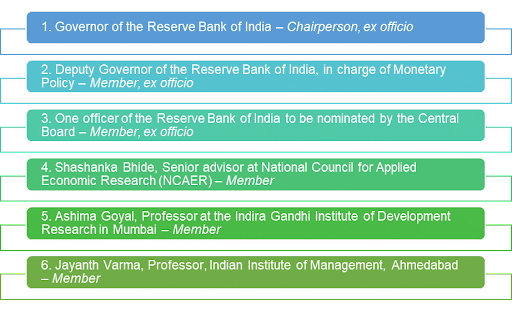
- Chairman: The Governor of the Reserve Bank of India serves as the committee's ex-officio Chairman.
- Members: The committee consists of six members (including the Chairman): three RBI officials and three government-nominated external members.
- The RBI officials are:
- Governor of the Reserve Bank of India
- Deputy Governor of the Reserve Bank of India, in charge of Monetary Policy – Member, ex officio;
- One officer of the Reserve Bank of India to be nominated by the Central Board – Member, ex officio;
Present Monetary Policy Committee
|
Monetary Policy Committee - Significance
- Transparency and Accountability: The MPC enhances transparency in the formulation and communication of monetary policy decisions. The committee releases detailed policy statements that provide insights into the rationale behind its decisions, contributing to greater accountability and credibility of the central bank.
- Informed Decision-Making: The MPC consists of experts from both the Reserve Bank of India (RBI) and external members with diverse backgrounds. This composition ensures a well-rounded and informed decision-making process that takes into account various economic perspectives and insights.
- Reduced Biases: By involving external members in the decision-making process, the MPC reduces the risk of policy decisions being influenced by individual biases or interests. This enhances the credibility of monetary policy decisions.
- Rule-Based Framework: The MPC operates within a rule-based framework, focusing on achieving a specific inflation target. This approach provides clarity to both market participants and the public about the direction and objectives of monetary policy.
- Long-Term Orientation: The MPC's focus on maintaining price stability contributes to a stable macroeconomic environment, which is conducive to long-term economic growth and investment.
- Credibility: The establishment of the MPC has bolstered the credibility of India's monetary policy. The committee's decisions are based on data-driven analysis and a structured process, strengthening the confidence of investors, businesses, and the public in the central bank's actions.
- Effective Communication: The MPC communicates its decisions through policy statements, press conferences, and other channels. This communication helps market participants and the public understand the rationale for policy changes, reducing uncertainty and promoting better decision-making.
Limitations of Monetary Policy Committee
Lack of Democratic Accountability
- MPCs often consist of appointed experts and central bank governors who make important economic decisions without being elected.
- Concerns about the absence of democratic accountability in the decision-making process may arise as a result of this.
Limited Transparency
- MPCs frequently work in secret, making it difficult for the general public to fully comprehend the grounds and justifications for their choices.
- After MPC meetings, central banks normally provide comments and minutes, but they might not go into great length to explain the opinions of the various members or the particular economic data and models taken into consideration.
Potential for Prejudice and Conflicts of Interest
- MPC members' personal biases and conflicts of interest may have an impact on the decisions they make on policy.
- For instance, certain members may have ties to particular businesses or interest groups, which may affect their objectivity.
Limited Representation of Diverse Perspectives
- MPCs are made up of a small number of people who might share similar backgrounds and viewpoints.
- This may reduce the variety of perspectives and insights that are taken into account when discussing policy.
Inflexibility and Rigidity
- MPCs frequently function within predetermined frameworks and mandates, which may hinder their ability to react effectively to unexpected events or rapidly changing economic situations.
- This rigidity may be a drawback in emergency situations where quick or unusual policy actions may be required.
Conclusion
The Monetary Policy Committee serves as a crucial institution in India's economic governance, responsible for steering the country's monetary policy to achieve the twin goals of price stability and economic growth. Through its transparent decision-making process and well-defined objectives, the MPC contributes to maintaining macroeconomic stability and ensuring a conducive environment for sustainable economic development.
| Other Relevant Links | |
|---|---|
| Indian Economics Notes | Monetary Policy |
| Banking Sector in India | Inflation |
FAQs
Q1: What is the Monetary Policy Committee (MPC)?
Answer: The MPC is a statutory body responsible for setting the benchmark interest rate (repo rate) in India to maintain price stability and achieve economic growth.
Q2: When was the MPC established in India?
Answer: The MPC was established in 2016, under the Reserve Bank of India Act, 1934, as a part of the monetary policy framework agreement between the Government of India and the RBI.
Q3: What is the primary function of the MPC?
Answer: The MPC's main function is to decide the repo rate, which influences inflation, liquidity, and credit availability in the economy.
Q4: Who are the members of the MPC?
Answer: The MPC consists of six members—three officials from the Reserve Bank of India (including the RBI Governor) and three external members nominated by the government.
Q5: How often does the MPC meet to review monetary policy?
Answer: The MPC meets at least four times a year (quarterly), and its decisions are published immediately after the meetings.
MCQs
- What is the current mandate of the MPC?
A) Control fiscal deficit
B) Maintain price stability
C) Set currency exchange rates
D) Manage government debt
Answer: (B) See the Explanation
- How many members are there in the MPC?
A) 5
B) 6
C) 7
D) 9
Answer: (B) See the Explanation
- What tool does the MPC primarily use to manage inflation?
A) Repo rate
B) CRR (Cash Reserve Ratio)
C) SLR (Statutory Liquidity Ratio)
D) Reverse repo rate
Answer: (A) See the Explanation
- Who chairs the meetings of the MPC?
A) Finance Minister
B) RBI Governor
C) Prime Minister
D) Deputy Governor of RBI
Answer: (B) See the Explanation
- What is the inflation target set for the MPC?
A) 2-4%
B) 4-6%
C) 3-5%
D) 5-7%
Answer: (B) See the Explanation
GS Mains Questions and Model Answers
Q1. Discuss the significance of the Monetary Policy Committee in India’s economic framework.
Answer: The Monetary Policy Committee (MPC) plays a pivotal role in India’s economic framework by ensuring price stability, which is essential for sustainable growth. Established in 2016, the MPC provides a structured and transparent mechanism for determining interest rates, primarily the repo rate. Its mandate to maintain inflation within a specified target range (4% ± 2%) reflects the balance required between controlling inflation and fostering economic growth. Through its regular meetings and policy decisions, the MPC influences credit availability, consumer spending, and investment, making it an essential part of economic governance. The MPC’s independence also ensures that monetary policy decisions are not unduly influenced by political factors.
Q2. Analyze the impact of MPC’s decisions on inflation and economic growth.
Answer: The MPC’s decisions have a direct impact on inflation and economic growth. By adjusting the repo rate, the MPC controls the money supply in the economy. A hike in the repo rate increases borrowing costs, reducing liquidity and curbing inflation. Conversely, a cut in the repo rate makes borrowing cheaper, promoting investment and consumption. However, maintaining a balance is crucial, as high inflation erodes purchasing power, while excessive growth-focused policies can lead to overheating of the economy. The MPC's inflation-targeting framework ensures that inflation is kept under control without compromising long-term growth prospects.
Q3. How does the Monetary Policy Committee contribute to financial stability in India?
Answer: The MPC contributes to financial stability by managing inflation expectations, ensuring liquidity, and guiding credit growth. Its policy decisions impact interest rates across the banking sector, influencing the borrowing and lending behavior of businesses and consumers. By maintaining inflation within a prescribed range, the MPC ensures that purchasing power remains stable, which is critical for financial stability. Additionally, transparent communication of its policy decisions builds trust and predictability in financial markets. The MPC’s ability to respond promptly to economic changes, such as inflationary pressures or economic slowdowns, reinforces its role in safeguarding financial stability.
Previous Year Questions on Monetary Policy Committee
1. UPSC CSE 2022
Question. Examine the role of the Monetary Policy Committee in controlling inflation in India.
Answer: The Monetary Policy Committee (MPC) plays a crucial role in controlling inflation through its policy instruments, primarily the repo rate. The MPC’s inflation-targeting framework, established in 2016, mandates that inflation should remain within the range of 4% ± 2%. This target ensures that inflation remains under control without hampering economic growth. By adjusting the repo rate, the MPC influences the money supply and borrowing costs. For instance, when inflation rises beyond the target, the MPC increases the repo rate to reduce liquidity. This tight monetary policy curbs inflationary pressures by discouraging borrowing and consumption. Conversely, when inflation is low, the MPC lowers interest rates to stimulate demand. This approach helps in stabilizing inflation, contributing to overall economic stability.
2. UPSC CSE 2023
Question. How does the MPC ensure transparency and accountability in monetary policy?
Answer: The MPC ensures transparency and accountability by conducting periodic meetings and publishing its decisions along with detailed minutes. These meetings, held at least four times a year, result in announcements about key policy rates, including the repo rate. The publication of minutes, which include voting patterns and rationales behind the decisions, promotes transparency and helps stakeholders understand the MPC’s policy stance. The inflation-targeting framework further ensures accountability, as the MPC is required to explain to the government if inflation deviates from the target range for three consecutive quarters. This system ensures that the MPC remains answerable to the public and the government, fostering trust in the monetary policy framework.
Download the PREPP App and attempt FREE IAS Exam Mock Tests and get complete study material!

Full Test - 04: UPSC CSE Prelims CSAT (Paper-II)
Full Test - 03: UPSC CSE Prelims CSAT (Paper-II)
UPSC CSE Prelims 2026 GS Paper 1 Question Paper (24-May-2026)
UPSC CSE Prelims 2026 CSAT Paper 2 Question Paper (24-May-2026)

17 February 2025 | The Hindu Must Read Articles | Current Affairs

16 February 2026 | The Hindu Must Read Articles | Current Affairs

13 February 2026 | The Hindu Must Read Articles | Current Affairs









Comments