On I-Day, Stalin seeks transfer of education back to State List
Relevance: GS2: Indian Polity and Constitution, Government policies and interventions, Prelims
(Source: The Hindu, 08/16/23)
Click here for Daily Current Affairs
Why in the news?
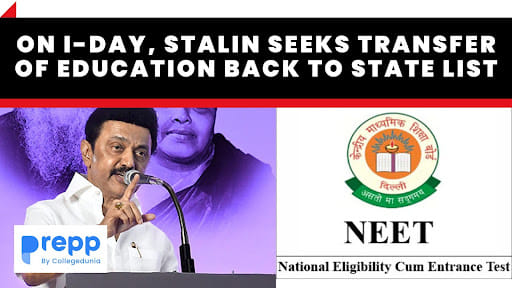
- The Chief Minister of Tamil Nadu, during the independence day speech, advocated for returning education to the State List of the Seventh Schedule of the Constitution, emphasising that this step is necessary to eliminate centralised exams such as NEET.
- Tamil Nadu's opposition to the NEET grew substantially after the tragic suicide of a student and his father raised an issue about exam-related stress.
Table of Contents
The National Eligibility Entrance Test (NEET) and its Background
- The National Eligibility Entrance Test (NEET), formerly known as the All India Pre-Medical Test (AIPMT), is the entrance exam for MBBS and BDS programmes. The National Testing Agency (NTA) is in charge of it.
- The NEET was declared unconstitutional by the Supreme Court in 2013, and the MCI was given no authority to issue notifications to govern admissions to medical/dental institutions.
- In April 2016, a five judge bench recalled its 2013 judgement and eventually mandated the conduct of NEET.
- In response to appeals from various stakeholders, the Union Government issued an ordinance in May 2016 exempting State-run medical institutions from the scope of the Supreme Court mandate for a year.
- Based on a Supreme Court order in 2016, NEET was implemented across the country.
- The Tamil Nadu government was adamantly opposed to the entrance test from the start, and initially obtained exemption from NEET-based admissions.
- The President refused to grant assent to two bills passed unanimously by the Tamil Nadu Legislative Assembly in 2017 that sought exemption from NEET-based admissions for undergraduate and postgraduate degree medical programmes.
Why is the Tamil Nadu government against NEET?
- In Tamilnadu, the politicians argue that the NEET privileges wealthier students from urban backgrounds.
- Tamil Nadu formed a committee led by former High Court judge Justice A. K. Rajan to investigate the implications of the NEET-based admission procedure.
- According to Justice A. K. Rajan committee, the use of NEET as the primary criteria for admission to medical institutions has reduced the percentage of seats previously held by students who completed the Tamil Nadu Board of Secondary Examination (TNBSE). It benefited Central Board of Secondary Education (CBSE) pupils.
- Coaching issues: The majority of students who were enrolled in medical colleges after taking the NEET underwent coaching.
- Coaching, as opposed to learning a topic, focuses solely on preparing students to answer questions presented in a certain test.
- It has switched the emphasis on passing the 'be-all-end-all' test rather than mastering the topics at the higher secondary level.
- Socio-Economic issues: Taking the examination a second or third time in order to obtain the coveted medical seat necessitates financial and social resources. This is well out of reach for families from lower socioeconomic backgrounds.
- Corruption: NEET was implemented to guarantee that only qualified students seeking medical seats get admitted to medical schools, as well as to abolish the practice of collecting capitation fees, which fueled corruption.
- NEET behaviour has been inconsistent, including reports of impersonation. Even in the recent NEET exams, the CBI discovered an impersonation ring and detained eight people.
7th Schedule of Indian constitution
|
Conclusion
The Tamil Nadu NEET debate is much more than simply an admission test; it signifies a bigger movement for educational parity, autonomy, and social justice. The state's devotion to its distinctive vision of education and healthcare clashes with central standardisation, igniting a critical debate in the country concerning the nature of democracy and justice.
FAQs
Question: What is a union list?
Answer:
The Union List, commonly known as List-I, is a list of 97 numbered items included in the Seventh Schedule of the Indian Constitution on which Parliament has sole legislative authority. The Union List contains topics of national importance such as national defence, foreign affairs, banking, communications, and currency.
Question: What is A. K. Rajan committee?
Answer:
Tamil Nadu appointed a committee to explore the ramifications of the NEET-based admission method, chaired by former High Court judge Justice A. K. Rajan.The introduction of NEET as the key criterion for admission to medical colleges, according to Justice A. K.Rajan committee has lowered the percentage of seats previously held by students who finished the Tamil Nadu Board of Secondary Examination (TNBSE).
Question: What is Article 246?
Answer:
Article 246 of the Constitution of India delineates the distribution of legislative powers between the central (Union) government and the individual state governments. It outlines the subjects on which each level of government can legislate.
MCQs
Question: Which of the following provisions of the Constitution of India have a bearing on Education? (UPSC 2012)
- Directive Principles of State Policy
- Rural and Urban Local Bodies
- Fifth Schedule
- Sixth Schedule
- Seventh Schedule
Select the correct answer using the codes given below:
(a) 1 and 2 only
(b) 3, 4 and 5 only
(c) 1, 2 and 5 only
(d) 1, 2, 3, 4 and 5
Answer: (d) See the Explanation
- Article 45- Provides for early childhood care and education for children under the age of six. So statement 1 is correct.
- The Panchayati raj institutions have permitted 29 topics to function in their respective districts under Schedule 11 of the constitution. One of them is education. Similarly, Schedule 12 of the constitution includes education as one of the 18 disciplines. So statement 2 is correct.
- The Indian Constitution's Fifth Schedule deals with the administration and management of Scheduled territories and Scheduled tribes where tribal groups predominate.
- The purpose of this Schedule is to keep the state accountable for the accomplishment of tribal educational and economic goals. It also seeks to provide them with social justice and to shield them from all types of exploitation. So statement 3 is correct.
- Autonomous District Councils (ADC) were created in four northeastern states, namely Assam, Meghalaya, Tripura, and Mizoram, under the Sixth Schedule.
- These councils shall have the authority to enact legislation concerning education, elementary and secondary education, and vocational training within their respective districts. So statement 4 is correct.
- The constitution's seventh schedule addresses the division of authorities among states and centres through three lists: the State List, the Centre List, and the Concurrent List.
- The 42nd Amendment Act of 1976 moved the following five items from the State List to the Concurrent List:
- Education. So statement 5 is correct.
- Forested areas
- Wild animal and bird protection
- Weights and measurements
- Administration of justice, constitution, and organisation of all courts other than the Supreme and High Courts
Therefore all the options are correct.
Download the PREPP App and attempt FREE IAS Exam Mock Tests and get complete study material!

Full Test - 04: UPSC CSE Prelims CSAT (Paper-II)
Full Test - 03: UPSC CSE Prelims CSAT (Paper-II)
UPSC CSE Prelims 2026 GS Paper 1 Question Paper (24-May-2026)
UPSC CSE Prelims 2026 CSAT Paper 2 Question Paper (24-May-2026)

17 February 2025 | The Hindu Must Read Articles | Current Affairs

16 February 2026 | The Hindu Must Read Articles | Current Affairs

13 February 2026 | The Hindu Must Read Articles | Current Affairs









Comments