On I-Day, CJI Announces Plan To Expand Supreme Court With 27 Additional Courts And 51 Judges’ Chambers
Relevance: GS 2 - Structure, organization and functioning of the Judiciary; E-governance.
(Source: The Hindu, 08/16/23)
Click here for Daily Current Affairs
Why in the news?
- Recently, Chief Justice of India (CJI) D.Y. Chandrachud in his address at the 77th Independence Day celebrations, announced a plan to expand the Supreme Court with 27 additional courts and 51 judges’ chambers.
- At present, the Supreme Court has 17 courtrooms and two registrar courts. Its judicial strength as of now is 32.
Table of Contents

Access to justice
- Chief Justice Chandrachud emphasized the need for an "overhaul" of court infrastructure to enhance accessibility and inclusivity.
- Modernize judicial infrastructure: The expansion involves constructing a new building to house 27 extra courts, 51 judges' chambers, 4 registrar court rooms, 16 registrar chambers, and other facilities for lawyers and litigants.
- The expansion will occur in two phases.
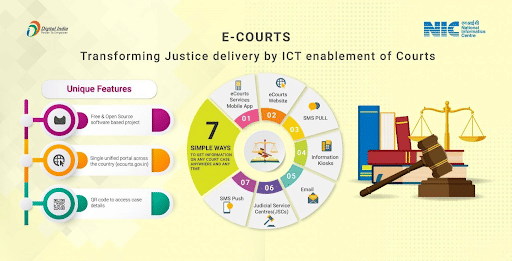
Importance of technology
- E-courts project: The Supreme Court is implementing Phase 3 of the e-Courts project, which seeks to revolutionize the working of courts in India by inter-linking courts across the country.
- It also includes setting up an infrastructure of paperless courts, digitisation of court records, and setting up advanced e-sewa kendras in all court complexes.
- The eCourts Project was conceptualized on the basis of the “National Policy and Action Plan for Implementation of Information and Communication Technology (ICT) in the Indian Judiciary – 2005” submitted by eCommittee, Supreme Court of India with a vision to transform the Indian Judiciary by ICT enablement of Courts.
- The eCourts Mission Mode Project, is a Pan-India Project, monitored and funded by the Department of Justice, Ministry of Law and Justice, Government of India for the District Courts across the country.
Pros of ecourts
- Efficiency: It will provide efficient & time-bound citizen-centric service delivery and will help in overcoming the procedural barriers to justice.
- Transparency: To automate the processes to provide transparency and accessibility of information to its stakeholders.
- Enhance Productivity: It will enhance judicial productivity, both qualitatively & quantitatively, to make the justice delivery system affordable, accessible, cost-effective, predictable, reliable and transparent.
- Accessibility: Technology will make access to justice and services disabled-friendly.
- For instance, the Supreme Court had operationalized screen-readable websites and case files to remove the barriers faced by the blind community in accessing the court services.
- Eliminate physical presence: It will reduce footfalls in the courts by eliminating the physical presence of violator or advocate in the court thereby saving precious judicial time.
Cons of e-courts
- Digital- divide: Oxfam report 'India Inequality Report 2022: Digital Divide' report, states that the reach of digital technologies remains limited to largely male, urban, upper-caste, and upper-class households and individuals. This may further increase inequality by hindering access to justice.
- Technical Glitches: Technical issues such as server downtime, connectivity problems, or software glitches can disrupt court proceedings and case filings.
- Cybersecurity Concerns: Digital records and online platforms can be vulnerable to cyberattacks, potentially compromising sensitive case information.
- Privacy Concerns: Storing personal and confidential information digitally raises concerns about data privacy and unauthorized access.
- Transitioning to new technology: There has been reports that some of High Courts just switch off their cameras and microphones during hearings, ignoring the infrastructure made available to them.
Recent initiatives by Supreme Court promoting the digitisation
- The projects such as the online portal for RTI, eSCR, an online appearance portal for advocates, iJuris, and neutral citations.
- The other recent initiatives of the Supreme Court include live streaming of court proceedings, translation of judgments from English to vernacular languages, and live transcription of court proceedings.
(*Click this link to read prelims specific weekly current affairs articles)
FAQs
Question: What is eCourts project?
Answer:
The eCourts Project was conceptualized on the basis of the “National Policy and Action Plan for Implementation of Information and Communication Technology (ICT) in the Indian Judiciary – 2005” submitted by eCommittee, Supreme Court of India with a vision to transform the Indian Judiciary by ICT enablement of Courts.
The eCourts Mission Mode Project, is a Pan-India Project, monitored and funded by Department of Justice, Ministry of Law and Justice, Government of India for the District Courts across the country.
Question: What is the Jurisdiction of Supreme court?
Answer:
The Supreme Court has original, appellate and advisory jurisdiction. Its exclusive original jurisdiction extends to any dispute between the Government of India and one or more States or between the Government of India and any State or States on one side and one or more States on the other or between two or more States, if and insofar as the dispute involves any question (whether of law or of fact) on which the existence or extent of a legal right depends. In addition, Article 32 of the Constitution gives an extensive original jurisdiction to the Supreme Court in regard to enforcement of Fundamental Rights.
Question: What is SuSwagatam?
Answer:
SuSwagatam is an initiative by the Supreme Court of India to facilitate the visitors to have a smooth and simple process of getting online ePass required to visit the SCI for official/ case related purpose. It has advanced features of eliminating all the cumbersome and tedious procedure of making a request for visit.
It is a cloud based application software developed by NIC with an easy to use graphical interface and embedded with comprehensive security features. It assists in maintaining all-relevant information about the visitor, which is automatically saved in a database.
UPSC Mains Practice Question:
|
MCQ
Question: With reference to eCourts Project, consider the following statements:
- It was conceptualized on the basis of the National Policy and Action Plan for Implementation of Information and Communication Technology (ICT) in the Indian Judiciary.
- eCourts Mission Mode Project is a Pan-India Project funded by Department of Justice, Ministry of Law and Justice.
Which of the above statements is/are correct?
(a) 1 only
(b) 2 only
(c) Both 1 and 2
(d) Neither 1 nor 2
Answer: (c) See the Explanation
- The eCourts Project was conceptualized on the basis of the “National Policy and Action Plan for Implementation of Information and Communication Technology (ICT) in the Indian Judiciary – 2005” submitted by eCommittee, Supreme Court of India with a vision to transform the Indian Judiciary by ICT enablement of Courts. Hence, statement 1 is correct.
- The eCourts Mission Mode Project, is a Pan-India Project, monitored and funded by Department of Justice, Ministry of Law and Justice, Government of India for the District Courts across the country. Hence, statement 2 is correct.
- Therefore, option (c) is the correct answer.
Download the PREPP App and attempt FREE IAS Exam Mock Tests and get complete study material!

Full Test - 04: UPSC CSE Prelims CSAT (Paper-II)
Full Test - 03: UPSC CSE Prelims CSAT (Paper-II)
UPSC CSE Prelims 2026 GS Paper 1 Question Paper (24-May-2026)
UPSC CSE Prelims 2026 CSAT Paper 2 Question Paper (24-May-2026)

17 February 2025 | The Hindu Must Read Articles | Current Affairs

16 February 2026 | The Hindu Must Read Articles | Current Affairs

13 February 2026 | The Hindu Must Read Articles | Current Affairs









Comments