Natural Disasters in India - Geography Notes
Natural Disaster means a natural event that causes severe damage to lives and properties. For example flood, earthquake, or hurricane. Natural disasters in India are often due to the climate of India. The most common natural disasters in India are cyclones, droughts, flash floods, avalanches, landslides caused by torrential rainfall, and snowstorms. Natural disasters are unpredictable and it may take many years to recover and restore the damage caused by natural disasters. The topic “Natural Disasters in India” is an important part of the UPSC/IAS Exam Geography syllabus which is discussed in this article in detail.
| To Read update on this topic: |
|
Table of Contents |
What are Natural Disasters?
- Natural disasters are environmental events that threaten a community's safety and functionality.
- Hurricanes, floods, tsunamis, and avalanches are examples of natural disasters.
- Natural Disaster has the potential to do substantial damage to both public and private property.
- Landslides can be caused by activities such as deforestation, agricultural operations, mining, and so on. Furthermore, flames may wreak havoc on the natural habitats of plants and animals.
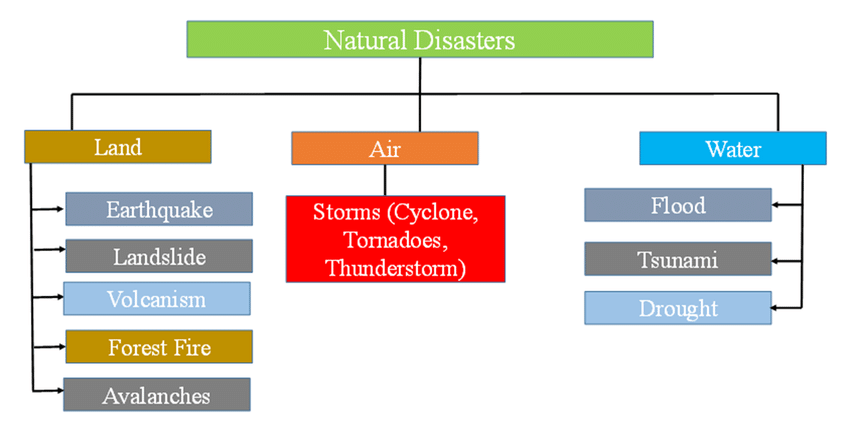
- Natural disasters are classified into five types. These are some examples.
- Geological disasters
- Hydrological disasters
- Meteorological disasters
- Space disasters
- Wildfires
|
|
|
|---|---|
| Earthquakes in India | Vulcanicity in India |
| Tsunami in India | Cyclones in India |
Geological Disasters
- Geological disasters are caused by changes above or under the earth's surface.
- Geological disasters caused by tectonic plates have unforeseen and out-of-control consequences.
- Examples of geological disasters include Earthquakes, volcanic eruptions, landslides, and avalanches.
- Earthquake occurs when there is a rapid release of energy in the Earth's crust, which causes seismic waves.
- Earthquakes exhibit themselves at the Earth's surface as vibration, shaking, and, in certain cases, displacement of the ground. Slippage within geological faults causes earthquakes.
- In the Lower Himalayas, landslides are prevalent. Because the region's hills are young, they include rock formations that are prone to sliding.
- Deforestation is caused by rising population and development pressures, mainly from logging and tourism.
- Avalanches are frequent in Kashmir, Himachal Pradesh, and Sikkim, among other places.
- Landslides are also extremely dangerous in India, where many Indian families and farmers live in the hills or mountains.
Hydrological Disasters
- Hydrological disasters are caused by abrupt changes in the quality or distribution of water under the earth's surface, as well as changes in meteorological conditions.
- Examples of hydrological disasters include flooding, drought, mudslides, tsunamis, volcanic eruptions, etc.
- A flood is defined as an excess of water on land. A river may acquire more water from strong rains or other natural calamities. When this occurs, the water overflows from its typical course in the river bed and onto dry ground.
- Tsunamis are sometimes referred to as tidal waves because they resemble fast-rising tides, but experts avoid using this term since tides are generated by the gravitational pull of the sun and moon, but tsunamis are caused by water displacement.
- The tsunami of 2004 was produced by a massive earthquake, the third-largest earthquake ever recorded on a seismograph.
Meteorological Disasters
- Meteorological Disasters are primarily caused due to extreme weather conditions such as drought, snow, and rain.
- These natural disasters have an impact on the weather-forming process and atmospheric conditions.
- Examples of meteorological disasters include blizzards, droughts, cold waves, tornadoes, cyclonic storms, etc.
- A cyclone is defined as any low-pressure system with inward-spiraling winds. In the Northern Hemisphere, cyclones revolve anticlockwise, whereas, in the Southern Hemisphere, they rotate clockwise.
- Cyclogenesis is the process of cyclone development and strengthening.
- A drought is a period of drier-than-normal weather that causes water-related issues.
- The quantity of precipitation in a given area fluctuates from year to year, but the average amount remains fairly steady throughout time.
Space Disasters
- Disasters produced by asteroids, meteors, and solar flares are all examples of space disasters.
- Failures in technology, design, and management result in terrible loss of life in space.
- While fatal accidents like the Columbia Disaster, the Challenger Explosion, and the tragic flight of Soyuz 11 cause dramatic responses.
- There is just as much to be learned from unmanned failures and near misses that highlight design and operational flaws away from the public eye, because when a space accident does not claim lives, it is more a matter of luck than of preparedness.
Wildfires
- Wildfires can be caused by natural calamities such as drought and lightning. Many humans, however, burn fires in woods to make way for agricultural land.
- Forest fires have become a global hazard, with many nations suffering major loss of life and property.
- Furthermore, the carbon dioxide released into the atmosphere as a result of forest fires causes lung and skin illnesses in humans.
- Forest fires in India are most common in March and April when the ground is covered with dried logs, hay, weeds, trees, and leaves.
- When the temperature is high or extremely dry, friction from rubbing branches can cause forest fires in some cases.
Consequences of Disasters
- Individuals are affected literally (by loss of life, injuries, health, and disability) as well as mentally.
- The destruction of property, human settlements, and infrastructure, among other things, causes massive economic damage.
- Disasters can change the natural environment, causing habitat loss for many plants and animals and causing ecological stress, which can lead to biodiversity loss.
- Following natural disasters, food and other natural resources, such as water, frequently become scarce, resulting in food and water shortages.
- People are relocated as a result of the disaster, and the displaced population frequently faces several problems in new settlements; as a result, the poor become even more destitute.
- Disaster raises the amount of susceptibility, multiplying the impact of the disaster.
Major Disasters in India
- The Kashmir floods of 2014 killed about 500 people in Srinagar, Bandipur, Rajouri, and other parts of J&K.
- The Uttarakhand Flash Floods in 2013 killed around 5,000 people in Govindghat, Kedar Dome, and the Rudraprayag region of Uttarakhand.
- The Indian Ocean Tsunami (2004) killed around 2 lakh people in southern India and the Andaman and Nicobar Islands, as well as Sri Lanka and Indonesia.
- Gujarat Earthquake (2001) killed around 20,000 people in Bhuj, Ahmedabad, Gandhinagar, Kutch, Surat, Surendranagar, Rajkot district, Jamnagar, and Jodia districts.
- The Odisha Super Cyclone or Paradip cyclone (1999) killed around 10,000 people in the coastal districts of Bhadrak, Kendrapara, Balasore, Jagatsinghpur, Puri, and Ganjam.
- The Great Famine (1876-1878) killed around 3 crore people in Madras, Mysore, Hyderabad, and Bombay. Even now, it is regarded as one of India's biggest natural disasters of all time.
- Coringa Cyclone (1839), which devastated the Andhra Pradesh region of Coringa, and the Calcutta Cyclone (1737) are two more examples of natural disasters that the country has encountered in the past.
- Between 1770 and 1943, the Bengal Famine devastated Bengal, Odisha, and Bihar, killing about a million people.
Disaster Management in India
- Disaster management is the focus of disaster management initiatives.
- Disaster Management efforts refer to the systematic process of implementing policies, strategies, and coping capacities of society and communities to decrease the effect of natural hazards and linked environmental and technological disasters.
- These include all operations, both structural and non-structural, to avoid (prevent) or reduce (mitigation and readiness) the detrimental impacts of hazards.
- The Disaster Management Act of 2005 describes disaster management as "an integrated process of planning, organizing, coordinating, and implementing actions required for-
-
Averting the possibility of a disaster
-
Reducing the likelihood of a tragedy or its repercussions
-
Preparedness to deal with any type of calamity
-
Dealing with a crisis as soon as possible
-
Determining the magnitude of a disaster's consequence
-
Rescue and assistance
-
Rehabilitating and rebuilding
Conclusion
It can be understood that natural disasters in India occur more frequently because of its unique geo-climatic conditions and high socioeconomic vulnerability to disasters. This damages the states severely. Though it's crucial to make efforts to reduce disaster losses on all fronts, trends point to the necessity for strong and timely policy measures to prevent human losses from natural disaster-related deaths.
|
|
|
|---|---|
| Geography Notes | Physical Geography |
| India's Physiographic Divisions | Indian Drainage Systems |
| Climatology | Water Resources in India |
FAQs
Q1: What are the most common natural disasters in India?
Answer: India is prone to several natural disasters, including earthquakes, floods, cyclones, droughts, landslides, and tsunamis. These disasters vary across regions, depending on geographical and climatic conditions.
Q2: Which regions in India are most affected by earthquakes?
Answer: The Himalayan region, Northeast India, and parts of Northwestern India (including areas in Jammu & Kashmir and Rajasthan) are most prone to earthquakes due to tectonic plate movements.
Q3: What causes floods in India?
Answer: Floods in India are primarily caused by heavy monsoon rains, especially in regions like the Ganges and Brahmaputra river basins. Factors like poor drainage systems, deforestation, and encroachments also contribute to flood occurrences.
Q4: How does India manage disaster risks?
Answer: India has established institutions such as the National Disaster Management Authority (NDMA) and developed frameworks like the National Disaster Management Plan (NDMP) to manage and mitigate disaster risks. Early warning systems and awareness programs are also critical components of disaster management.
Q5: What is the role of the National Disaster Response Force (NDRF) in India?
Answer: The National Disaster Response Force (NDRF) is a specialized unit that responds to natural and man-made disasters in India. It plays a crucial role in rescue, relief, and rehabilitation efforts during disasters.
MCQs
- Which of the following regions in India is most prone to earthquakes?
a) Deccan Plateau
b) Western Ghats
c) Himalayan region
d) Eastern Coastal Plains
Answer: (C) See the Explanation
The Himalayan region is highly prone to earthquakes due to the tectonic activity between the Indian and Eurasian plates.
- What is the primary cause of floods in India?
a) Deforestation
b) Cyclones
c) Heavy monsoon rains
d) Urbanization
Answer: (C) See the Explanation
Heavy monsoon rains are the leading cause of floods in India, particularly in the Ganges and Brahmaputra river basins.
- Which organization is responsible for disaster management in India?
a) Indian Meteorological Department (IMD)
b) National Disaster Management Authority (NDMA)
c) Ministry of Environment, Forest and Climate Change
d) Geological Survey of India
Answer: (B) See the Explanation
The NDMA is the apex body responsible for formulating policies and coordinating disaster management efforts in India.
- What role does the NDRF play in disaster management?
a) Preventing disasters
b) Monitoring weather conditions
c) Rescue, relief, and rehabilitation operations
d) Controlling pollution levels
Answer: (C) See the Explanation
The National Disaster Response Force (NDRF) specializes in rescue, relief, and rehabilitation efforts during natural and man-made disasters.
- Which natural disaster is most frequent along India’s eastern coast?
a) Earthquake
b) Landslide
c) Cyclone
d) Avalanche
Answer: (C) See the Explanation
The eastern coast of India, especially states like Odisha and Andhra Pradesh, frequently experiences cyclones due to tropical storms originating in the Bay of Bengal.
GS Mains Questions and Model Answers
Q1. Analyze the geographical factors contributing to the vulnerability of India to natural disasters.
Answer: India’s geographical diversity and vast size make it vulnerable to a wide range of natural disasters. The Himalayan region is prone to earthquakes due to the collision of the Indian and Eurasian tectonic plates. Similarly, the Indo-Gangetic plains are susceptible to flooding during the monsoon season due to heavy rainfall and inadequate drainage systems.
The eastern coast frequently experiences cyclones due to tropical storms from the Bay of Bengal, while the western coast is also vulnerable to cyclones originating in the Arabian Sea. Landslides are common in hilly regions, particularly during the monsoons. Droughts are another major challenge, especially in central and western India due to erratic monsoons and poor water management practices. These geographical factors highlight the need for a robust disaster management framework in India.
Q2. Discuss the role of the National Disaster Management Authority (NDMA) in disaster risk reduction in India.
Answer: The National Disaster Management Authority (NDMA) plays a central role in disaster risk reduction in India by formulating policies, plans, and guidelines for disaster management. The NDMA works in coordination with state governments, local authorities, and other stakeholders to enhance preparedness and mitigate the impact of natural disasters.
One of the key contributions of the NDMA is the development of the National Disaster Management Plan (NDMP), which outlines the responsibilities of various agencies and provides a strategic framework for disaster preparedness, response, and recovery. The NDMA also promotes capacity-building initiatives, early warning systems, and public awareness campaigns to reduce disaster risks. Its efforts have been instrumental in improving India's disaster resilience and minimizing loss of life and property during calamities.
Q3. Evaluate the effectiveness of India’s disaster management framework in addressing the challenges posed by natural disasters.
Answer: India’s disaster management framework has made significant progress in addressing the challenges posed by natural disasters, particularly through the establishment of institutions like the NDMA and NDRF. The NDMA’s proactive role in formulating policies, conducting awareness campaigns, and coordinating with state governments has improved disaster preparedness at both the national and local levels.
The deployment of the National Disaster Response Force (NDRF) during major disasters, such as cyclones, earthquakes, and floods, has been effective in saving lives and reducing damage. Early warning systems, particularly for cyclones and tsunamis, have also improved, enabling timely evacuations and minimizing casualties. However, challenges remain, such as inadequate infrastructure in rural areas, poor implementation of disaster management plans at the grassroots level, and the need for greater community participation. Despite these challenges, India’s disaster management framework continues to evolve, with ongoing efforts to enhance resilience and reduce vulnerabilities.
Previous Year Questions on Natural Disasters in India
1. UPSC CSE Mains 2019
Question. How has the Indian government’s disaster management framework evolved to address the increasing frequency of natural disasters?
Answer: The Indian government’s disaster management framework has evolved significantly over the past two decades, with a shift from a reactive approach to a proactive and preventive one. The establishment of the National Disaster Management Authority (NDMA) in 2005, under the Disaster Management Act, marked a major step in this evolution. The NDMA is responsible for formulating disaster management policies, plans, and guidelines, focusing on disaster risk reduction and preparedness.
The government has also strengthened its response capabilities by creating the National Disaster Response Force (NDRF), a specialized force trained to handle rescue and relief operations during disasters. The implementation of early warning systems for cyclones, floods, and tsunamis has improved disaster preparedness, allowing timely evacuations and reducing casualties. Programs such as the National Cyclone Risk Mitigation Project (NCRMP) and the Integrated Coastal Zone Management (ICZM) initiative have further contributed to enhancing resilience in vulnerable areas. These measures reflect India’s commitment to building a robust disaster management framework that addresses both prevention and response.
2. UPSC CSE Mains 2020
Question. Discuss the role of technology in improving disaster management in India.
Answer: Technology has played a crucial role in improving disaster management in India by enhancing early warning systems, communication networks, and response mechanisms. Advanced meteorological models and satellite imagery provided by agencies such as the Indian Meteorological Department (IMD) and ISRO have significantly improved the accuracy and timeliness of weather forecasts, particularly for cyclones, floods, and droughts. These technologies enable early warnings, allowing authorities to evacuate vulnerable populations and minimize loss of life.
Additionally, the use of drones and geospatial technologies has revolutionized disaster response by enabling real-time assessment of affected areas, aiding in rescue operations, and providing critical data for relief efforts. The integration of GIS mapping and remote sensing has also helped in identifying high-risk areas and developing more targeted disaster preparedness plans. Overall, technology has become a key enabler in making India’s disaster management more effective, reducing the time between disaster occurrence and response, and ultimately saving lives and property.
Download the PREPP App and attempt FREE IAS Exam Mock Tests and get complete study material!

Full Test - 04: UPSC CSE Prelims CSAT (Paper-II)
Full Test - 03: UPSC CSE Prelims CSAT (Paper-II)
UPSC CSE Prelims 2026 GS Paper 1 Question Paper (24-May-2026)
UPSC CSE Prelims 2026 CSAT Paper 2 Question Paper (24-May-2026)

17 February 2025 | The Hindu Must Read Articles | Current Affairs

16 February 2026 | The Hindu Must Read Articles | Current Affairs

13 February 2026 | The Hindu Must Read Articles | Current Affairs









Comments