Tsunami in India - Geography Notes
Tsunami means “harbour wave” in Japanese. Tsunami is an earthquake or volcanic eruption under the sea that creates gigantic waves. Tsunami waves are also known as seismic sea waves, and they're one of nature's most powerful and destructive forces. Tsunami (2004) in India was the worst disaster that killed 26,040 people. The topic “Tsunami in India” is an important part of the UPSC/IAS Exam Geography syllabus which is discussed in this article in detail.
|
Table of Contents |

2004 Indian Ocean Tsunami
What exactly is Tsunami?
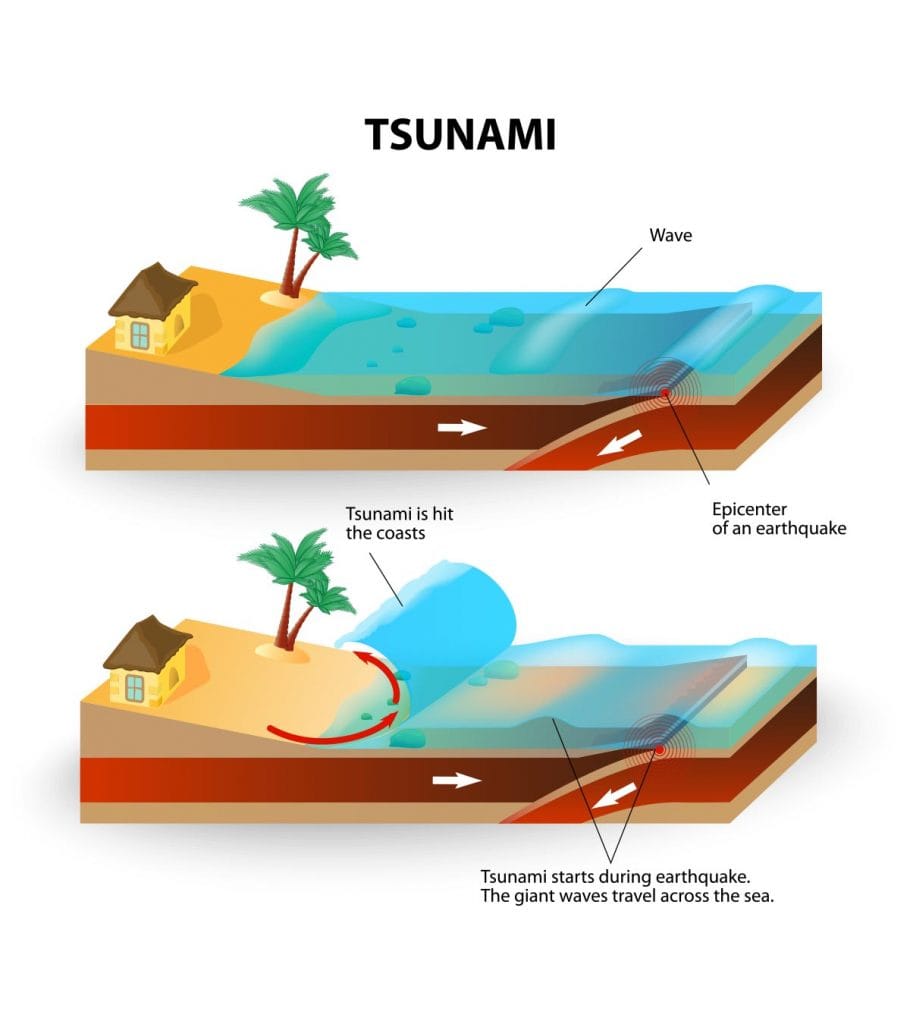
- A tsunami is a sequence of very long-wavelength waves created by a huge disturbance above or below the water surface, or by the displacement of a large volume of water, in enormous bodies of water such as oceans or big lakes.
- Due to their lengthy wavelengths, they are frequently referred to as tidal waves, despite the fact that the Moon and Sun have no influence on their production.
- Tsunamis can be caused by earthquakes (such as the 2004 Indian Ocean Tsunami), volcanic eruptions (such as the 1883 tsunami caused by the violent eruption of Krakatoa), landslides (such as the 2018 tsunami caused by the collapse of a section of Anak Krakatoa), underwater explosions, meteorite impacts, and other events.
- A tsunami can be caused by an impulsive force generated by a marine volcanic eruption that displaces the water column.
- During a submarine landslide, debris sliding over the seafloor changes the equilibrium sea level.
- The tsunami is then propagated by gravitational forces.
- The most severe tsunamis can be created by extraterrestrial objects colliding with the earth.
|
|
|
|---|---|
| Earthquakes in India | Vulcanicity in India |
| Landslides in India | Cyclones in India |
Indian Ocean Tsunami
- Tsunamis are frequently referred to as tidal waves because they mimic fast-rising tides, but scientists avoid using this term since tides are created by the gravitational pull of the sun and moon, but tsunamis are caused by the displacement of water.
- A tremendous earthquake, the third-largest earthquake ever recorded on a seismograph, triggered the tsunami of 2004.
- It had a magnitude of 9.1 to 9.3 on the Richter scale. The faulting lasted between 8.3 and 10 minutes, which was the longest time ever.
- It caused multiple aftershocks that lasted up to 3 to 4 months following the initial event.
- As a result of the seismic activity, a tremendous quantity of energy was released, and the earth is supposed to have wobbled slightly on its axis.
- The shift in mass and energy released resulted in a shift in the earth's rotation.
- The seafloor rose vertically by many meters as a result of the earthquake, displacing a massive volume of water and creating a tsunami.
- Due to its closeness, Indonesia was the first nation to be struck by the tsunami. It also witnessed the highest number of casualties, with about 1,70,000 people dead.
Tsunami in India
- Tsunamis haven't struck the Indian coastal area in a long time. However, earthquake activity in the North Bay of Bengal has been accompanied by waves.
- The government has compiled a list of tsunami-prone regions along India's eastern coast. Puri, Kakinada, Machilipatnam, Nizampatnam-Vetapalem, Chennai, Cuddalore-Pondicherry, Rameshwaram, Thoothukudi, Alappuzha-Chavara, Kochi are just a few of them.
- On June 26, 1941, an earthquake of a magnitude of 7.7 to 8.1 rocked the Andaman Islands. Because much of Southeast Asia was in the midst of World War II, few details about this occurrence are available.
- The earthquake and tsunami caused serious damage in the Andaman Islands, and up to 8,000 people were killed in the Andaman and Nicobar Islands, India, and Sri Lanka.
- The tsunami may have caused damage and casualties in Bangladesh, Myanmar, and Thailand.
- The tsunami struck the states of Andhra Pradesh and Tamil Nadu on the Indian mainland's southern coast roughly 2 hours after the earthquake in 2004.
- At the same time, it landed in Kerala, a state on India's southwest coast. In some regions, two to five tsunamis hit at the same time as the local high tide.
- Due to its proximity to the earthquake, the tsunami devastated the Andaman and Nicobar Islands in mere minutes.
- The tsunami had a mild impact on the Andaman Islands, but it had a catastrophic impact on the island of Little Andaman and the Nicobar Islands.
Tsunami Early Warning System in India
- INCOIS, Hyderabad, created and operates the Indian Tsunami Early Warning System (ITEWS) in 2007.
- It is the result of a collaborative effort by several institutions, including the Department of Space (DOS), the Department of Science and Technology (DST), the Council of Scientific and Industrial Research (CSIR), the Survey of India (SOI), and the National Institute of Ocean Technology (NIOT).
- To identify tsunamigenic earthquakes, monitor tsunamis, and deliver timely alerts to susceptible areas, ITEWS consists of a real-time network of seismic stations, tidal gauges, and a 24X7 operational tsunami warning center.
- Indian scientists can detect major underwater earthquakes in the Indian Ocean in real-time and provide a tsunami warning 10-20 minutes later.
- Tsunami Ready initiatives must be emulated in other vulnerable coastal towns since they improve the ability to respond to cyclones and storm surges.
- Even the finest warning systems can fail if populations are not prepared, do not comprehend the official and natural warning indications of a tsunami, and do not respond appropriately and immediately.
Conclusion
The Indian National Centre for Ocean Information Services (INCOIS) has now developed a system that will be able to predict risk to coastal areas, the height of waves that can hit them, and even pinpoint vulnerable buildings, all in "real-time," represents a significant improvement in India's capacity to assess dangers following a tsunami event. According to INCOIS (an institution within the Indian Ministry of Earth Sciences), this made India the first country to do so. Due to this, India is significantly safer from tsunami threats.
|
|
|
|---|---|
| Geography Notes | Physical Geography |
| India's Physiographic Divisions | Indian Drainage Systems |
| Climatology | Water Resources in India |
FAQs
Q1: What causes tsunamis?
Answer: Tsunamis are typically caused by underwater earthquakes, volcanic eruptions, or landslides, displacing large volumes of water.
Q2: How often do tsunamis occur in India?
Answer: While tsunamis are relatively rare, India has experienced significant events, such as the 2004 Indian Ocean tsunami.
Q3: Which Indian states are most at risk from tsunamis?
Answer: Coastal states like Tamil Nadu, Andhra Pradesh, Odisha, and Kerala are particularly vulnerable to tsunami threats.
Q4: What measures are taken for tsunami preparedness in India?
Answer: India has established a Tsunami Warning Centre and conducts regular drills and awareness campaigns to educate coastal communities.
Q5: What impact did the 2004 tsunami have on India?
Answer: The 2004 tsunami resulted in significant loss of life, displacement of communities, and extensive damage to infrastructure, especially in Tamil Nadu.
MCQs
- What is the primary cause of most tsunamis?
a) Meteorological phenomena
b) Underwater earthquakes
c) Tsunami bombs
d) Coastal erosion
Answer: (B) See the Explanation
- Which Indian state was most affected by the 2004 tsunami?
a) Gujarat
b) West Bengal
c) Tamil Nadu
d) Maharashtra
Answer: (C) See the Explanation
- How does the Tsunami Warning Centre in India function?
a) Provides daily weather forecasts
b) Monitors seismic activity and oceanic conditions
c) Controls fishing activities
d) Issues agricultural advisories
Answer: (B) See the Explanation
- Which of the following is NOT a characteristic of a tsunami?
a) Long wavelengths
b) High speed in deep water
c) Short wave height in the open ocean
d) Occurs only during monsoon season
Answer: (D) See the Explanation
- What was a significant consequence of the 2004 tsunami for India?
a) Increase in tourism
b) Strengthening of disaster management policies
c) Decrease in fishing activities
d) Complete destruction of coastal infrastructure
Answer: (B) See the Explanation
GS Mains Questions and Model Answers
Q1: Assess the preparedness and response strategies for tsunamis in India.
Answer: India's preparedness for tsunamis has significantly improved since the 2004 disaster, which exposed the vulnerabilities of coastal regions. The establishment of the Indian National Centre for Ocean Information Services (INCOIS) has been pivotal in monitoring seismic activity and oceanographic conditions, facilitating timely tsunami warnings. Furthermore, regular drills and community awareness programs enhance local preparedness, ensuring that coastal populations are informed and equipped to respond effectively. However, ongoing challenges include the need for infrastructure improvements and continuous education to address the unique vulnerabilities of different coastal regions.
Q2: Evaluate the socio-economic impacts of the 2004 tsunami on Indian coastal communities.
Answer: The 2004 tsunami had devastating socio-economic impacts on Indian coastal communities, particularly in Tamil Nadu and the Andaman and Nicobar Islands. Thousands lost their lives, and many more were injured, leading to long-term psychological effects. The destruction of homes and livelihoods resulted in significant economic losses, disrupting local fishing and tourism industries. Recovery efforts highlighted the resilience of communities but also exposed gaps in disaster preparedness and response. Rehabilitation initiatives have since focused on rebuilding infrastructure, enhancing livelihood opportunities, and fostering community resilience against future disasters.
Q3: Discuss the role of technology in tsunami detection and management in India.
Answer: Technology plays a crucial role in tsunami detection and management in India, significantly enhancing the country's ability to respond to potential threats. The Indian National Centre for Ocean Information Services (INCOIS) employs advanced seismic monitoring systems and ocean buoys to detect undersea earthquakes and measure wave heights. These technologies enable timely tsunami warnings, allowing for effective evacuation procedures in vulnerable coastal areas. Additionally, the use of satellite technology and data analytics improves forecasting accuracy and aids in formulating disaster management strategies. The integration of technology in public awareness campaigns further empowers communities to prepare and respond to tsunami threats effectively.
Previous Year Questions on Tsunami in India
1. UPSC CSE 2016
Question: "Explain the impact of the 2004 tsunami on the socio-economic conditions of affected regions in India."
Answer: The 2004 tsunami had a profound impact on the socio-economic conditions of affected regions, especially in Tamil Nadu and the Andaman and Nicobar Islands. Immediate consequences included the loss of thousands of lives and extensive injuries, which devastated local communities. Economically, vital sectors such as fishing and tourism suffered severe losses, leading to job displacement and a decline in income for many families. Recovery efforts required significant investment in rebuilding infrastructure, restoring livelihoods, and enhancing disaster preparedness, which underscored the need for comprehensive disaster management policies. Long-term rehabilitation initiatives focused on community resilience, underscoring the importance of ongoing support for affected regions to prevent future vulnerabilities.
2. UPSC CSE 2019
Question: "Critically analyze the disaster management policies in India post the 2004 tsunami."
Answer: Post the 2004 tsunami, India undertook significant reforms in disaster management policies to enhance preparedness and response capabilities. The establishment of the National Disaster Management Authority (NDMA) and the formulation of the Disaster Management Act, 2005, marked pivotal steps toward a more structured approach to disaster management. Emphasis was placed on community involvement, risk reduction strategies, and improved warning systems, including the integration of technology for real-time monitoring and alerts. While these policies have led to improvements, challenges remain, particularly in ensuring equitable access to resources and education for all vulnerable communities. Ongoing evaluations and adaptations of policies are necessary to address evolving threats, ensuring that disaster management remains proactive rather than reactive.
Download the PREPP App and attempt FREE IAS Exam Mock Tests and get complete study material!

Full Test - 04: UPSC CSE Prelims CSAT (Paper-II)
Full Test - 03: UPSC CSE Prelims CSAT (Paper-II)
UPSC CSE Prelims 2026 GS Paper 1 Question Paper (24-May-2026)
UPSC CSE Prelims 2026 CSAT Paper 2 Question Paper (24-May-2026)

17 February 2025 | The Hindu Must Read Articles | Current Affairs

16 February 2026 | The Hindu Must Read Articles | Current Affairs

13 February 2026 | The Hindu Must Read Articles | Current Affairs









Comments