Money – Indian Economy Notes
Money is a widely used and accepted medium of exchange for payment for goods and services or as a means of debt settlement. Money is the most liquid of all assets in the sense that it is universally accepted and thus can be easily exchanged for other commodities. “Money” is one of the important concepts in the UPSC/IAS 2023 Economy syllabus which is discussed in this article in detail.
|
Table of Contents |
What exactly is Money?
- Money is a medium of exchange that is widely accepted in transactions to buy goods, and services, or settle debts.
- It serves as a unit of account, a store of value, and a standard of deferred payment.
- Money is fundamental to economies because it enables trade and promotes financial growth.
- As a currency, money serves as the primary indicator of wealth and circulates anonymously from person to person and country to country.
- In essence, money is a crucial component of modern economies, facilitating economic activities, trade, and financial transactions.
- Money comes in various forms and can include both physical currency and digital representations.
Historical Background – How the Concept of Money Evolved?
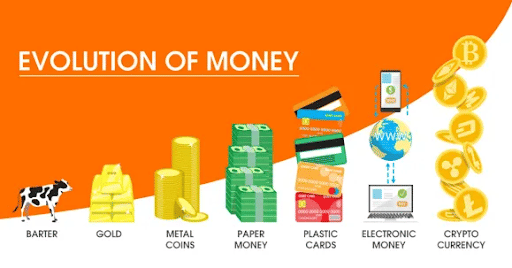
Barter System
- Money as a medium of exchange was not used in early human history since households were self-sufficient and there was little exchange of goods.
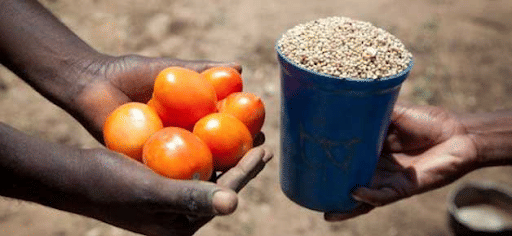
- Whatever exchange occurred between the households was done through barter or the exchange of goods for other goods.
- As there was no common unit of account and medium of exchange, the barter system did not allow for direct purchases of goods.
- The problem with a barter system is that in order to obtain a specific good or service from a supplier, one must also have a good or service of equal value that the supplier desires.
- In other words, in a barter system, the exchange can occur only if two transacting parties have a double coincidence of wants.
- The likelihood of a double coincidence of wants is quite low making the exchange of goods and services rather difficult.
- To solve the problems of barter trade, early humans devised a payment and exchange system that allowed the direct purchase of goods using any instrument that has the following characteristics:
- Unit of account
- High Liquidity
- Possible to store
- It must be desired by all (It should have high demand)
- It is easily exchangeable (Medium of Exchange)
Commodity Money
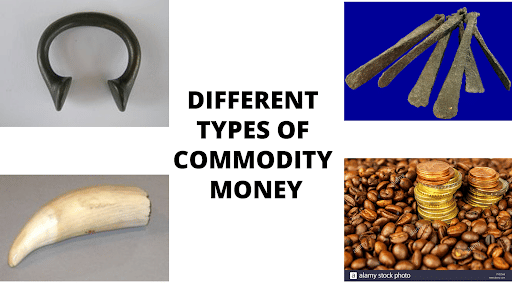
- In the beginning, there were only a few commodities that were required by everyone.
- Commodities such as arrows, bows, and seashells, which are mostly used for hunting, became the first form of medium of exchange and thus acted as money.
- When early humans transitioned from hunting to agriculture in the second stage of evolution, animals such as cattle, goats, and sheep became a medium of exchange and acted as money.
- Since commodities have limitations such as a lack of a standard unit of account, limited supply, natural factors, etc. their use was limited and was eventually replaced by other forms of money.
Metallic Money
- Commodity money evolved into metallic money as human civilization progressed.
- Metals such as gold, silver, copper, and others were used because they could be easily handled and quantified. It was the primary form of money for the majority of recorded history.
- With the passage of time and technological advancements, the hard form of gold and silver was replaced by a coinage system (gold and silver coins) that was widely used as money.
Paper Money
- It was discovered that transporting gold and silver coins was both inconvenient and dangerous. As a result, the invention of paper money marked a watershed moment in the evolution of money.
- The country's central bank regulates and controls paper money (RBI in India).
- At the moment, a large portion of the money is made up of currency notes or paper money issued by the central bank.
Credit Money
- The emergence of credit money occurred almost concurrently with the emergence of paper money.
- People keep a portion of their cash in bank deposits, which they can withdraw at their leisure via cheques.
- The cheque (also known as credit money or bank money) is not money in and of itself, but it serves the same functions as money.
Plastic Money
- Plastic money, such as credit and debit cards, is the most recent type of money.
- They intend to do away with the need to carry cash when conducting transactions.
Mobile Payments
- Mobile payments are payments made for goods or services using a portable electronic device such as a cell phone, smartphone, or tablet.
- Money can also be sent to friends and family members using mobile payment technology.
- Paytm, PhonePe, Google Pay, and so on are increasingly competing for retailers to accept their platforms for point-of-sale payments.
| Other Relevant Links | |
|---|---|
| Types of money | Functions of money |
| Demand for Money and Supply of Money | Money Creation by Banking System |
Types of Money
| Type | Description |
|---|---|
| Commodity Money |
|
| Fiat Money |
|
| Fiduciary Money |
|
| Legal Tender Money |
|
| Cryptocurrency |
|
Properties of Money
The properties of money are as follows
- Fungible (interchangeability): To be fungible, each unit must be capable of being replaced by another.
- Durable: Money must be able to resist repeated usage.
- Divisible: It should be capable of being divisible to smaller units.
- Portable: Money should be easily carried and transported.
- Acceptable: The majority of people must accept money as a mode of payment.
- Scarce: Its available supply must be restricted.
Significance of Money
- It serves as a medium of exchange; it can be used to purchase any commodity.
- It serves as a measure of value or account of a unit. Every commodity has a monetary value that can be expressed in terms of money.
- It acts as a store of value.
- It serves as a standard mode for deferred payments. It can be used to settle future monetary obligations. As an example, a loan obtained today is paid back in installments.
- It is the most liquid of all assets because it is universally accepted and thus easily exchanged for other commodities.
- It also has an opportunity cost. Instead of keeping a specific cash balance, you can earn interest on it by putting it in a fixed deposit with a bank.
- Money provides consumers and businesses with some very basic and practical advantages.
- Money's main advantage is that it increases an economy's efficiency by lowering transaction costs.
- When people can use money instead of bartering, the economy becomes more specialized and has a better division of labor.
- Money facilitates exchange and promotes trade.
- Money provides incentives for people to work hard and satisfy their wants.
- Money helps producers to earn profits and reinvest the profit to generate more income and employment.
- Money in the form of wages increases the productivity of labor in the economy.
Conclusion
Money has evolved significantly since the days of shells and skins, but its primary function has remained unchanged. Money, in whatever form it takes, provides a medium of exchange for goods and services and allows the economy to grow by allowing transactions to be completed at faster rates.
| Other Relevant Links | |
|---|---|
| Indian Economy Notes | Monetary Policy |
| Banking Sector in India | Inflation |
FAQs
Q1: What is the definition of money in economics?
Answer: Money is a medium of exchange that facilitates trade and acts as a store of value.
Q2: What are the primary functions of money?
Answer: It serves as a medium of exchange, unit of account, store of value, and standard of deferred payment.
Q3: What are the components of the money supply?
Answer: The components include currency in circulation, demand deposits, and savings deposits.
Q4: What is the difference between narrow money and broad money?
Answer: Narrow money (M1) includes liquid assets, while broad money (M3) includes all deposits.
Q5: How does the RBI control the money supply?
Answer: The RBI uses tools like CRR, SLR, repo rate, and open market operations.
MCQs
- Which of the following is a function of money?
a) Medium of exchange
b) Unit of account
c) Store of value
d) All of the above
Answer: (D) See the Explanation
- What is included in M1 (narrow money)?
a) Savings deposits with banks
b) Fixed deposits
c) Demand deposits with banks
d) Both a and c
Answer: (C) See the Explanation
- Which institution regulates the money supply in India?
a) Ministry of Finance
b) Reserve Bank of India
c) SEBI
d) NITI Aayog
Answer: (B) See the Explanation
- What happens when the money supply increases excessively?
a) Deflation
b) Inflation
c) Unemployment
d) None of the above
Answer: (B) See the Explanation
- What is broad money (M3)?
a) Only currency in circulation
b) Currency plus demand deposits
c) M1 plus savings and fixed deposits
d) Only fixed deposits
Answer: (C) See the Explanation
GS Mains Questions and Model Answers
Q1: Explain the functions of money in an economy.
Answer: Money performs essential functions in an economy, including:
Medium of exchange: It facilitates transactions, eliminating the need for barter.
Unit of account: It provides a common measure of value, making it easier to compare goods and services.
Store of value: Money can be saved and used for future transactions.
Standard of deferred payment: It allows transactions to be made on credit, ensuring future payments.
Q2: Discuss the impact of money supply on inflation.
Answer: The money supply directly affects inflation. When the money supply increases beyond the production capacity of an economy, demand rises, leading to inflation. Conversely, controlling the money supply can reduce inflation. Central banks, like the RBI, manage this through tools such as CRR, repo rates, and open market operations to maintain economic stability.
Q3: Analyze the role of the Reserve Bank of India in controlling the money supply.
Answer: The Reserve Bank of India (RBI) uses several instruments to regulate the money supply, including:
Cash Reserve Ratio (CRR): Banks must hold a percentage of deposits with the RBI.
Statutory Liquidity Ratio (SLR): Banks must maintain reserves in liquid assets.
Repo and reverse repo rates: These influence borrowing costs and liquidity.
Open market operations: The RBI buys or sells government securities to control liquidity.
Previous Year Questions on Money
1. UPSC CSE 2019
Question: "Explain the significance of M3 in measuring the money supply."
Answer: M3, known as broad money, includes M1 (currency in circulation and demand deposits) along with savings and time deposits. It reflects the total money available in the economy for transactions and investment. M3 is a comprehensive measure of the money supply, providing insights into economic activity and liquidity conditions.
2. UPSC CSE 2020
Question: "How does the Reserve Bank of India control inflation through monetary policy?"
Answer: The RBI controls inflation through monetary policy tools such as the CRR, repo rate, and open market operations. By increasing the CRR or repo rate, the RBI reduces the money supply, curbing demand and inflation. Conversely, lowering these rates increases liquidity, encouraging investment and spending. The RBI’s ability to modulate the money supply ensures macroeconomic stability.
Download the PREPP App and attempt FREE IAS Exam Mock Tests and get complete study material!

Full Test - 04: UPSC CSE Prelims CSAT (Paper-II)
Full Test - 03: UPSC CSE Prelims CSAT (Paper-II)
UPSC CSE Prelims 2026 GS Paper 1 Question Paper (24-May-2026)
UPSC CSE Prelims 2026 CSAT Paper 2 Question Paper (24-May-2026)

17 February 2025 | The Hindu Must Read Articles | Current Affairs

16 February 2026 | The Hindu Must Read Articles | Current Affairs

13 February 2026 | The Hindu Must Read Articles | Current Affairs









Comments