Membership of Parliament - Indian Parliament - Indian Polity Notes
Member of Parliament (MP) is a person who holds a position in either the Lok Sabha or the Rajya Sabha, which are the two chambers of Parliament of India. Article 79-122 deals with parliament which includes provisions regarding eligibility criteria, qualifications and disqualification of MPs etc. Members of Parliament serve as a vital link between the government and the citizens, ensuring that the voices of the people are heard and their concerns addressed. The UPSC Indian Polity and Governance Syllabus includes Membership of Parliament which is described in this article.
Table of Contents
|
Member of Parliament (MP) is a person who holds a position in either the Lok Sabha or the Rajya Sabha. Article 79-122 deals with parliament which includes provisions regarding eligibility criteria, qualifications and disqualification of MPs etc |
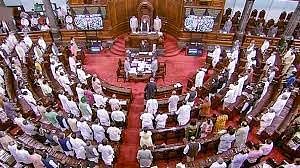
Constitutional Provisions Regarding the Membership of Parliament
Article 79 - 122 of the Indian Constitution deals with provisions related to the parliament. It also includes provisions related to qualifications, disqualifications and functions of MPs.
MPs of Lok Sabha
- The Lok Sabha comprises representatives elected directly by the people through Universal Adult Suffrage.
- According to Article 81 of the Constitution, the maximum strength of Lok Sabha is 550 members, with 530 representing the States and 20 representing the Union Territories. Currently, the Lok Sabha consists of 543 seats occupied by elected members.
MPs of Rajya Sabha
- According to Article 80 of the Indian Constitution, Rajya Sabha is to have a maximum strength of 250 members, comprising 238 representatives from States and Union Territories, and 12 members nominated by the President.
- Unlike the Lok Sabha, the Rajya Sabha is a permanent body and does not face dissolution.
- Every two years, one-third of its members retire and are replaced by newly elected members. Each member serves a term of six years.
| Other Relevant Links | |
|---|---|
| Lok Sabha | Rajya Sabha |
| Salaries and allowances of Member of Parliament | Presiding Officers Of Parliament |
Eligibility for Becoming a Member of Parliament
Qualifications prescribed by Constitution
Article 84 of the Constitution lays down the qualifications for membership of Parliament.
- He must be a citizen of India
- He must have subscribed to an oath before the person authorized by the election commission for the purpose.
- He must be not less than 25 years of age in case of Lok Sabha and not less than 30 years of age in case of Rajya Sabha.
- He must possess other qualifications as may be prescribed by Parliament.
Qualifications prescribed by the Representation of People Act(1951)
- He must be registered as an elector for a parliamentary constituency.
- He must be a member of a scheduled caste or scheduled tribe in any state or union territory,if he wants to contest a seat reserved for them. However, a member belonging to the SCs or STs community can also contest a seat not reserved for them.
- The condition that a candidate contesting an election to the Rajya Sabha from a specific state should be an elector in that particular state was removed in 2003.
Disqualification of MPs
Article 102 of the Constitution provides grounds for disqualification of member of either house of the Parliament.The member shall be disqualified if
- If he holds any office of profit under the Government of India or the Government of any State except the post of minister or any other office exempted by Parliament.
- If he is of unsound mind and stands so declared by a competent court.
- If he is an undischarged insolvent.
- If he is not a citizen of India, or has voluntarily acquired the citizenship of a foreign State, or is under any acknowledgment of allegiance or adherence to a foreign State.
- If he is so disqualified by or under any law made by Parliament.
Disqualification on the Ground of Defection
- The Constitution has also prescribed disqualifications for members of Lok Sabha on the ground of defection under the provisions of the Tenth Schedule, which was added by the 52nd Amendment Act of 1985.
- The anti-defection law deals with the defection of (a) members of a political party(b) independent members (c) nominated members.
- A Member incurs disqualifications under the following circumstances.
- If he or she voluntarily gives up the membership of a political party or joins any other political party after the election
- If he/she votes or abstains from any crucial voting contrary to the directive circulated by his/her respective political party.
- A nominated member joins any political party after six months.
- The Chairman or the Speaker of the House has the absolute power in deciding the cases of disqualification of members on the ground of defection.
- In 1992,the Supreme Court ruled that the decision of the speaker/chairman in this regard is subjected to judicial review.
Additional disqualifications mentioned in Representation of People Act (1951):
- He must not have been found guilty of certain election offenses or corrupt practices in the elections.
- He must not have been convicted for any offense resulting in imprisonment for two or more years. But, the detention of a person under a preventive detention law is not a disqualification.
- He must not have failed to lodge an account of his election expenses within the time.
- He must not have any interest in government contracts, works, or services.
- He must not be a director or managing agent nor hold an office of profit in a corporation in which the government has at least 25 percent share.
- He must not have been dismissed from government service for corruption or disloyalty to the State.
- He must not have been convicted for promoting enmity between different groups or for the offense of bribery.
- He must not have been punished for preaching and practising social crimes such as untouchability,dowry and sati.
In case of disqualification on the basis of above given grounds, the President's decision is final.However he should consult the election commission and act accordingly.
Vacation of Seat by MP
Article 101 of the Indian Constitution deals with vacation of seat by MP
Double Membership
- If a person is elected to both the Houses of the Parliament,he/she has to choose one house,otherwise his/her seat in Rajya Sabha becomes vacant.
- If a sitting member of one House is also elected to another one,his seat in the first House becomes vacant.
- If a person is elected to two seats in the same house,he/she should exercise his option for one.Otherwise both seats become vacant.
Disqualifications
- If a member of Parliament becomes subject to any of the disqualifications mentioned in Article 102,his/her seat becomes vacant.
Resignation
- If an MP resigns his/her seat by writing to the Chairman or the Speaker, as the case may be, and his/her resignation is accepted by the Chairman or the Speaker, as the case may be,the seat becomes vacant.
Absence
- If for a period of sixty days a member of either House of Parliament is absent without permission of the House from all meetings thereof, the House may declare his seat vacant.
- Provided that in computing the said period of sixty days no account shall be taken of any period during which the House is prorogued or is adjourned for more than four consecutive days.
Privileges Of MPs
Parliamentary Privileges are the special rights , immunities and exemptions enjoyed by the two Houses, their Committees and their members
- MPs cannot be arrested during the session of Parliament, 40 days before and 40 days after the end of a session.This privilege is only available in civil cases and not in criminal cases or preventive detention cases.
- Members have freedom of speech in Parliament, and no member is liable to any proceedings in any court for anything said or any vote given in Parliament
- They are exempted from jury service.They can refuse to give evidence and appear as a witness in a case pending in a court when Parliament is in session.
Diminishing Role of individual MPs in India’s parliamentary Setup
Here are some key aspects contributing to this perception:
- Whip System: Political parties often enforce a strict whip system, compelling MPs to vote along party lines rather than based on their constituents' interests or their own beliefs. This can limit MPs' ability to exercise independent judgment and contribute meaningfully to legislative debates.
- Legislative Productivity: The efficacy of the legislative process in India has faced criticism due to factors such as frequent disruptions, filibustering, and a high volume of bills being passed without adequate scrutiny. This can undermine the role of MPs in scrutinizing legislation and holding the government accountable.
- Concentration of Power: Power tends to be concentrated within the leadership of political parties, particularly the ruling party. This can marginalize the role of individual MPs, especially those who are not part of the ruling party or do not hold influential positions within their party.
- Weak Oversight Mechanisms: Oversight mechanisms, such as parliamentary committees, are often perceived as ineffective in holding the government accountable. This can diminish the role of MPs in scrutinizing government actions and policies.
- Lack of Autonomy: MPs may face constraints in exercising autonomy due to factors such as party discipline, patronage networks, and the need to prioritize party interests over those of their constituents.
- Role of Anti-Defection Law: Anti-Defection Law discourages MPs from expressing dissent or holding views contrary to their party's position, as defection could result in disqualification from office.It limits the ability of MPs to voice the concerns of their constituents or engage in constructive debate.
Conclusion
Members of Parliament (MPs) play a pivotal role as representatives of the people. They are not just lawmakers but also guardians of the public interest, entrusted with the responsibility of shaping policies, scrutinizing the government, and advocating for the welfare of their constituency members. Through parliamentary debates, discussions, and question hours, MPs hold the executive accountable for its actions and policies. This mechanism of checks and balances is essential for fostering transparency and upholding the principles of good governance.
| Other Relevant Links | |
|---|---|
| Indian Polity UPSC Notes | The Preamble |
| Fundamental Rights | Indian Parliamentary System |
FAQs
Question: What is the composition of the Indian Parliament?
Answer: The Indian Parliament consists of two houses: the Lok Sabha (House of the People) and the Rajya Sabha (Council of States). The Lok Sabha has 545 members, directly elected by the people, while the Rajya Sabha comprises 245 members, elected by the state legislative assemblies and nominated by the President. This bicameral structure ensures balanced representation of both the population and the states.
Question: How are members of the Rajya Sabha elected?
Answer: Members of the Rajya Sabha are indirectly elected through a system of proportional representation by means of a single transferable vote. Each state legislature elects representatives in accordance with the population of the state. Additionally, 12 members are nominated by the President from various fields like arts, science, literature, and social service to bring expertise into the house.
Question: What is the maximum term for a member of the Lok Sabha?
Answer: The members of the Lok Sabha are elected for a term of five years unless the house is dissolved earlier. Elections to the Lok Sabha are held every five years to elect its members. In cases where the Lok Sabha is dissolved before completing its full term, fresh elections are conducted.
Question: Can a member of Parliament hold office in both the Lok Sabha and Rajya Sabha?
Answer: No, a member of Parliament can either be a member of the Lok Sabha or the Rajya Sabha, but not both. The Constitution of India mandates that a person must be elected to one of the two houses to represent the people. However, they can be elected to either house in different terms or can be appointed as a Rajya Sabha member after serving in the Lok Sabha.
Question: What qualifications are required to become a member of the Lok Sabha?
Answer: To become a member of the Lok Sabha, a person must be a citizen of India, at least 25 years of age, and should not hold an office of profit under the government. Additionally, the individual must be nominated or elected from a constituency, and must not be disqualified due to any legal or constitutional reasons, such as criminal conviction or election misconduct.
MCQs
1. What is the maximum membership of the Lok Sabha?
A) 500
B) 545
C) 600
D) 550
Answer: (B) See the Explanation
Explanation: The maximum membership of the Lok Sabha is 545 members. Out of these, 543 are directly elected by the people of India from various constituencies, and 2 members are nominated by the President to represent the Anglo-Indian community, though this provision was abolished by the 104th Amendment of the Constitution in 2019.
2. Who can nominate members to the Rajya Sabha?
A) The President of India
B) The Prime Minister of India
C) The Chief Justice of India
D) The Speaker of the Lok Sabha
Answer: (A) See the Explanation
Explanation: The President of India has the authority to nominate 12 members to the Rajya Sabha. These members are nominated for their expertise in fields such as literature, science, art, and social service, ensuring a wide range of perspectives in the house. This is done to bring intellectual and cultural diversity to the legislative process.
3. What is the term duration for a member of the Rajya Sabha?
A) 5 years
B) 6 years
C) 4 years
D) 7 years
Answer: (B) See the Explanation
Explanation: The term duration for a member of the Rajya Sabha is 6 years. However, Rajya Sabha is a permanent body, and members are elected in a staggered manner, with one-third of the members retiring every two years. This ensures continuity in the functioning of the house.
4. What is the minimum age required to become a member of the Lok Sabha?
A) 25 years
B) 30 years
C) 35 years
D) 40 years
Answer: (A) See the Explanation
Explanation: The minimum age required to become a member of the Lok Sabha is 25 years. A person must also be a citizen of India and should not hold any office of profit under the government to be eligible to contest for the Lok Sabha election.
5. Which of the following is the correct description of the membership of the Rajya Sabha?
A) It is directly elected by the people
B) It has 250 members, all nominated
C) It has both elected and nominated members
D) All members are appointed by the President
Answer: (C) See the Explanation
Explanation: The Rajya Sabha consists of 245 members, of which 233 are elected by the state legislatures through a system of proportional representation. The remaining 12 members are nominated by the President from fields like arts, science, and social service to bring expertise and diversity to the house.
GS Mains Questions and Model Answers
Q1: Discuss the role of the Rajya Sabha in the Indian legislative process. How does it complement the Lok Sabha?
Answer: The Rajya Sabha, as the Upper House of Parliament, plays a crucial role in the Indian legislative process by reviewing and suggesting amendments to bills passed by the Lok Sabha. While the Lok Sabha represents the people directly, the Rajya Sabha represents the states and Union territories, ensuring that state interests are considered in legislation. The Rajya Sabha acts as a revising chamber, and though it cannot veto money bills, it can delay other types of legislation, thereby offering a second opinion and enhancing the quality of laws passed. The bicameral structure of the Parliament ensures a balanced representation, with the Lok Sabha focusing on direct popular representation and the Rajya Sabha providing broader representation of state interests.
Q2: Evaluate the qualifications and disqualifications for membership in the Indian Parliament, with special emphasis on the Lok Sabha.
Answer: To be eligible for membership in the Lok Sabha, a candidate must be a citizen of India, at least 25 years of age, and must not hold an office of profit under the government. The candidate must also not be declared disqualified by the Election Commission on grounds such as conviction for certain offenses, undischarged insolvency, or being of unsound mind. Disqualifications also extend to individuals found guilty of corrupt practices during elections. The qualifications ensure that only eligible and capable citizens can represent the people, while the disqualifications maintain the integrity of the electoral system.
Q3: Analyze the system of proportional representation in the election of Rajya Sabha members and its advantages over direct elections.
Answer: Rajya Sabha members are elected through a system of proportional representation by means of a single transferable vote, where each state's elected representatives in the state legislature vote to elect the Rajya Sabha members. This system ensures that the composition of the Rajya Sabha reflects the political diversity of the states, reducing the possibility of domination by any single party. It also allows smaller parties to have a voice in the Upper House, providing more balanced representation. The system promotes a broader spectrum of political opinions and expertise in the legislative process, which might not be achievable through direct elections alone.
Previous Year Questions on Membership of Parliament
1. UPSC CSE 2021:
Question: Examine the role and significance of the Rajya Sabha in the legislative process and its impact on the federal structure of India.
Answer: The Rajya Sabha plays a significant role in shaping legislation and ensuring that the interests of the states are represented at the national level. Its function as a revising chamber helps to enhance the quality of legislation passed by the Lok Sabha. The Rajya Sabha's composition, with members elected by state legislatures, reflects the federal structure of India and allows the states to participate in national decision-making.
2. UPSC CSE 2019:
Question: Discuss the powers and limitations of the Lok Sabha and Rajya Sabha in the Indian parliamentary system. How do they differ in their functions?
Answer: The Lok Sabha, as the directly elected house, has more legislative powers, especially in matters related to money bills, which can only be introduced and passed in the Lok Sabha. The Rajya Sabha, while having the power to delay legislation and suggest amendments, cannot veto money bills. Both houses complement each other, but the Lok Sabha is more powerful in terms of decision-making and representation of the people's will.
*email: contactus@prepp.in
Download the PREPP App and attempt FREE IAS Exam Mock Tests and get complete study material!

Full Test - 04: UPSC CSE Prelims CSAT (Paper-II)
Full Test - 03: UPSC CSE Prelims CSAT (Paper-II)
UPSC CSE Prelims 2026 GS Paper 1 Question Paper (24-May-2026)
UPSC CSE Prelims 2026 CSAT Paper 2 Question Paper (24-May-2026)

17 February 2025 | The Hindu Must Read Articles | Current Affairs

16 February 2026 | The Hindu Must Read Articles | Current Affairs

13 February 2026 | The Hindu Must Read Articles | Current Affairs









Comments