Market Price - Indian Economy Notes
Market Price refers to the prevailing price at which goods and services are bought and sold in an open market, influenced by the interaction of supply and demand forces. It serves as a key determinant of economic decisions, affecting consumer behavior, business strategies, and policy formulation. The topic “Market Price” is one of the important concepts in the UPSC/IAS 2023 Economy syllabus which is discussed in this article in detail.
|
Table of Contents |
What is Market Price?
- Market price refers to the current and prevailing price at which goods, services, commodities, or financial assets are bought and sold in an open market.
- It is the outcome of the interaction between supply and demand forces within the market.
- Market price serves as a key indicator of the value of a product or asset at a specific point in time and is a fundamental concept in economics and finance.
- The determination of market price is influenced by various factors, including the balance between supply and demand, consumer preferences, production costs, competition, economic conditions, and external factors such as government policies and regulations.
- In essence, market price represents the equilibrium point at which the quantity of a product or asset that buyers are willing to purchase matches the quantity that sellers are willing to provide.
- This equilibrium is reached when there is neither excess demand (shortage) nor excess supply (surplus) in the market.
- Market price plays a crucial role in economic decision-making, as it affects both producers and consumers.
- For producers, it helps determine the level of production, pricing strategies, and profitability.
- For consumers, it influences purchasing decisions based on affordability and perceived value.
- To arrive at the market price, government taxes will be added to the factor cost, while subsidies will be subtracted from the factor cost.
- Taxes are added because they are costs that raise the price.
- Excise tax, sales tax, service tax, and import and export charges are all examples of product taxes.
- Subsidies are reduced because they compensate for the factor cost or reduce the market price and the factor cost.
- Food, petroleum, and fertilizer subsidies are examples of product subsidies.
|
Market price = Basic price + Product taxes – Product subsidy OR Market Price = Factor cost + Net indirect taxes (Net indirect taxes = Indirect taxes – Subsidy) |
Understanding the Market Price
- A shift in the market price for an item or service can be caused by shocks to the supply or demand for that good or service.
- A supply shock occurs when an unforeseen occurrence occurs that causes the supply of an item or service to abruptly shift.
- Interest rate reduction, tax cuts, government stimulus, terrorist attacks, natural catastrophes, and stock market collapses are all instances of a supply shock.
- A demand shock occurs when the demand for an item or service suddenly surges or declines.
- A sharp increase in the price of oil or other commodities, political unrest, natural calamities, and technological advancements are all instances of a demand shock.
Market Price - Influencing Factors
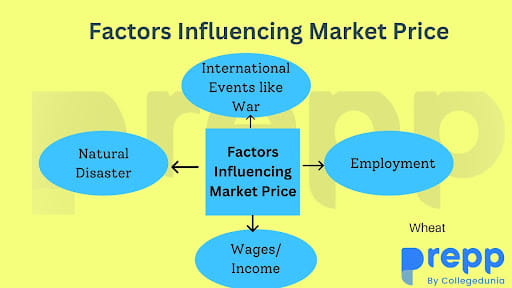
Apart from supply and demand, other factors can have an impact on the market price of goods and services. The influencing factors of the market price are:
- Natural Disasters: Any natural disaster can result in a significant rise or fall in the cost of goods, assets, and commodities.
- For instance, if a flood hits a place that produces wheat in the greatest number, it would undoubtedly boost the price of wheat in all other regions throughout the world due to the concern that there will soon be no more wheat available.
- International Events: International events such as war, military activity, international relations, etc. have an impact on the market price.
- For example, the conflict between Russia and Ukraine has significantly increased fuel prices, which has caused concern among consumers worldwide about long-term price increases.
- Employment & Wages: The employment rate and wages/salaries also have an impact on market prices. People's purchasing power will suffer if they are unemployed and have no income.
- As a result, under pressure, brands either raise or lower their pricing in response to the circumstances, which could have a negative impact on economies.
- Cost of Production: Production costs influence the minimum price at which producers are willing to supply goods.
- Market Competition: Intense competition in the market can lead to lower prices, as producers strive to attract consumers.
Market Price vs. Other Price Concepts
- Market Price vs. Basic Price: Market Price includes taxes, subsidies, and other external factors, while Basic Price focuses solely on the value of the product itself.
- Market Price vs. Factor Cost: Market Price reflects the final price paid by consumers, while Factor Cost represents the cost of production.
Significance of Market Price
- Allocation of Resources: Market prices serve as signals that guide the allocation of resources. When prices rise, it indicates higher demand relative to supply, prompting producers to allocate more resources to meet that demand.
- Supply and Demand Dynamics: Market prices reflect the delicate balance between supply and demand. They provide insights into the health of markets and industries by indicating whether demand is growing, stable, or declining.
- Consumer Behavior: Market prices directly influence consumer choices and preferences. Consumers tend to opt for goods and services that provide the best value for their money at prevailing market prices.
- Profit Maximization: Businesses make production and pricing decisions based on market prices to optimize their profits. They adjust production levels and pricing strategies to align with consumer preferences and competitor offerings.
- Efficient Resource Allocation: Market prices ensure that resources are allocated efficiently, with products and services that are in high demand receiving higher prices, thereby incentivizing production.
- Economic Indicator: Market prices are used as economic indicators to assess inflation, deflation, and overall price stability. Fluctuations in market prices can provide insights into broader economic trends.
Challenges Related to Market Price
- Price Volatility: Market prices can be highly volatile, particularly in financial markets and commodity markets. Rapid price changes can lead to uncertainty for both producers and consumers.
- Information Asymmetry: In some cases, there might be an imbalance of information between buyers and sellers, leading to unfair pricing practices or market inefficiencies.
- Market Manipulation: Unscrupulous market participants can engage in market manipulation to artificially inflate or deflate prices for personal gain, leading to distortions in market dynamics.
- External Factors: Market prices can be influenced by external factors such as government policies, taxes, subsidies, and geopolitical events, which might not directly reflect supply and demand fundamentals.
- Income Inequality: High market prices for essential goods and services can disproportionately impact lower-income segments of the population, leading to income inequality.
- Market Bubbles: Speculative behavior can drive market prices to unsustainable levels, resulting in market bubbles that can lead to significant market corrections.
- Environmental Impact: In cases where market prices do not account for negative externalities such as environmental costs, there can be overexploitation of resources and environmental degradation.
Conclusion
Market Price acts as a compass guiding economic agents through the intricacies of supply and demand dynamics. India's efforts to ensure fair pricing and consumer protection align with the pursuit of balanced economic development. As we delve deeper into economic complexities, Market Price remains a pivotal force, influencing decisions, policies, and the overall trajectory of economic progress.
FAQs
Question. What is Market Price?
Answer: Market price is the prevailing price at which goods and services are bought and sold in an open market, influenced by supply and demand forces. It reflects the equilibrium point where buyers and sellers agree on a price.
Question. How is market price determined?
Answer: Market price is determined by the interaction of supply and demand. If demand increases and supply remains constant, the price rises. Conversely, if supply increases and demand stays constant, the price falls.
Question. What factors influence market price?
Answer: Factors such as supply and demand, production costs, competition, international events, natural disasters, wages, and government policies influence market prices.
Question. What is the difference between market price and factor cost?
Answer: Market price includes taxes and subsidies, while factor cost refers to the cost of production without including indirect taxes or subsidies.
Question. Why is market price important in economics?
Answer: Market price acts as an indicator of economic health, guiding businesses and consumers in decision-making. It affects resource allocation, profit maximization, and consumer behavior.
MCQs
- What does the market price of a commodity depend on?
A) Only on the cost of production
B) The interaction of supply and demand
C) Government subsidies only
D) Consumer preferences alone
Answer: (B) See the Explanation
Market price is determined by the interaction of supply and demand in the market.
- Which of the following is NOT a factor affecting market price?
A) Natural disasters
B) Market competition
C) Production cost
D) Consumer income
Answer: (D) See the Explanation
While consumer income influences purchasing decisions, it doesn't directly affect market price, unlike supply and demand factors.
- How does a supply shock affect market price?
A) Decreases supply and increases price
B) Increases supply and decreases price
C) No impact on price
D) Only affects demand
Answer: (A) See the Explanation
A supply shock reduces the availability of a product, leading to higher prices if demand remains unchanged.
- What is the relationship between market price and consumer behavior?
A) Market price directly influences consumer preferences
B) Consumers always ignore price fluctuations
C) Higher prices increase demand
D) Price has no impact on consumer choices
Answer: (A) See the Explanation
Consumers are more likely to purchase goods at a price they perceive as affordable, making market price a key factor in purchasing decisions.
- What does market price represent in an economy?
A) Only the cost of goods produced
B) The price level set by the government
C) The equilibrium point for buyers and sellers
D) The cost of production plus taxes
Answer: (C) See the Explanation
Market price represents the point at which the quantity demanded equals the quantity supplied.
GS Mains Questions and Model Answers
Q1: Discuss the factors influencing market price and their impact on the economy.
Answer: Market price is influenced by various factors, including supply and demand, production costs, market competition, and external factors like government policies or international events. A shift in any of these factors can lead to price volatility, affecting both consumers and producers. For example, an increase in demand for a product without a corresponding increase in supply will raise the price, while increased competition may drive prices down. Understanding these dynamics helps policymakers control inflation, stabilize the economy, and ensure efficient resource allocation.
Q2: Explain the significance of market price in economic decision-making.
Answer: Market price is a key indicator in economic decision-making for both producers and consumers. For producers, it determines the pricing strategy and the level of production, as they aim to sell at a price that maximizes profit. For consumers, it influences purchasing decisions, determining what goods and services they can afford. Market prices guide resource allocation in the economy, signaling where demand is high and where resources need to be redirected. In essence, market price ensures that resources are efficiently distributed across sectors.
Q3: Analyze the challenges posed by price volatility in markets.
Answer: Price volatility can lead to uncertainty in the economy, making it difficult for both consumers and producers to plan effectively. For consumers, fluctuating prices may affect purchasing power and savings. For producers, unpredictable prices can result in reduced profitability and hinder investment in production. Price volatility is often caused by factors like natural disasters, geopolitical events, and speculative trading. Governments often respond by implementing price controls or subsidies to stabilize essential goods' prices, but these measures may have long-term economic consequences.
Previous Year Questions on Market Price
1. UPSC CSE 2019
Question: "What factors determine the market price of a commodity, and how does it affect economic decisions?"
Answer: Market price is determined by the forces of supply and demand, production costs, competition, and external factors like natural disasters or government policies. It directly influences economic decisions by signaling the value of a product, helping consumers make purchasing decisions and guiding producers in setting prices and determining the level of production.
2. UPSC CSE 2020
Question: "Examine the challenges posed by price volatility in the Indian market and suggest measures to mitigate them."
Answer: Price volatility, often due to fluctuations in supply and demand, natural calamities, and external events, can destabilize markets. It affects both producers, who face uncertainty in pricing, and consumers, who experience changes in affordability. Measures to mitigate volatility include improving supply chain resilience, enhancing market information systems, and implementing buffer stocks and price stabilization schemes.
Download the PREPP App and attempt FREE IAS Exam Mock Tests and get complete study material!

Full Test - 04: UPSC CSE Prelims CSAT (Paper-II)
Full Test - 03: UPSC CSE Prelims CSAT (Paper-II)
UPSC CSE Prelims 2026 GS Paper 1 Question Paper (24-May-2026)
UPSC CSE Prelims 2026 CSAT Paper 2 Question Paper (24-May-2026)

17 February 2025 | The Hindu Must Read Articles | Current Affairs

16 February 2026 | The Hindu Must Read Articles | Current Affairs

13 February 2026 | The Hindu Must Read Articles | Current Affairs









Comments