Circular Flow of Income - Indian Economy Notes
Circular Flow of Income means an economic model that represents the continuous flow of income, expenditure and the production of goods and services in an economy. It depicts the circular transfer of income between the manufacturing unit (businesses) and households. The topic “Circular Flow of Income” is one of the important concepts in the UPSC/IAS 2023 Economy syllabus which is discussed in this article in detail.
|
Table of Contents |
What exactly is Circular Flow of Income?
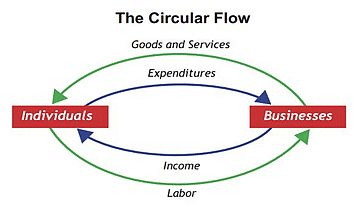
- The circular flow in an economy refers to the continuous movement of goods and services, their production, earnings, and expenditure.
- This model thus depicts how money circulates in an economy.
- Money moves from producers to employees as wages, then back to producers as product payment. In a nutshell, an economy is a never-ending circle of money.
- Although this is the most basic version of the concept, actual money flows are more complex.
- Economists have included extra variables to properly reflect today's complicated economy.
- These elements make up a country's gross domestic product (GDP) or national income.
- Land, labor, capital, and entrepreneurship are the four factors of production:
- Rent is a payment given in exchange for the contribution produced by fixed natural resources (often known as land).
- Wage is the monetary compensation for a human worker's contribution.
- Interest is the payment provided in exchange for the capital contribution.
- Profit is the monetary reward for entrepreneurship's contribution.
Methods of Calculating National IncomeThe three methods of calculating national income are Value Added Method, the Expenditure method, and the Income method. Income Method
Expenditure Method
Value Added Method
*To know more about the topic, click this link Methods of Calculating National Income |
| Other Relevant Links | |
|---|---|
| National Income Aggregates | Methods of Calculating National Income |
| Gross Domestic Product (GDP) | Gross National Product (GNP) |
| Net Domestic Product (NDP) | Gross Value Added (GVA) |
Phases of Circular Flow of Income
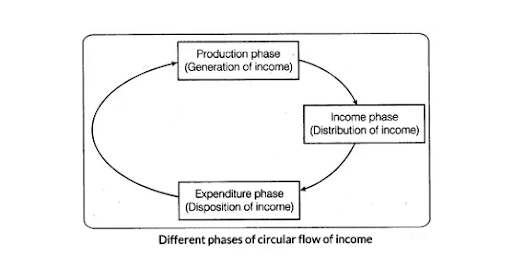
The three different phases in a circular flow of income are:
- Generation: The generation phase is the initial stage of the circular flow of money. In this stage, businesses use factor services to help them produce goods and services.
- Distribution: The distribution phase is the second stage of the income flow cycle. Factor incomes including wages, rent, interest, and profit flow from businesses to households during this phase.
- Disposition: The Disposition Phase is the final stage of the income cycle. During this stage, the income generated by the production elements is used to purchase the items and services that the businesses produce.
Types of Circular Flow of Income
The two types of circular flow are:
Real Flow
- The Real Flow in an economy refers to the movement of factor services from households to businesses and the corresponding movement of goods from businesses to consumers.
- Physical Flow is another name for real flow.
- There is no money involved in this kind of circular movement, and only the goods and services are transferred between the two economic sectors. An economy can use this flow to estimate the size of its growth process.
- For instance, if enterprises receive more factor services, they will generate more volume, which will subsequently hasten the process of economic growth.
Money Flow
- Money flow refers to the exchange of factor payments between businesses and households.
- In this type, there is an exchange for their factor services and the exchange of consumer spending between businesses and households for the purchase of goods and services produced by businesses.
- Nominal flow is another name for money flow.
- Money is exchanged between the two sectors, i.e., households and businesses, in this kind of circular flow.
Circular Flow of Income - Case of Two-Sector Economy
- It is described as the exchange of payments and receipts for products, services, and factor services between households and businesses.
- The diagram's lower portion depicts the flow of factor services from homes to businesses, as well as the equivalent flow of factor payments from businesses to consumers (C).
- The upper portion depicts the movement of goods and services from businesses to consumers (B), as well as the flow of consumer spending (A) from consumers to businesses.

Outcome of a Circular Flow Model
- A circular flow model need not contain an outcome or end.
- Instead, it describes where an economy is right now in terms of how its inflows and outflows are being used.
- Changes to the economy can be made using this information.
- For instance, a nation may decide to cut back on imports and some government initiatives if it realises its national income is insufficient.
Significance of Circular Flow of Income
- Helps in understanding the interdependence among sectors: The household sector, the government sector, the producer sector, and the foreign sector are among the various economic sectors.
- The economy's cyclical flow of income makes it easier to see how various sectors are interdependent on one another.
- In other words, it depicts how these economic sectors work best together so that a nation's overall economic activity is not disrupted.
- Aids in the calculation of National Income: The three phases of income (generation, distribution, and disposition) are depicted in this circular flow model.
- The income generated by an economy in these phases can be used to calculate the income produced by an economy, i.e., Production Method, Income Method, and Expenditure Method.
- Displays an economy's equilibrium position: Any disruption of an economy's circular flow can lead to disequilibrium, which can affect how well it functions. As a result, an economy's circular flow of income reveals its state of balance.
- Aids in recognising various leakages and injections: An economy's cyclical flow of income aids in locating leaks and injections in the system as well.
Limitations of Circular Flow of Income
- Simplification: The Circular Flow is a simplified representation of a complex economy, omitting certain nuances and external factors.
- Closed Economy Assumption: The Circular Flow assumes a closed economy without external trade, which doesn't reflect the reality of global economic interconnections.
- Neglects Government Intervention: It overlooks the role of the government in regulating the economy, implementing policies, and addressing market failures.
- Limited to Real Transactions: The Circular Flow typically focuses on real transactions, omitting financial activities and flows.
- Static Representation: It presents a static snapshot of the economy at a particular moment, without capturing dynamic changes over time.
- Income Distribution Simplification: While it shows income flow between sectors, it doesn't delve deeply into the intricacies of income distribution and inequality.
Conclusion
The Circular Flow of Income portrays the synchronization of households, businesses, and the government in an economy. It exemplifies the interdependence that fuels economic growth, value creation, and wealth distribution. In India, where economic inclusivity is a priority, understanding and optimizing the Circular Flow becomes essential. As we navigate the complexities of economic systems, the Circular Flow serves as a guide, reminding us of the intricate balance that underpins a nation's economic prosperity.
| Other Relevant Links | |
|---|---|
| Indian Economics Notes | National Income Accounting |
| Economic Growth and Economic Development | Human Development |
FAQs
Question: What is the circular flow of income?
Answer: The circular flow of income is an economic model that illustrates the continuous flow of income, spending, and goods/services production within an economy, typically between households and firms. This model helps visualize economic activity as an ongoing cycle.
Question: How does the circular flow of income relate to national income?
Answer: The circular flow of income captures the total economic activity, representing national income. It encompasses all monetary transactions between households and businesses, forming the basis of national income calculations.
Question: What are the main components of the circular flow of income?
Answer: The circular flow consists of income, expenditure, and production components. Income flows from firms to households, expenditure from households to firms, and production occurs as firms supply goods and services, maintaining economic activity.
Question: What is the difference between real flow and money flow?
Answer: Real flow refers to the movement of goods and services, while money flow pertains to monetary transactions, such as wages and payments. Both flows facilitate the circular flow of income in an economy.
Question: What role do injections and leakages play in the circular flow?
Answer: Injections (investments, exports) add to the circular flow, increasing income, while leakages (savings, imports) reduce it. Managing these helps stabilize economic growth and sustain equilibrium in the flow.
MCQs
1. Which component is considered an injection in the circular flow of income?
A) Savings
B) Exports
C) Taxes
D) Imports
Answer: (B) See the Explanation
Explanation: Exports are an injection as they bring additional income into the economy, whereas savings, taxes, and imports are leakages, removing money from the flow.
2. In a closed economy, which sectors are involved in the circular flow of income?
A) Households and Firms
B) Firms and Government
C) Households and Foreign Sector
D) Government and Foreign Sector
Answer: (A) See the Explanation
Explanation: In a closed economy, only households and firms are involved in the circular flow, as there are no government or foreign sector interactions.
3. Which term best describes the circular flow of income in an economy?
A) Linear
B) Cyclical
C) Static
D) Converging
Answer: (B) See the Explanation
Explanation: The circular flow of income is cyclical, indicating continuous economic activity with income flowing between households and firms in a repetitive cycle.
4. Which phase in the circular flow involves households receiving income?
A) Generation
B) Distribution
C) Consumption
D) Production
Answer: (B) See the Explanation
Explanation: The distribution phase involves income transfer from firms to households, as households provide labor and receive wages and other factor payments.
5. What term describes the movement of goods from firms to households in the circular flow?
A) Money Flow
B) Real Flow
C) Credit Flow
D) Nominal Flow
Answer: (B) See the Explanation
Explanation: Real flow refers to the transfer of goods and services between firms and households, separate from the monetary transactions (money flow).
GS Mains Questions and Model Answers
Q1: Explain the concept of the circular flow of income and its importance in understanding economic activity. How does it facilitate national income measurement?
Answer: The circular flow of income represents a continuous movement of money, goods, and services between economic sectors, primarily households and firms. This model shows income generation, distribution, and expenditure, forming the basis of economic activity. It simplifies complex transactions into a cyclical flow, aiding in national income calculations by showing total income and expenditure. Circular flow analysis is crucial for understanding economic dynamics, as it captures interdependencies and reveals economic health, thus supporting GDP measurement and policymaking.
Q2: Analyze the role of injections and leakages in the circular flow of income. How do these factors impact economic stability?
Answer: Injections, such as investments, government spending, and exports, add money to the economy, stimulating income flow and production. Conversely, leakages like savings, taxes, and imports withdraw funds, potentially reducing demand. A balance between injections and leakages is essential for economic stability, as excessive leakages can lead to recession, while excess injections may cause inflation. Managing these components helps maintain an equilibrium in the flow, sustaining growth and preventing economic instability.
Q3: Discuss the phases of the circular flow of income and their relevance to economic growth. How does each phase contribute to overall economic development?
Answer: The circular flow has three phases: generation, distribution, and disposition. In the generation phase, production occurs, generating income. The distribution phase transfers this income to households through wages, rent, and profits. Finally, the disposition phase involves households spending income on goods and services, sustaining demand. These phases ensure continuous economic activity, as each stage drives the next. Economic growth depends on efficient flow through these phases, as it enables reinvestment, consumption, and expansion, collectively enhancing development.
Previous Year Questions on Circular Flow of Income
1. UPSC CSE Prelims 2021:
Question: Which of the following is considered a leakage in the circular flow of income?
A) Government Spending
B) Savings
C) Exports
D) Investments
Answer: (B)
Explanation: Savings reduce the income available for spending in the economy, representing a leakage that diminishes the circular flow, unlike government spending, exports, and investments which add to the flow.
2. UPSC CSE Mains 2020 (GS Paper 3):
Question: "Evaluate the significance of the circular flow of income model in macroeconomic analysis." Discuss its utility for policymakers in managing economic cycles.
Answer: The circular flow model illustrates economic interdependencies, aiding policymakers in understanding and regulating economic cycles. By tracking income and expenditure flows, policymakers can gauge economic health, assess recession or inflation risks, and apply fiscal adjustments. The model reveals leakages and injections, highlighting areas for intervention to stabilize growth. In sum, the circular flow model serves as a macroeconomic diagnostic tool, guiding effective policy strategies.
Download the PREPP App and attempt FREE IAS Exam Mock Tests and get complete study material!

Full Test - 04: UPSC CSE Prelims CSAT (Paper-II)
Full Test - 03: UPSC CSE Prelims CSAT (Paper-II)
UPSC CSE Prelims 2026 GS Paper 1 Question Paper (24-May-2026)
UPSC CSE Prelims 2026 CSAT Paper 2 Question Paper (24-May-2026)

17 February 2025 | The Hindu Must Read Articles | Current Affairs

16 February 2026 | The Hindu Must Read Articles | Current Affairs

13 February 2026 | The Hindu Must Read Articles | Current Affairs









Comments