Methods of Calculating National Income - Indian Economy Notes
The different methods of calculating national income are the Income Method, Production (Value-Added) Method, and Expenditure Method. National Income serves as a critical indicator of a country's economic health and progress. It quantifies the total value of all goods and services produced within the country's borders during a specific time period. To accurately measure this economic metric, economists employ various methods, each offering a unique perspective on economic activity. The topic “Methods of Calculating National Income” is one of the important concepts in the UPSC/IAS 2023 Economy syllabus which is discussed in this article in detail.
|
Table of Contents |

How is National Income Calculated?
- After depreciation, the total worth of final products and services generated by normal residents throughout an accounting year is called the national income.
- Goods and services are generally produced by the production units. They do it by utilising four factors of production: land, labour, capital, and entrepreneurship.
- These four factors of production work together to create goods and services, adding value to existing goods.
- This additional value, or net domestic product, is dispersed among the owners of the four components of production, who receive rent, employee compensation, interest, and profit in exchange for their contribution to the production of products and services.
- The profits earned by the owners of the factors of production are used to acquire goods and services from the production units for consumption and investment.
- In a nutshell, manufacturing generates revenue. Income is utilised to fund spending, and spending, in turn, fuels more production.
- The circular flow of national income has three phases: Production, Income and Expenditure.

Methods of Calculating National Income
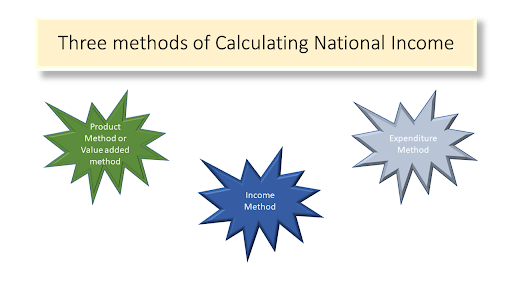
- The three methods of calculating national income are:
- Value Added Method
- Income Method
- Expenditure Method
- To enhance accuracy and comprehensiveness, economists often combine two or more methods to calculate National Income.
- This triangulation helps mitigate the limitations of individual methods and provides a more accurate depiction of an economy's performance.
| Other Relevant Links | |
|---|---|
| Value Added Method | Expenditure Method |
| Income Method | Gross National Product (GNP) |
| Net Domestic Product (NDP) | Gross Domestic Product (GDP) |
What is Value Added Method?
- Value added refers to the difference between the value of a firm's output and the value of the intermediate goods and services used in the production process.
- It represents the net contribution of a firm or a sector to the economy.
- The method involves breaking down the economy into different sectors such as agriculture, industry, and services.
- For each sector, the value added is calculated by subtracting the value of intermediate consumption (inputs used in production) from the value of output (goods or services produced). This ensures that only the additional value created at each stage is considered.
- One of the primary challenges in calculating National Income is the risk of double counting. Double counting occurs when the value of intermediate goods and services is included multiple times in the calculation process.
- The Value Added Method addresses this challenge by excluding intermediate consumption, focusing only on the value added at each stage.
*Click Here to read more about Value Added Method
What is the Income Method?
- The Income Method is one of the key approaches used to calculate a nation's National Income.
- It focuses on assessing the total income earned by individuals, businesses, and the government within an economy during a specific time period.
- This method provides insights into how the generated income is distributed among different factors of production, such as labor, capital, and land.
- By analyzing various sources of income, the Income Method offers a comprehensive view of the economic activity within a country.
- The method involves aggregating the different sources of income earned by various economic agents, including individuals, households, businesses, and the government.
- These sources of income include wages and salaries, rent, interest, profits, and taxes.
*Click Here to read more about Income Method
What is the Expenditure Method?
- The Expenditure Method focuses on estimating the total value of expenditures made by various economic agents within an economy during a specific time period, typically a year.
- By analyzing the expenditures made by consumers, businesses, government entities, and net exports (exports minus imports), the Expenditure Method provides insights into the overall economic activity and performance of a country.
- The Expenditure Method is based on the principle that the total expenditure in an economy is equal to the total income generated in that economy.
- It assumes that every transaction that involves spending contributes to the production of goods and services, and thus, to the generation of income.
- To avoid double counting, certain items such as intermediate goods (goods used in the production of other goods) are excluded, while taxes on products and subsidies are included.
*Click Here to read more about the Expenditure Method
Conclusion
Calculating National Income is a complex endeavor that requires a comprehensive approach. By using different methods, economists and policymakers gain a multifaceted understanding of an economy's dynamics. While each method has its limitations, their combination helps provide a more accurate and holistic picture of economic health.
| Other Relevant Links | |
|---|---|
| Indian Economics Notes | Circular Flow of Income |
| National Income Aggregates | National Income Accounting |
FAQs
Question: What are the primary methods used to calculate national income?
Answer: The three primary methods used to calculate national income are the Production Method (or Value-Added Method), the Income Method, and the Expenditure Method. Each method looks at national income from a different perspective, such as production, income generation, or expenditure patterns in the economy.
Question: What is the Production Method of calculating national income?
Answer: The Production Method, also known as the Value-Added Method, calculates national income by summing up the value added by each industry or sector in the economy. It focuses on the contribution of goods and services produced during a specific period.
Question: How does the Income Method measure national income?
Answer: The Income Method calculates national income by adding up all the incomes earned by individuals and businesses in the form of wages, profits, rents, and interest. It measures the total factor income generated in the economy.
Question: What role does the Expenditure Method play in national income calculation?
Answer: The Expenditure Method calculates national income by summing up all the expenditures made by households, businesses, and the government. This method focuses on the spending side of the economy, including consumption, investment, government expenditure, and net exports.
Question: What is the difference between GDP and GNP in national income accounting?
Answer: Gross Domestic Product (GDP) measures the total value of goods and services produced within a country’s borders, while Gross National Product (GNP) includes the value of goods and services produced by a country’s residents, whether within the country or abroad. GNP adjusts GDP by adding income earned from abroad and subtracting income earned by foreign residents within the country.
MCQs
1. Which method of calculating national income focuses on the value added by industries in the economy?
A) Income Method
B) Expenditure Method
C) Production Method
D) Factor Cost Method
Answer: C See the Explanation
Explanation: The Production Method, also known as the Value-Added Method, focuses on calculating the national income by summing the value added by different industries and sectors in the economy.
2. What is included in the calculation of national income using the Income Method?
A) Wages and Profits
B) Consumption and Investment
C) Net Exports
D) Savings
Answer: A See the Explanation
Explanation: The Income Method includes all factor incomes such as wages, profits, rents, and interest earned by individuals and businesses within the economy.
3. Which of the following is not a component of the Expenditure Method in national income calculation?
A) Government Expenditure
B) Personal Consumption
C) Savings
D) Net Exports
Answer: C See the Explanation
Explanation: Savings are not directly included in the Expenditure Method. This method includes consumption, investment, government expenditure, and net exports to calculate national income.
4. What does Gross National Product (GNP) account for that Gross Domestic Product (GDP) does not?
A) Government Expenditure
B) Net Income from Abroad
C) Capital Formation
D) Intermediate Consumption
Answer: B See the Explanation
Explanation: GNP includes net income from abroad, which accounts for income earned by residents from foreign investments minus income earned by foreigners from domestic investments, whereas GDP measures only domestic production.
5. Which of the following best describes the relationship between Net National Product (NNP) and GNP?
A) NNP is GNP minus depreciation
B) NNP is GNP plus depreciation
C) NNP is equal to GDP
D) NNP excludes government expenditure
Answer: A See the Explanation
Explanation: Net National Product (NNP) is calculated by subtracting depreciation (wear and tear of capital) from GNP, reflecting the net output after accounting for capital consumption.
GS Mains Questions and Answers
Q1: Discuss the different methods used to calculate national income in India. Highlight their respective strengths and limitations.
Answer: National income in India is calculated using three main methods: the Production Method, the Income Method, and the Expenditure Method. The Production Method focuses on value added by industries, which is useful for understanding the contribution of different sectors but may overlook informal economic activities. The Income Method sums up factor incomes, providing a clear picture of how income is generated, but it may be difficult to account for unreported or illegal incomes. The Expenditure Method tracks total spending on goods and services, useful for assessing demand, but it may involve double-counting and requires accurate data on consumption, investment, and net exports. These methods complement each other and together provide a comprehensive picture of national income.
Q2: Analyze the role of the Expenditure Method in measuring national income, particularly in developing economies like India.
Answer: The Expenditure Method measures national income by summing up consumption, investment, government spending, and net exports. In developing economies like India, this method is particularly useful in understanding patterns of consumption and investment, which are key drivers of economic growth. By examining government expenditure, the method also highlights the role of fiscal policy in economic development. However, it faces challenges like accounting for the informal sector, which constitutes a significant part of India's economy. Additionally, fluctuations in external trade can affect net exports, impacting the overall accuracy of national income estimates in developing countries.
Q3: Compare and contrast the concepts of GDP and GNP. Discuss their relevance in understanding the economic performance of a country.
Answer: Gross Domestic Product (GDP) and Gross National Product (GNP) are both key indicators of economic performance. GDP measures the total value of goods and services produced within a country’s borders, while GNP includes the value of goods and services produced by a country’s residents, both domestically and internationally. GDP is often used to assess domestic economic activity, but GNP provides a broader view by accounting for income earned abroad. For economies with significant international investment or migration, GNP offers a better understanding of economic performance. However, GDP remains the more commonly used metric as it reflects the output generated within the country's economy. Both metrics are important for evaluating the overall economic health of a nation.
Previous Year Questions on National Income
1. UPSC CSE Prelims 2019:
Question: Which method of national income calculation is most suitable for understanding sectoral contributions to the economy?
A) Income Method
B) Production Method
C) Expenditure Method
D) Capital Formation Method
Answer: B
Explanation: The Production Method, also known as the Value-Added Method, is most suitable for understanding the contributions of different sectors to the economy by summing the value added at each stage of production.
2. UPSC CSE Mains 2020 (GS Paper 3):
Question: "Evaluate the limitations of using Gross Domestic Product (GDP) as a measure of national income and development, especially in developing countries like India."
Answer: GDP is a widely used indicator of economic activity, but it has limitations in measuring development, particularly in developing countries. It does not account for the informal sector, which constitutes a large part of India's economy. GDP also ignores income inequality, environmental degradation, and the overall well-being of the population. In countries like India, where a significant portion of economic activity occurs outside formal markets, GDP may underestimate the true scale of economic activity. Additionally, GDP focuses on economic output without considering the distribution of wealth or the sustainability of growth, making it an incomplete measure of national development.
Download the PREPP App and attempt FREE IAS Exam Mock Tests and get complete study material!

Full Test - 04: UPSC CSE Prelims CSAT (Paper-II)
Full Test - 03: UPSC CSE Prelims CSAT (Paper-II)
UPSC CSE Prelims 2026 GS Paper 1 Question Paper (24-May-2026)
UPSC CSE Prelims 2026 CSAT Paper 2 Question Paper (24-May-2026)

17 February 2025 | The Hindu Must Read Articles | Current Affairs

16 February 2026 | The Hindu Must Read Articles | Current Affairs

13 February 2026 | The Hindu Must Read Articles | Current Affairs









Comments