Major Industrial Regions of the World - Geography Notes
Industrial regions are areas where industries have concentrated due to favourable geo-economic conditions. These are areas where the manufacturing industry operates on a large scale and employs a large proportion of the population. The spatial distribution of manufacturing units demonstrates a clear trend of localization towards a few select areas; these areas are referred to as 'industrial regions.' Western and central Europe, eastern Europe, eastern Asia, and eastern North America are the world's major industrial regions.
Major industrial hubs typically lie close to seaports, especially those near coalfields. Furthermore, there are some methods that can assist entrepreneurs in determining their locational requirements. This article will explain to you about Major Industrial Regions of the World which will be helpful in Geography preparation for the UPSC Civil service exam.
Major Industrial Regions of the World
- The world's industrial regions are very unevenly distributed across the globe.
- Natural and cultural factors are both involved in any explanation of the global distribution of manufacturing regions, but the great differences in the localization of any industrial region can be explained to a large extent by resource availability.
- Many industrial centres have sprung up since the development of machinery, where there is an abundance of coal, coal and iron, or extensive water power - the main sources of modern industry - and all such towns are more or fewer business centres.
- The world's five major industrial regions. The following are the industrial regions:
- North American Region
- European Region
- Other European Regions
- Asian Regions
- Other Asian Industrial Zones.
- Several factors influence the concentration or localization of industry.
- The market, the labour supply, the cost of land resources, the situation of raw materials, the nature and situation of natural and human resources, the value of commodities produced in relation to the cost of the various items entering into their production, and finally, the supply of capital are the main localising factors.
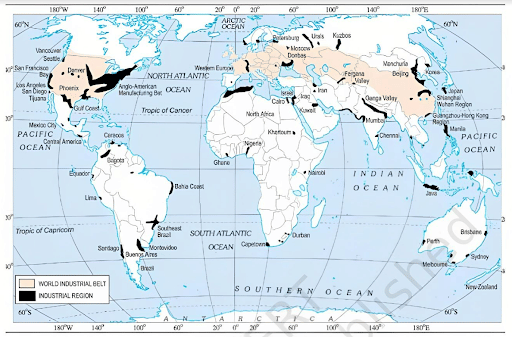
Major Industrial Regions of the World
|
|
|
|---|---|
| Industrial Regions of India | Electronic Industries |
| Stand Up India | Jute Industries |
| Fourth Industrial Revolution | Woolen Industries |
| Copper Industries | Plastic Industries |
| Automobile Industries | Silk Industries |
| Iron and Steel Industry | Sugar industry |
| Aluminum Industries | Fertilizer Industries |
| Cotton Textile Industries | Paper Industries |
| Pharmaceutical industry | Food Processing Industry |
| Agro based Industries | Tourism: Prospects and Impact on Environment |
Factors influencing Global industry location
Historical Factors
- Manufacturing patterns in all developed countries are heavily influenced by their history.
- It evolved in Europe among communities that were self-sufficient in most of life's necessities.
- A subsidiary industry is one that uses a byproduct from the primary industry. Alternatively, provide one of its essential requirements.
- An old industry, such as Oxford Motors or Rolls Royce, may gradually phase out its old production and transition to a new one.
- Industry's decline resulted in a pool of unemployed labour as well as assets such as factory buildings, railway facilities, and transportation networks.
Geographical Factors
- Natural and Climatic Conditions: Natural and climatic concerns include ground level, topography of an area, water facilities, drainage facilities, waste disposal, and so on.
- These considerations can have an impact on where industries are located.
- For example: The humid climates of Bombay, India, and Manchester in England, provided excellent opportunities for the development of cotton textile industries in both cities.
- Availability of Resources: One of the most significant variables in an industrial site is Raw materials and Resources. The availability or location of raw materials and Resources may dictate the location of industries in and of themselves.
- Availability of Power: The availability of affordable power is another element that influences the location of an Industry.
- Water, wind, coal, gas, oil, and electricity are the basic sources of energy. Prior to the invention of the steam engine, both water and wind power were actively pursued as potential sources of energy.
- During the nineteenth century, proximity to coalfields became the most important determining factor in the establishment of new businesses, notably heavy industries.
- Transportation: In general, transportation infrastructure has an impact on the placement of industry.
- Transportation, with its three modes, namely water, road, and rail, plays a vital role. As a result, the intersections of waterways, highways, and trains become bustling hubs of industrial activity.
- Site and Services: The presence of public utility services, the low cost of the site's value, amenities associated with a certain site such as the level of ground, the form of vegetation, and the location of allied activities all impact the placement of an industry to some extent.
Other Factors
- Availability of Labour: An adequate supply of inexpensive and trained workers is required for each industry.
- The attractiveness of an industry to labour centres is determined by the ratio of labour cost to total cost of production, which Weber refers to as the "Labour cost of Index."
- Ex: One of the elements that contributed to the original concentration of the cotton textile industry in the Bombay region was the availability of skilled employees in the region's interior.
- Consumer proximity Market: The market is determined by the population and the level of income of the people. India is a large market for industries, and world industries are drawn to India because of its size.
- Area of agglomeration: Agglomeration economies are those economies which have multiple industries coming together to make use of the advantages offered by urban centres and complementary to each other.
- Agglomeration of firms in specific regions is driven by several factors that can be explained by localization (the clustering of similar firms due to geographic advantages, such as access to inputs) and urbanisation (the clustering of firms in different industries due to the advantages that cities themselves provide).
- Benefits arise from the agglomeration of physical capital, companies, consumers and workers
- Low transport costs
- Geographic advantages
- Labour pooling and matching
- Availability of Competent Technology and related mobilised information and knowledge
Classification of Industries
- Primary industry is the most basic type of industry, consisting of first processing raw materials and then producing industrial raw materials. Bauxite smelting to make aluminium is one of these industries.
- The secondary industry encompasses all reprocessing of partially manufactured goods to create more complex products, such as the use of cloth in clothing and paper in the production of books. Engineering, metal goods, heavy chemicals, shipbuilding, locomotives, and light industries are examples of heavy industries.
- Tertiary industries include trade, transportation, commerce, entertainment, personal services, tourism, and administration, among others.
- Quaternary industry: This group is involved in scientific and technological research, as well as other high-level tasks. Scientists, doctors, and lawyers are among them.
- Some consider the quinary sector to be a subset of the quaternary sector, which includes the highest levels of decision-making in a society or economy.
- Top executives or officials from government, science, universities, nonprofits, healthcare, culture, and the media would be included in this sector. These are advisory services.

Major Industries in the world
| Major Industries | Features |
|---|---|
| Basic Industries |
|
| Consumer goods Industries |
|
| Metallic Industries |
|
| Shipbuilding Industry |
|
| Automobile Industry |
|
| Railway equipment and aeroplanes |
|
| Chemical Industries |
|
| Textile Manufacturing |
|
| Agro-based industries |
|
| Forest-based industry |
|
Major Industrial Regions of the World
North American Region
- The United States of America contributes roughly one-fifth of the industrial output in this region. Canada is another significant producer.
- Only 5% of these countries' land area contains one-third of their population and nearly two-thirds of their manufacturing output.
- This manufacturing belt has risen to prominence as a result of a combination of historical and environmental factors.
- Important Location Factors
- The early settlement gave eastern cities an advantage in becoming the country's dominant industrial centre.
- Access to Raw Materials- essential raw materials were available (by waterway or natural resources).
- Transportation- The Great Lakes and major rivers played an early role in determining waterway transportation.
- Access to fresh water and power- close proximity to large lakes
The Great Lakes region of North America
- It consists of the eight U.S. states of Illinois, Indiana, Michigan, Minnesota, New York, Ohio, Pennsylvania, and Wisconsin, as well as the Canadian province of Ontario.
- Navigable terrain, waterways, and ports fueled unprecedented regional transportation infrastructure construction.
- With significant innovations in both production processes and business organisation, the region is a global leader in advanced manufacturing and research and development.
New England region
- New England is a region in the northeastern United States that includes the six states of Maine, New Hampshire, Vermont, Massachusetts, Rhode Island, and Connecticut.
- It has historically been a significant industrial manufacturing centre and a supplier of natural resource products such as granite, lobster, and codfish.
- The majority of exports are industrial products, such as specialised machines and weaponry.
- Industrial and commercial machinery, such as computers and electronic and electrical equipment, account for roughly half of the region's exports.
West Coast region of Canada
- The Canadian West Coast - Western Canada's dominant industries are energy and agriculture, and this region, with only 10 million people, is one of the world's largest net exporters of both energy and agricultural commodities.
- Estimated breakdown: Oil (13% of global reserves; 4% of global output) Uranium (8% of global reserves; 20% of global production), Potash (60% of global reserves; 30% of global production), Wheat, coarse grains, and oilseeds (21% of the global export market for wheat; 10% for oilseeds).
Other Industrial regions in Northern America
- The region of New York-Mid-Atlantic.
- The Midwestern Region
- Region of the North-East
- The region to the south.
- The Western Region
- The Pacific Region.
European Region
- The majority of countries in the European Union, particularly in Western Europe, are highly industrialised.
- Some of the countries are world leaders in manufacturing. Germany, the United Kingdom, Italy, France, and Spain are examples.
- The United Kingdom is one of the world's most industrialised countries. In fact, modern industrialization was largely born on British soil.
- The industrial revolution began in Europe, and as a result, heavy industries on a large scale developed in many parts of Europe.
- Despite industrial development in many parts of the world, Europe remains a major industrial power.
- Industries in Europe are dispersed across many countries, and Europe's manufacturing belt is not continuous.
United Kingdom
- The United Kingdom was the world's first highly industrialised country. The coalfields are closely associated with the majority of its industrial regions.
- The industry is currently declining due to cheaper and more efficient production overseas, as well as old equipment and labour problems at home.
- Nonetheless, the UK's industrial structure is regarded as significant.
North East Coast
- The industrial region of the northeast coast is also fairly close to a coalfield, that of Durham and Northumberland.
- Coal mining and iron and steel production are two of the most important industries.
- In recent years, its economic fortunes have not differed significantly from those of West Cumberland, despite the establishment of a greater variety of steel processing industries as well as other industries such as chemicals.
Lorraine region
- Lorraine is a region of France located in the northeast corner of the country, bordering Germany, Belgium, and Luxembourg.
- This region of France is mostly agricultural, with the rivers Meuse and Moselle flowing through it and rising on the forested slopes of the Vosges.
- The region is well-known for its iron and steel industry, as well as its crystal works.
Germany's Ruhr and Silesia
- The Ruhr valley is a city in North Rhine-Westphalia.
- It is the most densely populated region in Germany and is known for its coal mining and steel industries.
Other Industrial regions in Europe
| Germany | France | Italy |
|---|---|---|
|
|
|
Other European Regions
- Several other industrial regions can be found in various European countries.
- Swiss Plateau in Switzerland, Stockholm region in Sweden, Rotterdam-Amsterdam region in Holland, and Brussels-Antwerp industrial region in Belgium are all important.
- Separating one European industrial zone from another is a difficult task. In reality, all of these areas are merely sub-regions of a much larger European industrial zone.
The Moscow-Tula Industrial Region
- This is one of the Soviet Union's oldest industrial conurbations.
- Numerous industrial establishments can be found in Moscow, the capital city, as well as other urban centres such as Tula, Gorky, Ivanovo, and Yaroslav. During its early stages of development, Tula iron ore and Moscow brown coal proved advantageous.
- However, the mineral resources declined later on. However, this region's growth continues unabated.
- The Moscow-Tula region has the highest concentration of industries.
- Iron-steel, heavy chemical, metallurgy, machine tools, refineries, textile, electrical, automobiles, and so on are major industries. This industrial agglomeration accounts for nearly a quarter of total national industrial output.
The Southern Industrial Region
- The great Ukrainian region is the largest industrial area. This region contributed the most iron steel and other metallurgical products.
- The famous Donetz coal and Krivoi Rog iron ore provided the foundation for the region's overall economic and industrial growth.
- Aside from that, Nikopol manganese is widely used in iron limestone, another raw material found in the region.
The Southern Industrial Region:
- The great Ukrainian region is the largest industrial area in the CIS. This region contributed the most iron steel and other metallurgical products.
- The famous Donetz coal and Krivoi Rog iron ore provided the foundation for the region's overall economic and industrial growth.
- Aside from that, Nikopol manganese is widely used in iron limestone, another raw material found in the region.
The Ural Industrial Region
- The Ural industrial region owes much of its development to the massive iron ore deposits of Magnitogorsk, Nizhny Tagil, and S erov. Following the establishment of the Communist regime, Rural development was prioritised, and the 'UralKuznetsk Combine' was built to expedite the region's industrialization.
- This region has an excellent communication system, particularly railroads. Several other industries emerged gradually.
- Among these are machine tools, agricultural machinery, chemicals, and so on.
Other Industrial regions
- The Caucasus Industrial Region.
- The Volga Industrial Region.
- The Kuznetsk Industrial Region.
- The Central Asia Industrial Region.
Asian Regions
- No Asian country had a strong industrial base until recent times.
- However, with the rise of some countries in the industrial sector, such as Japan, China, India, Korea, and Taiwan, this region is now posing a serious threat to the traditionally developed nations.
- Indeed, when it comes to the world's future industrialization, Asia is frequently regarded as the dark horse.
Japan's Yokohama region
- Yokohama is the capital city of Kanagawa Prefecture and the second-most populous city in Japan after Tokyo.
- It is a significant commercial hub in the Greater Tokyo Area.
- The city's economy is strong, particularly in the shipping, biotechnology, and semiconductor industries.
China's Manchurian region
- China's Manchurian region is a major industrial hub, with massive coal mines, iron and steelworks, aluminium reduction plants, paper mills, and factories producing heavy machinery, tractors, locomotives, aircraft, and chemicals. Dalian is the main commercial port.
- The only extensively level area is the great Manchurian plain, which is crossed by the Liao and Songhua rivers.
- It has been a major manufacturing and agricultural centre in China because it is fertile and densely populated.
The Calcutta Conurbation
- Broadly, a narrow strip running from Bansberia and Naihati in the north to Budge Budge and Uluberia in the south along the Hooghly River may be taken as the demarcating line of India's oldest and largest industrial region.
- This area has seen the development of several suburban and satellite townships. Notable among these are Howrah, Liluah, Bally, Uttarpara etc
- Jute mills, cotton textiles, chemicals, drugs and pharmaceuticals, engineering, machine tools, automobiles, tobacco, food processing, leather, fabrication, paper, match, and other industries are located in this region.
Other Industrial regions in Asia
| Japan |
|
| China |
|
| India |
|
Other Asian Industrial Zones
- Aside from these major industrial regions, Asia has a few isolated and dispersed industrial centres.
- Seoul, Chongthu, Taejon, Taegu, Pohang, Ulsal, and Kwangju in South Korea are notable, as are small islands such as Hong Kong and Singapore.
- Karachi, Pakistan, Kuala Lumpur, Malaysia, and Kuwait are important smaller cities.
Other Major Industrial Zones
| Major Industrial Zones | Features |
|---|---|
| Magnitogorsk |
|
| Donbas of Ukraine (Donets Basin) |
|
| Kuzbass region |
|
| Appalachian region |
|
| Sao Paulo region |
|
Conclusion
Industrial regions are areas where industries have concentrated due to favourable geoeconomic conditions. The industrial regions of the world are very unevenly distributed across the globe. Although both natural and cultural factors play a role in any explanation of the global distribution of manufacturing regions, the large differences in localization of any industrial region can be explained to a large extent by resource availability. These industrial regions have a variety of industries and other infrastructures and are well-known for producing specific or diverse types of industrial goods.
|
|
|
|---|---|
| Geography Notes | Energy Resources in India |
| Major Mineral Belts of India | Mineral Resources of India |
FAQs
Question: What are some major industrial regions in North America?
Answer: Major industrial regions in North America include the Rust Belt in the USA, which is known for industries like automobiles, steel production, and heavy machinery. The Great Lakes region and areas around California are also significant industrial hubs.
Question: Which industries dominate the Western European industrial region?
Answer: The Western European industrial region is dominated by automobiles, chemicals, machinery, and manufacturing industries. Countries like Germany, France, and the UK are key contributors to the region’s industrial output.
Question: How has East Asia emerged as a leading industrial region?
Answer: East Asia has emerged as a leading industrial region due to its focus on electronics, automobiles, and manufacturing. Countries like China, Japan, and South Korea have developed advanced industrial infrastructure and export-oriented industries.
Question: What are some major industrial regions in India?
Answer: In India, major industrial regions include Mumbai-Pune, Chennai, Delhi-NCR, and Bangalore, with industries ranging from textiles to automobiles, electronics, and pharmaceuticals.
Question: What role does Russia play in the global industrial sector?
Answer: Russia is a major industrial player in the production of heavy machinery, mining equipment, and energy resources. Its industrial regions are concentrated around Moscow, St. Petersburg, and the Ural region.
MCQs
- Which region in the USA is known for its steel and automobile industries?
A. Silicon Valley
B. Rust Belt
C. Sun Belt
D. Great Plains
Answer: (B) See the Explanation
The Rust Belt in the USA is known for its steel and automobile industries. It includes cities like Detroit (known for automobiles) and Pittsburgh (known for steel production).
- Which country in East Asia is known for its dominance in electronics and automobile manufacturing?
A. South Korea
B. Vietnam
C. Thailand
D. Singapore
Answer: (A) See the Explanation
South Korea is known for its dominance in electronics and automobile manufacturing, with companies like Samsung and Hyundai being global leaders in these industries.
- What are the major industries in the Western European industrial region?
A. Textiles and farming
B. Automobiles, chemicals, and machinery
C. Agriculture and mining
D. Fisheries and tourism
Answer: (B) See the Explanation
The Western European industrial region is known for industries such as automobiles, chemicals, machinery, and manufacturing. Germany, France, and the UK play a key role in this region.
- Which of the following is a major industrial hub in India?
A. Kerala
B. Mumbai-Pune
C. Sikkim
D. Assam
Answer: (B) See the Explanation
The Mumbai-Pune region is one of the largest industrial hubs in India, with industries ranging from automobiles to textiles and electronics.
- What is a major industrial product of Russia's industrial regions?
A. Cotton textiles
B. Energy resources and heavy machinery
C. Electronics
D. Automobiles
Answer: (B) See the Explanation
Russia's industrial regions are known for the production of energy resources (like oil and gas) and heavy machinery, particularly in regions like Moscow, St. Petersburg, and the Ural region.
GS Mains Questions and Model Answers
Q1: Discuss the factors that contribute to the development of major industrial regions in the world.
Answer: The development of major industrial regions around the world is influenced by several factors, including availability of raw materials, skilled labor, transportation networks, and proximity to markets. For instance, the Rust Belt in the USA grew due to the availability of coal and iron ore, necessary for the steel industry. Similarly, East Asia's industrial success is driven by investment in infrastructure, technology, and a strong export-oriented strategy. Government policies and foreign investments also play a crucial role in the development of these industrial hubs, as seen in countries like China and South Korea.
Q2: Analyze the impact of industrialization on the economic development of regions like East Asia and Western Europe.
Answer: Industrialization has been a key driver of economic development in regions like East Asia and Western Europe. In East Asia, countries like Japan, China, and South Korea have become global manufacturing leaders, contributing significantly to their economic growth and international trade. In Western Europe, the development of industries such as automobiles, chemicals, and machinery has fueled economic prosperity. These regions have also benefited from technological advancements, a skilled workforce, and strong infrastructure, which have boosted productivity and exports, transforming them into major global economic powers.
Q3: Evaluate the challenges faced by industrial regions in the 21st century and suggest measures to address them.
Answer: Industrial regions face several challenges in the 21st century, including environmental degradation, technological disruption, and global competition. For instance, industries in the Rust Belt in the USA have struggled with deindustrialization due to automation and global competition. In regions like China, the challenge is balancing economic growth with environmental sustainability. To address these challenges, governments and industries need to focus on sustainable industrial practices, technological innovation, and diversification of the economy to remain competitive. Investing in green technologies and skilled labor is crucial to ensure long-term growth in these industrial regions.
Previous Year Questions on Major Industrial Regions of the World
1. UPSC CSE Prelims 2019
Question: Which of the following is a major industrial region in the USA known for its automobile industry?
A. Silicon Valley
B. Rust Belt
C. Great Plains
D. Sun Belt
Answer: B
Explanation: The Rust Belt is a major industrial region in the USA known for its automobile and steel industries, particularly in cities like Detroit and Pittsburgh.
2. UPSC CSE Mains 2018 (GS Paper 1)
Question: "Industrial regions are the backbone of a nation’s economy." Discuss the factors that contribute to the development of major industrial regions and their role in economic growth.
Answer: Industrial regions are indeed the backbone of a nation’s economy, playing a critical role in driving growth, innovation, and employment. Several factors contribute to the development of major industrial regions. The availability of raw materials, such as minerals and energy resources, is essential for industries to thrive, as it reduces production costs and ensures a steady supply of inputs. Skilled labor is another key factor, as a highly trained workforce enhances productivity and fosters innovation. Well-developed transport networks, including roads, railways, and ports, are crucial for the efficient movement of goods and raw materials, linking industries to both domestic and international markets. Access to large consumer markets further stimulates industrial growth by ensuring demand for finished products.
Government policies and foreign investment also play a significant role in the development of industrial regions. Favorable policies, such as tax incentives, infrastructure development, and streamlined regulations, can attract domestic and foreign companies to invest in industrial areas. Foreign direct investment (FDI) brings capital, technology, and expertise, accelerating industrialization and economic growth.
Globally, industrial regions like East Asia, Western Europe, and North America have demonstrated the economic contributions of industrialization. In East Asia, regions like China’s Yangtze River Delta have become global manufacturing hubs, driving rapid economic growth. Western Europe, with its advanced industrial regions such as Germany's Ruhr Valley, has long been a center of innovation and production. Similarly, the industrial regions of North America, particularly in the U.S., have contributed significantly to the country's status as a global economic powerhouse. These industrial regions not only drive national economies but also contribute to global trade and economic integration.
Download the PREPP App and attempt FREE IAS Exam Mock Tests and get complete study material!

Live Test : UPSC CSE Prelims CSAT (Paper-II) (Oct 20 - 23)
Full Test - 04: UPSC CSE Prelims CSAT (Paper-II)
Full Test - 03: UPSC CSE Prelims CSAT (Paper-II)
UPSC CSE Prelims 2026 GS Paper 1 Question Paper (24-May-2026)
UPSC CSE Prelims 2026 CSAT Paper 2 Question Paper (24-May-2026)

17 February 2025 | The Hindu Must Read Articles | Current Affairs

16 February 2026 | The Hindu Must Read Articles | Current Affairs

13 February 2026 | The Hindu Must Read Articles | Current Affairs









Comments